

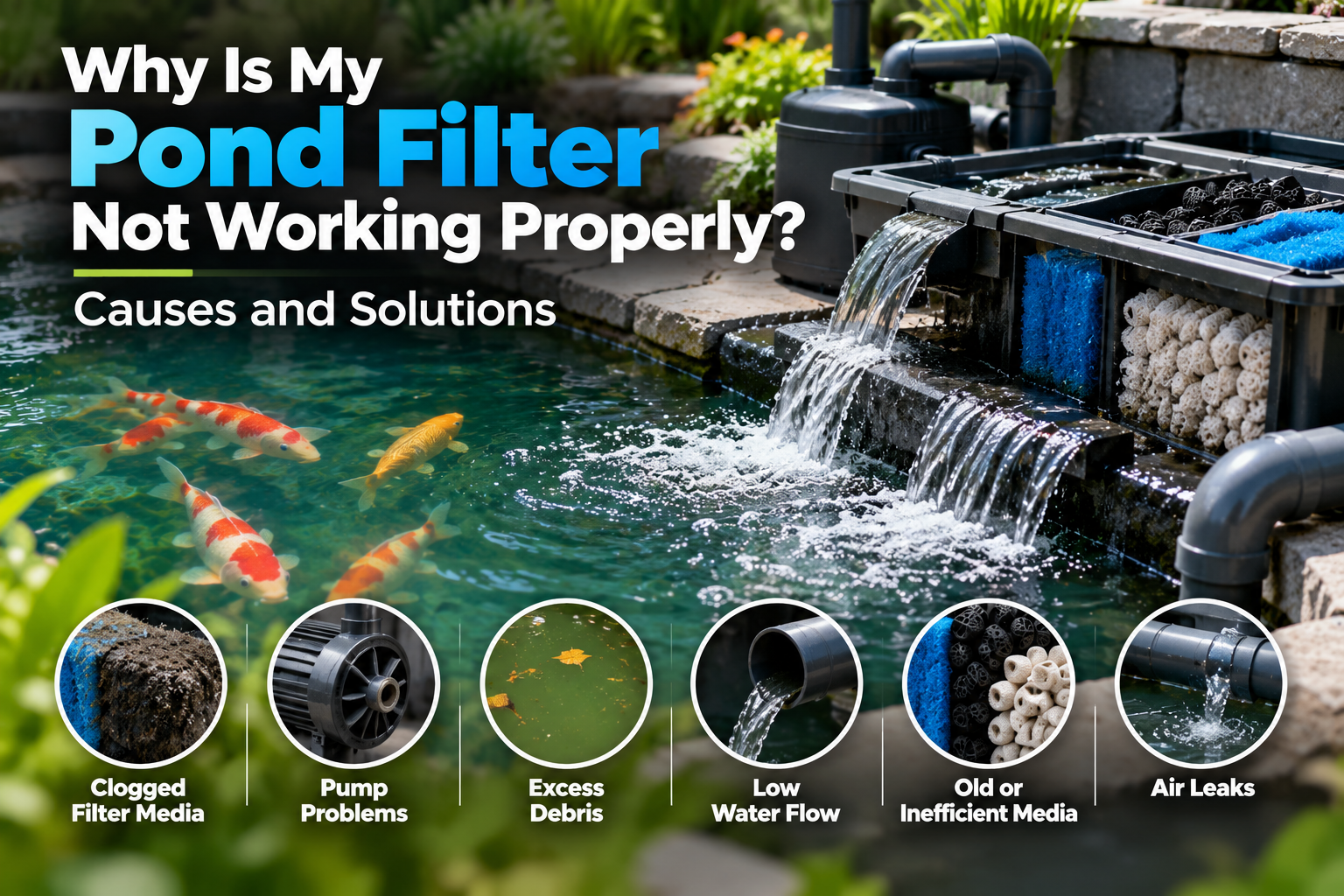
A pond filter plays an important role in maintaining clean, healthy water for koi fish and other pond inhabitants. It helps remove fish waste, uneaten food, suspended debris, and harmful substances that can affect water quality. However, if your pond filter is not working properly, you may notice cloudy water, green water, unpleasant smells, reduced water flow, or an increase in algae growth.
Understanding why your pond filter is not working properly can help you identify the problem and restore effective filtration before water quality deteriorates. In this guide, we explain common pond filter problems, their causes, and practical solutions to keep your pond clean and healthy.
Why Is My Pond Filter Not Working Properly?
A pond filter may stop performing effectively because of clogged filter media, insufficient pump flow, incorrect installation, damaged equipment, or a disrupted biological filtration system.
Before replacing your filter, check the pump, pipes, filter media, and water quality. Many common problems can be corrected through proper maintenance or simple adjustments.
1. Clogged Pond Filter Media
One of the most common reasons a pond filter stops working effectively is clogged filter media. Fish waste, uneaten food, leaves, algae, and other organic debris gradually accumulate inside the filtration system.
When the media becomes blocked, water cannot pass through efficiently. This reduces filtration performance and may cause water to bypass the intended filtration stages.
Common signs:
- Reduced water flow through the filter
- Dirty or overflowing filter chambers
- Cloudy pond water
- Increased debris in the pond
How to fix it:
- Inspect the mechanical filter media for accumulated dirt.
- Rinse reusable mechanical media according to the manufacturer’s instructions.
- Remove leaves and debris from filter chambers and inlet screens.
- Check whether the filter requires more frequent maintenance.
- Avoid aggressively cleaning all biological media at once.
Regular maintenance helps keep water moving through the filter and improves waste removal.
2. Pond Pump Flow Is Too Low
Your pond filter depends on a suitable water supply from the pond pump. If the pump cannot deliver sufficient flow, the filter may not process enough water to maintain good water quality.
A pump can lose flow because of blocked intake screens, clogged impellers, restricted pipes, excessive pumping height, or worn components.
How to fix it:
- Check the pump intake for leaves and debris.
- Inspect the impeller and clean it according to the manufacturer’s instructions.
- Check hoses and pipes for blockages, kinks, or leaks.
- Confirm that the pump is suitable for the pond’s volume and filtration requirements.
- Account for head height and flow losses when selecting a replacement pump.
A pump’s advertised flow rate is generally measured under specified conditions. Actual flow may be considerably lower once pipework, fittings, and elevation are taken into account.
3. Biological Filtration Is Not Working Properly
Biological filtration relies on beneficial bacteria that colonize filter media. These bacteria help convert ammonia from fish waste into nitrite and then nitrate through the nitrogen cycle.
If the biological filter is new, has been cleaned too aggressively, or has been exposed to harmful chemicals, its bacterial population may be insufficient.
This can cause ammonia or nitrite to accumulate, even if the water looks clear.
Common signs:
- Elevated ammonia or nitrite readings
- Fish gasping at the surface or behaving unusually
- Persistent water-quality problems
- A recently installed or heavily cleaned filter
How to fix it:
- Keep the filter operating continuously under normal conditions.
- Avoid washing biological media with untreated chlorinated water.
- Do not replace all biological media at once.
- Test ammonia and nitrite, particularly after major maintenance.
- Reduce feeding temporarily if water quality is deteriorating.
- Maintain adequate aeration to support fish and beneficial bacteria.
If ammonia or nitrite is elevated, take corrective action promptly. Do not rely on water clarity alone to judge whether the biological filter is working.
4. Incorrect Pond Filter Size
A filter that is too small for the pond may struggle to process waste effectively. This is particularly common in koi ponds, where fish produce substantial waste and are often fed frequently.
The correct filter capacity depends on more than pond volume. Fish population, fish size, feeding rate, debris load, and pump flow all influence filtration requirements.
How to fix it:
- Calculate the pond’s approximate water volume.
- Assess the number and size of fish.
- Check the manufacturer’s recommended pond capacity and stocking limitations.
- Consider a larger filter or additional filtration stages if the existing system is undersized.
- Ensure the pump delivers the required flow through the filter.
For heavily stocked koi ponds, a combination of mechanical and biological filtration may be more suitable than relying on a small filter alone.
5. Pond Filter Installation Problems
Even a good-quality filter may perform poorly if it is installed incorrectly. Common installation problems include incorrect inlet and outlet connections, poor pipe sizing, leaks, bypass routes, and insufficient water circulation.
In some systems, water may take the path of least resistance and bypass the filter media.
How to fix it:
- Check the inlet and outlet connections.
- Confirm that water follows the intended direction through the filter.
- Inspect joints and seals for leaks.
- Check that pipes are correctly sized for the pump and filter.
- Follow the manufacturer’s installation and operating instructions.
Correct installation helps ensure that water passes through the intended mechanical and biological filtration stages.
6. Pond Water Is Still Green After Filtration
Green pond water is often caused by suspended microscopic algae. A conventional mechanical filter may remove larger particles but may not effectively eliminate these tiny algae cells.
Excess nutrients, strong sunlight, and inadequate control of algae growth can contribute to the problem.
How to fix it:
- Remove accumulated organic waste.
- Avoid overfeeding fish.
- Maintain effective mechanical and biological filtration.
- Review the pond’s sunlight exposure and nutrient inputs.
- Consider a correctly sized UV clarifier if suspended algae are responsible for the green water.
A UV clarifier can help control suspended algae, but it does not replace a pond filter. It also will not solve every cause of green or cloudy water.
7. Pond Filter Produces a Bad Smell
A strong rotten or unpleasant smell may indicate accumulated organic waste, stagnant areas, clogged filter media, or poor oxygen conditions.
When waste decomposes inside a poorly maintained filter, water quality can deteriorate and the filtration system may become less effective.
How to fix it:
- Remove accumulated solids from mechanical filtration stages.
- Inspect the filter for stagnant water or blockages.
- Restore proper circulation and aeration.
- Clean reusable media according to the manufacturer’s instructions.
- Check ammonia and nitrite if fish appear stressed.
Avoid dismantling and thoroughly sterilizing the entire biological filter unless specifically required for a justified maintenance or safety reason. Doing so can remove beneficial bacteria and worsen water-quality problems.
8. Pond Filter Is Making Noise or Has Stopped Running
If the filter has stopped completely, the problem may be with the pump or its power supply rather than the filter itself.
Possible causes include a blocked impeller, damaged electrical components, overheating, or an interrupted power supply.
How to fix it:
- Check whether the pump has power.
- Inspect accessible intake screens for blockages.
- Follow the manufacturer’s safe shutdown and cleaning procedure.
- Check for visible damage or leaks.
- Have electrical faults inspected by a qualified professional.
Always disconnect electrical equipment from the power supply before handling or cleaning it. Use pond equipment and electrical protection suitable for outdoor or wet environments.
If the filter stops for an extended period, provide additional aeration where possible and monitor fish closely.
How to Maintain a Pond Filter Properly
Preventive maintenance can reduce the risk of filtration problems and help your equipment operate efficiently.
1. Inspect the Filter Regularly
Check water flow, filter pressure where applicable, mechanical media, and inlet screens. Clean the system when needed rather than waiting for a complete blockage.
2. Preserve Beneficial Bacteria
Biological media supports the bacteria required for the nitrogen cycle. Clean it gently when necessary and avoid exposing it to untreated chlorinated water.
3. Maintain the Pond Pump
A filter cannot operate effectively without sufficient water circulation. Inspect the pump, impeller, intake, and connected pipes as part of routine maintenance.
4. Avoid Overfeeding Fish
Uneaten food increases organic waste and places extra demand on the filtration system. Feed fish appropriately for their size, condition, and environmental temperature.
5. Test Pond Water Quality
Monitor ammonia, nitrite, pH, and other relevant parameters. Regular testing can reveal filtration problems before they become obvious from the appearance of the water.
6. Choose the Right Filter Media
Mechanical media captures solid waste, while biological media provides a surface for beneficial bacteria. The right combination depends on the filter design and pond requirements.
7. Ensure Adequate Aeration
Oxygen is important for fish and aerobic biological filtration. Adequate aeration becomes particularly important in warm weather and heavily stocked koi ponds.
Which Pond Filtration System Is Best for Your Pond?
Different pond setups require different filtration solutions.
Pressure pond filters: Suitable for some small and medium ornamental ponds, depending on fish load and the filter’s rated capacity. Many models are compact and relatively easy to maintain.
Multi-chamber filtration systems: Often used for larger or more heavily stocked koi ponds because they allow separate mechanical and biological filtration stages.
Biological filters: Help process dissolved nitrogenous waste through beneficial bacterial activity. They must be correctly sized and paired with suitable mechanical filtration.
UV clarifiers: Help control suspended algae that cause green water when correctly sized and installed.
When selecting a filtration system, consider pond volume, fish stocking, feeding rate, pump flow, maintenance requirements, and the manufacturer’s specifications.
Explore suitable pond pumps, filtration systems, UV clarifiers, and filter media at GreenfinIndia.com to find equipment for your pond setup.
Frequently Asked Questions
1. Why is my pond filter running but the water is still dirty?
The filter may be clogged, undersized, receiving insufficient flow, or unable to remove the type of particles present. Check mechanical media, pump performance, and water quality before deciding whether you need a different filtration system.
2. How often should I clean my pond filter?
The cleaning frequency depends on the filter design, fish load, feeding rate, and debris entering the pond. Inspect mechanical media regularly and clean it when it becomes dirty or restricts flow. Biological media generally requires gentler maintenance.
3. Can a pond filter cause cloudy water?
Cloudiness may occur if a filter is newly installed, biological filtration has been disrupted, fine particles are passing through the system, or waste is being stirred up during cleaning. Test the water and identify the cause before adding treatments.
4. Why is my pond filter losing water pressure?
Possible causes include clogged media, blocked pipework, a dirty pump impeller, air entering the system, or excessive pumping height. Inspect the entire circulation path and follow the equipment manufacturer’s instructions.
5. Does a pond filter need to run 24 hours a day?
Most established pond filtration systems should run continuously to maintain circulation and support biological filtration. Switching off a filter for long periods can reduce oxygen availability and affect beneficial bacteria. Follow the manufacturer’s guidance and provide adequate aeration during necessary shutdowns.
6. How do I know if my pond filter is too small?
Frequent clogging, persistently poor water quality, inadequate flow, and elevated ammonia or nitrite may indicate insufficient filtration capacity. However, these symptoms can also result from poor maintenance or incorrect installation. Assess the pond’s volume, fish population, feeding rate, and filter specifications together.
Conclusion
A pond filter may stop working properly because of clogged media, low pump flow, disrupted biological filtration, incorrect sizing, installation problems, or equipment failure. Identifying the underlying cause is the first step toward restoring effective filtration.
Regular maintenance, suitable pump flow, healthy biological media, adequate aeration, and routine water testing help keep pond water clean and fish healthy. Choosing the right filtration system for your pond’s size and fish population can also prevent recurring problems.
For pond pumps, filters, UV clarifiers, and other pond equipment, explore the available solutions at GreenfinIndia.com.