

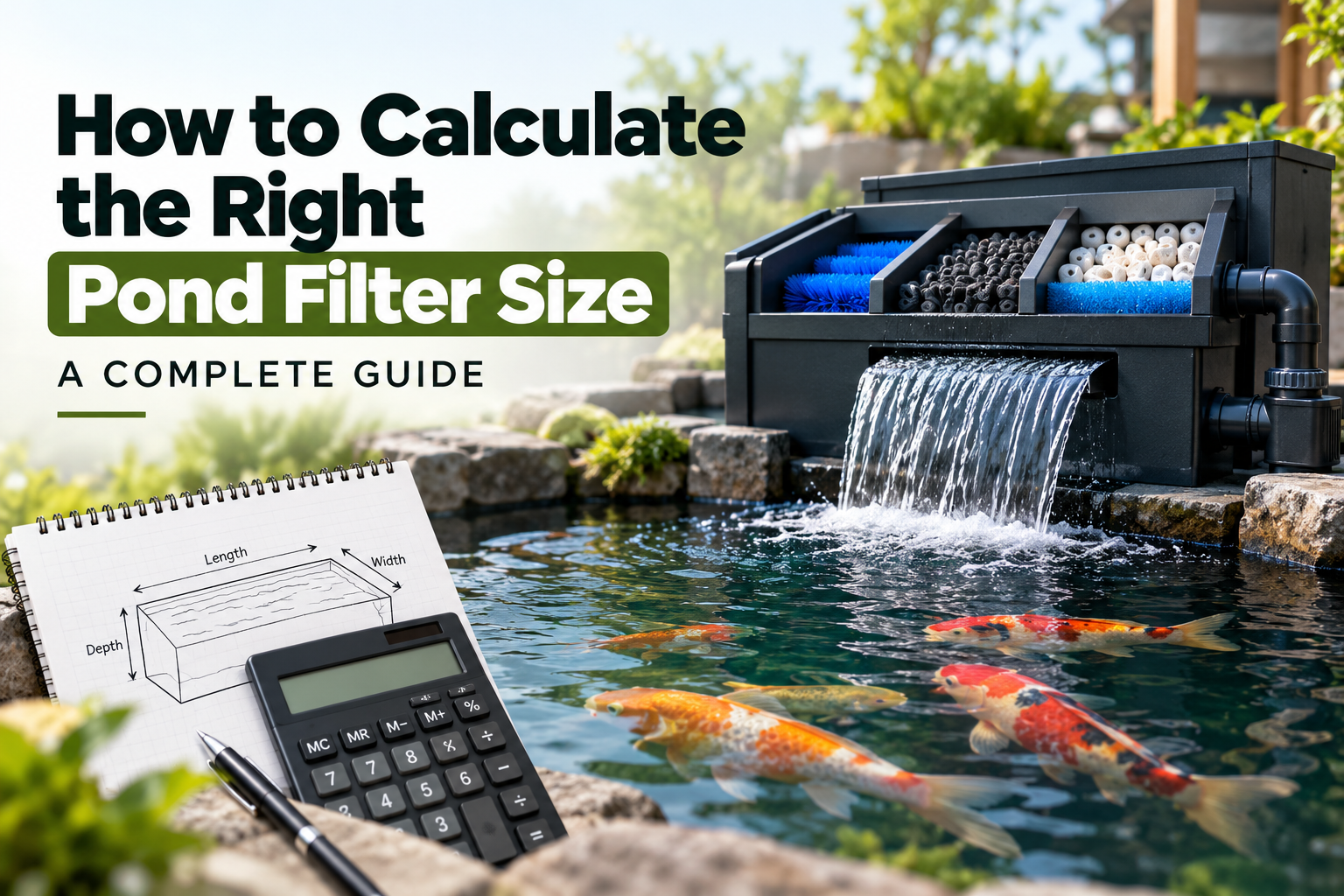
Choosing the right pond filter is essential for maintaining clean, clear, and healthy water. Whether you have a small garden pond, a large koi pond, or a decorative pond with a waterfall, the correct filtration system helps remove waste, control harmful substances, and maintain a healthy environment for fish.
Using a pond filter size calculator approach helps you estimate your pond’s water volume and identify the filtration capacity required for your pond. However, the ideal filter size also depends on fish stocking levels, feeding habits, pump flow rate, and the type of filtration media used.
In this guide, we explain how to calculate your pond filter size, choose the right filtration system, and avoid common filtration mistakes.
Why Is Choosing the Right Pond Filter Size Important?
A pond filter performs two essential functions: mechanical filtration and biological filtration.
Mechanical filtration removes physical waste, such as fish waste, uneaten food, leaves, and other debris. Biological filtration provides a surface for beneficial bacteria that help convert toxic ammonia into less harmful substances through the nitrogen cycle.
If your pond filter is too small, waste may accumulate, water quality may deteriorate, and fish may experience stress. An undersized filter can also require frequent cleaning and maintenance.
A correctly sized filtration system helps to:
- Maintain clear and healthy pond water.
- Reduce the accumulation of fish waste.
- Support beneficial bacteria.
- Improve water quality for koi and other pond fish.
- Reduce maintenance requirements when properly managed.
- Support healthy fish growth and appropriate stocking levels.
Selecting a filter based only on pond dimensions is not enough. You must also consider the number and size of fish, feeding rate, sunlight exposure, and the amount of debris entering the pond.
Step 1: Calculate Your Pond’s Water Volume
The first step in selecting a suitable pond filter is calculating the total water volume.
A pond filter size calculator starts with the pond’s dimensions. Once you know the approximate water volume, you can compare filtration systems designed for similar pond capacities.
Rectangular Pond Volume Calculation
For a rectangular pond, use this formula:
Water Volume (litres) = Length (m) × Width (m) × Average Water Depth (m) × 1,000
For example, consider a pond with the following dimensions:
- Length: 4 metres
- Width: 3 metres
- Average water depth: 1 metre
Calculation:
4 × 3 × 1 × 1,000 = 12,000 litres
Therefore, the pond holds approximately 12,000 litres of water.
If your pond has sloping sides or an uneven bottom, use the average water depth to estimate its volume.
Circular Pond Volume Calculation
For a circular pond, use the following formula:
Water Volume (litres) = 3.1416 × Radius² × Average Water Depth × 1,000
For example, a circular pond has:
- Diameter: 3 metres
- Radius: 1.5 metres
- Average water depth: 0.8 metres
Calculation:
3.1416 × 1.5 × 1.5 × 0.8 × 1,000 = approximately 5,655 litres.
The estimated water volume is 5,655 litres.
Irregular-Shaped Pond Volume Calculation
For an irregularly shaped pond, divide the pond into smaller sections, such as rectangles and circles. Calculate each section separately and add the results.
If the pond has shelves, slopes, or varying depths, use the actual average depth of each section for a more accurate estimate.
Remember that the final volume should represent the water actually held in the pond, rather than the total excavation volume.
Step 2: Determine Your Pond’s Filtration Requirements
After calculating the water volume, determine how much filtration your pond needs.
The correct filtration capacity depends on several factors.
1. Pond Volume
Larger ponds generally require filtration systems with greater processing capacity. A filter suitable for a 2,000-litre ornamental pond may not be appropriate for a 15,000-litre koi pond.
Always check the manufacturer’s recommended pond capacity and the conditions under which that capacity applies.
2. Fish Stocking Level
Fish produce waste that increases the biological load on a filter.
A pond containing a few small goldfish may require less filtration than a koi pond containing many large fish, even if both ponds have the same water volume.
Koi ponds typically need robust mechanical and biological filtration because koi can grow large and produce substantial waste.
3. Feeding Rate
The amount of food added to the pond directly affects the amount of waste the filtration system must process.
Heavily fed koi ponds generally need more filtration capacity than lightly stocked ponds. When choosing a filter, consider the expected feeding rate during periods of active fish growth.
4. Sunlight and Organic Debris
Ponds exposed to strong sunlight may experience increased algae growth. Outdoor ponds may also collect leaves, dust, and other organic debris.
These factors can increase maintenance requirements and influence the choice of mechanical filtration, UV clarification, and circulation equipment.
Step 3: Understand the Different Types of Pond Filters
Different filtration systems are suitable for different pond designs and operating requirements.
1. Multi-Chamber Pond Filters
Multi-chamber filtration systems use separate sections for mechanical and biological filtration.
Water passes through different filter stages, allowing physical waste to be captured while beneficial bacteria process dissolved waste compounds.
These systems are useful for many medium and large ponds, particularly koi ponds that require substantial biological filtration.
Best suited for: Koi ponds, larger ornamental ponds, and installations requiring flexible filtration capacity.
2. Pressurised Pond Filters
Pressurised pond filters are enclosed systems through which water is pumped. Many models combine mechanical and biological filtration, and some include a built-in UV clarifier.
They can be convenient for smaller ponds and installations where the filter needs to be positioned discreetly.
However, the actual capacity varies by model. Check the manufacturer’s recommendations for fish ponds, especially if you keep koi.
Best suited for: Small and medium garden ponds, compact installations, and selected waterfall systems.
3. Rotary Drum Filters
Rotary drum filters automatically remove fine mechanical waste from pond water using a screening mechanism.
They are often used in advanced koi pond filtration systems, particularly where high fish stocking levels and automated waste removal are priorities.
A rotary drum filter is generally part of a larger filtration arrangement rather than a complete replacement for biological filtration.
Best suited for: Large koi ponds, high-waste systems, and advanced pond installations.
4. Biological Filter Systems
Biological filters provide surfaces for beneficial bacteria to establish and process ammonia and nitrite.
Common biological media include plastic bio-media, moving-bed media, and Japanese filter mats.
Biological filtration is particularly important in fish ponds because clear-looking water is not necessarily safe water.
Best suited for: Fish ponds that require reliable biological waste processing, especially koi ponds.
Step 4: Estimate the Required Pond Filter Capacity
Once you know your pond volume and fish stocking level, you can estimate the filtration capacity required.
The following table provides a preliminary planning guide, not a universal manufacturer rating. Actual filter selection must be based on the product’s specifications, fish load, feeding rate, and filtration design.
| Pond Water Volume | Pond Type | Suggested Filtration Approach |
|---|---|---|
| Up to 2,000 litres | Lightly stocked ornamental pond | Compact pond filter with suitable biological media |
| 2,000–5,000 litres | Garden pond | Appropriately rated pressure or gravity-fed filter |
| 5,000–10,000 litres | Medium fish pond | Higher-capacity mechanical and biological filtration |
| 10,000–20,000 litres | Koi or large fish pond | High-capacity filtration, potentially using multiple stages |
| Above 20,000 litres | Large koi pond | Engineered filtration system based on fish load and hydraulic design |
These ranges are intended to help you begin planning. They do not mean that every filter advertised for a particular pond volume will be suitable for your installation.
For koi ponds, the manufacturer’s stated capacity for a heavily stocked fish pond is generally more relevant than its maximum capacity for an ornamental pond without fish.
If the manufacturer provides separate ratings for goldfish ponds and koi ponds, use the rating that matches your fish load.
Should You Choose a Larger Filter?
A filter with additional capacity can provide greater flexibility when fish grow or feeding rates increase.
However, a larger filter is not automatically the solution to every water-quality problem. The pump must deliver an appropriate flow rate, the filter must have adequate biological media, and the system must be maintained correctly.
For heavily stocked koi ponds, professional filtration planning can help prevent costly equipment selection mistakes.
Step 5: Calculate the Required Pond Pump Flow Rate
The pond filter and pump must work together.
A filter cannot perform as intended if the water flow is too low for the system’s design or too high for its rated capacity.
A preliminary pump-flow calculation can be made using the desired turnover time.
Required Flow Rate (litres per hour) = Pond Volume (litres) ÷ Desired Turnover Time (hours)
For example, suppose your pond contains 12,000 litres of water and you want a nominal turnover time of two hours.
12,000 ÷ 2 = 6,000 litres per hour.
The preliminary flow rate is therefore 6,000 litres per hour.
This is only a starting estimate. The appropriate turnover time depends on the pond’s design, fish stocking, filtration method, and water-quality requirements. It is not a universal rule that every pond must turn over all its water within two hours.
Account for Head Height and Pipe Resistance
A pond pump’s advertised flow rate may be measured under conditions that do not match your installation.
Actual flow is affected by:
- Vertical lift from the pond to the filter or waterfall.
- Pipe length and diameter.
- Pipe bends, valves, and fittings.
- Resistance within the filtration system.
- The pump’s performance curve.
For this reason, select a pump based on its expected flow at the actual operating head, rather than relying solely on the maximum flow printed on the packaging.
Also check the filter manufacturer’s minimum and maximum recommended flow rates.
If your filter requires a higher flow rate than the pump can deliver after installation losses, the filtration system may not perform as intended.
Step 6: Choose the Right Filter Media
Filter media play an important role in mechanical and biological filtration.
The right combination depends on the filter design and the amount of waste entering the system.
Mechanical Filter Media
Mechanical media capture physical particles before they accumulate in biological filtration stages.
Examples include:
- Filter brushes.
- Japanese filter mats.
- Filter sponges.
- Suitable mechanical screening media.
Mechanical filtration reduces the amount of solid waste entering biological stages and helps make routine cleaning easier.
Biological Filter Media
Biological media provide surfaces for beneficial bacteria to colonise.
Examples include:
- Plastic biological media.
- Moving-bed media.
- Japanese filter mats.
- Other manufacturer-approved biological media.
The amount of biological media required depends on the media’s properties, the filter’s design, oxygen availability, and the biological load produced by the fish.
There is no single media volume that works for every pond. Follow the filter manufacturer’s specifications and ensure that the system receives adequate oxygen and water circulation.
Why Mechanical and Biological Filtration Should Work Together
Mechanical filtration removes solid waste, while biological filtration processes dissolved waste compounds.
Using both stages appropriately helps maintain water quality and reduces unnecessary waste accumulation in the filter.
Regular maintenance is essential because clogged mechanical media can restrict water flow and affect the performance of the entire system.
Step 7: Consider UV Clarification for Green Pond Water
If your outdoor pond frequently develops green water, a UV clarifier may help control suspended algae.
UV clarification exposes circulating water to ultraviolet radiation, helping control certain free-floating algae when the equipment is correctly sized and operated.
However, a UV clarifier does not replace mechanical or biological filtration.
When choosing a UV unit, consider:
- Pond volume and fish stocking.
- The manufacturer’s recommended pond capacity.
- The water flow rate through the unit.
- The UV lamp’s output and operating condition.
- The intended purpose of the equipment.
For a pond with substantial fish waste, installing a UV clarifier alone will not solve inadequate biological filtration.
A properly designed combination of mechanical filtration, biological filtration, circulation, and UV clarification where appropriate can provide a more complete solution.
Common Mistakes to Avoid When Selecting a Pond Filter
Even a good filter may perform poorly if the system is incorrectly designed or maintained.
Avoid these common mistakes:
1. Choosing a filter based only on pond volume
Two ponds with the same water capacity can have very different filtration requirements because of differences in fish stocking and feeding.
2. Ignoring the manufacturer’s fish-pond rating
A filter rated for a large ornamental pond may have a much lower recommended capacity for a heavily stocked koi pond.
3. Using an unsuitable pump
A pump that delivers insufficient flow or exceeds the filter’s permitted flow range can reduce system performance.
4. Neglecting mechanical filter cleaning
Accumulated waste can restrict flow and increase maintenance problems.
5. Ignoring biological filtration
Clear water does not necessarily mean ammonia and nitrite levels are safe for fish.
6. Adding too many fish too quickly
Increasing fish numbers without increasing the system’s biological capacity can cause water-quality problems.
7. Expecting UV clarification to remove all pond waste
UV equipment helps control certain suspended algae but does not remove fish waste or replace biological filtration.
How to Maintain Your Pond Filter for Better Performance
Correct filter sizing is only the first step. Routine maintenance helps the system operate effectively.
Follow these practices:
- Inspect the filter regularly for accumulated waste.
- Clean mechanical media according to the manufacturer’s instructions.
- Avoid unnecessarily cleaning all biological media at once.
- Preserve beneficial bacteria during maintenance.
- Monitor ammonia and nitrite, especially after adding fish or changing the filtration system.
- Check the pump, pipes, and filter outlets for blockages.
- Inspect UV equipment and replace lamps according to the manufacturer’s recommendations.
- Avoid overfeeding fish.
- Keep records of water-quality readings and maintenance activities.
When cleaning biological media, avoid using untreated tap water if its chlorine or chloramine content could damage beneficial bacteria. Follow the filter manufacturer’s recommended cleaning procedure.
A well-maintained filtration system supports healthy fish and makes pond management more predictable.
Frequently Asked Questions
1. How do I calculate the correct pond filter size?
First, calculate your pond’s water volume using its length, width, and average water depth. Then consider the fish stocking level, feeding rate, and the manufacturer’s recommended filter capacity for your pond type.
2. What size filter do I need for a 10,000-litre koi pond?
The required filter depends on the number and size of koi, feeding rate, and filter design. Choose a filter explicitly rated for a koi pond of the appropriate capacity, rather than relying only on a general ornamental-pond rating.
3. Can a pond filter be too big?
A filter with additional capacity can provide flexibility, provided it operates within the manufacturer’s flow-rate requirements. However, correct plumbing, suitable pump selection, and routine maintenance remain essential.
4. How many litres per hour should my pond pump circulate?
Calculate the preliminary flow rate by dividing the pond volume by the desired turnover time. Then account for head height, pipe resistance, and the filter’s permitted flow range.
The required turnover time varies with pond design and fish load, so avoid using a single turnover rule for every installation.
5. Is a UV clarifier enough to keep pond water clean?
No. A UV clarifier can help control suspended algae, but it does not replace mechanical filtration, biological filtration, or routine pond maintenance.
6. How often should I clean my pond filter?
Cleaning frequency depends on the amount of waste entering the filter and the filter’s design. Inspect mechanical stages regularly and clean them when necessary, following the manufacturer’s recommendations.
7. What is the best filtration system for a koi pond?
The best system depends on pond volume, fish stocking, feeding rate, available space, and maintenance preferences. Multi-chamber systems, pressurised filters, and rotary drum systems can all be suitable in different situations.
Conclusion
Calculating the right pond filter size begins with understanding your pond’s water volume, but selecting the correct filtration system requires more than a simple calculation.
You must also consider fish stocking, feeding rate, mechanical and biological filtration, pump performance, and maintenance requirements.
A suitable pond filter size calculator approach helps you estimate your pond volume and narrow down your options. Always compare your calculations with the manufacturer’s specifications before purchasing a filter or pump.
If you are building a new pond or upgrading an existing filtration system, Greenfin The Pond Studio can help you evaluate your pond’s requirements and identify suitable filtration options.
Looking for the right pond filter for your koi pond? Explore pond filtration products at GreenfinIndia.com or contact Greenfin The Pond Studio for guidance on selecting a filtration system based on your pond size and fish load.