

Maintaining clean and healthy pond water requires more than simply adding fresh water. Outdoor ponds collect leaves, dust, fish waste, uneaten food, algae, and other organic debris. Without proper water circulation and filtration, these contaminants can affect water clarity, water quality, and fish health.
Two important pieces of pond equipment that often cause confusion are the pond filter and the pond skimmer.
Although both help maintain a cleaner pond, they perform different jobs.
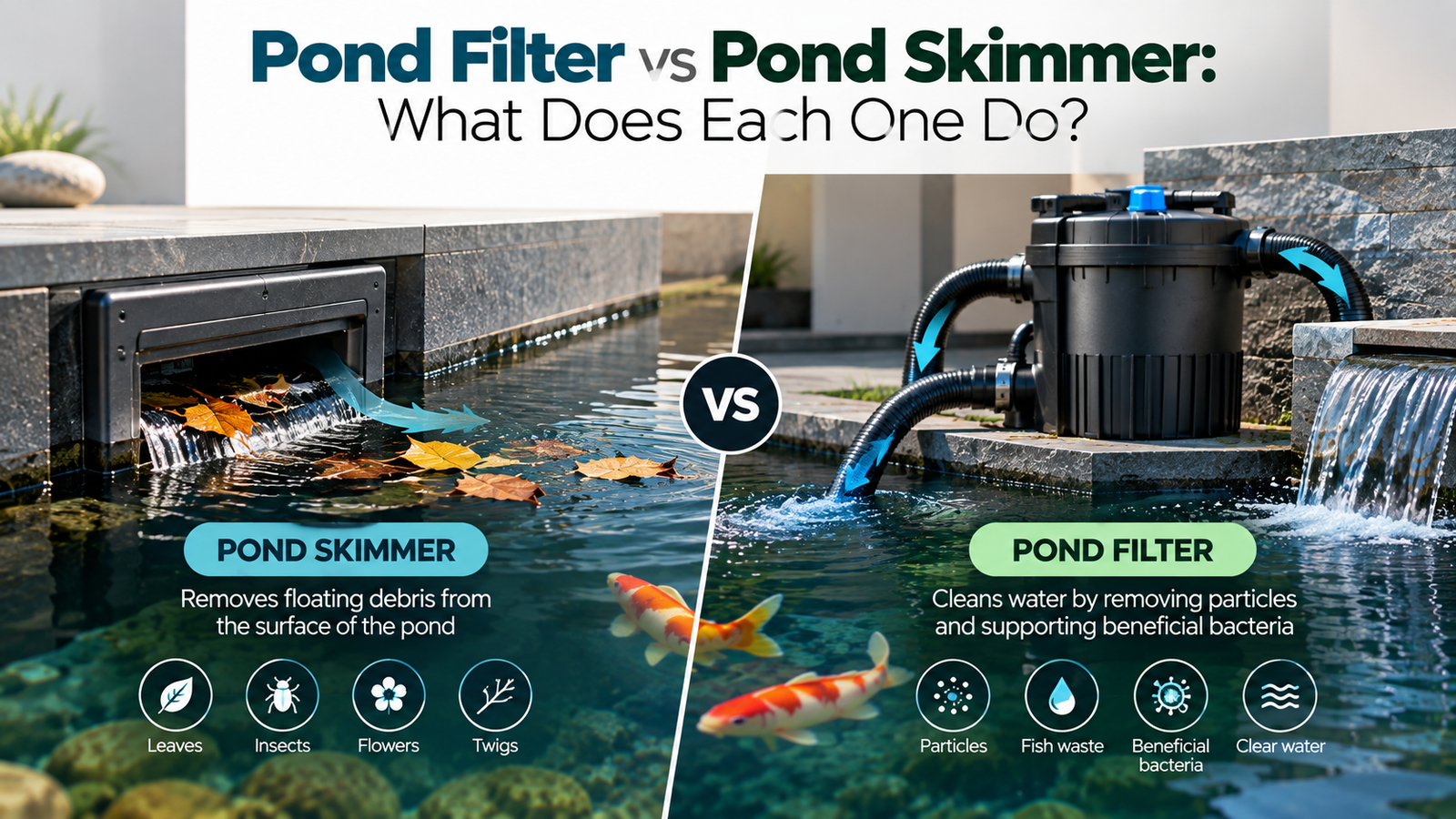
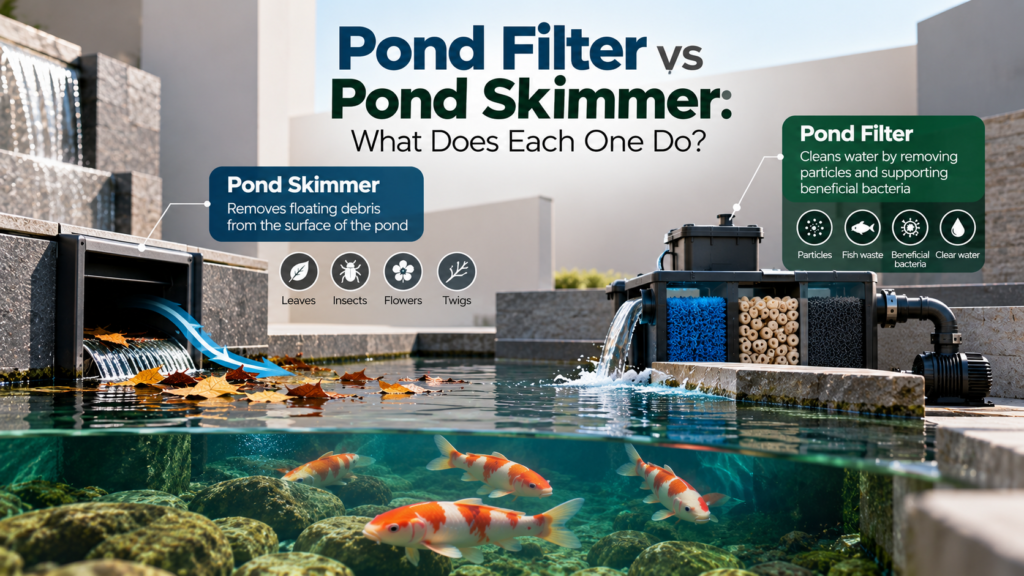
A pond skimmer primarily removes floating debris from the surface, while a pond filter processes water to remove suspended particles and support biological filtration.
Understanding the difference between a pond filter and pond skimmer can help you design a more effective pond filtration system and choose the right equipment for your pond.
What Is a Pond Filter?
A pond filter is a filtration system designed to clean water as it circulates through the pond.
Depending on the type of filter, it can remove physical particles and provide biological filtration. Some pond filtration systems can also work with UV clarifiers to help control suspended algae and improve water clarity.
A pond filter typically receives water from the pond through a pump, bottom drain, skimmer, or other intake system. The water passes through filtration media before returning to the pond.
What Does a Pond Filter Do?
A pond filter can help:
- Remove suspended particles
- Capture fine and coarse debris
- Support beneficial bacteria
- Process organic waste
- Improve water clarity
- Maintain healthier pond conditions
- Support fish and koi ponds
- Improve overall filtration efficiency
Different pond filters are designed for different pond sizes, fish loads, and filtration requirements.
What Is a Pond Skimmer?
A pond skimmer is a device designed to collect debris from the surface of the pond.
Instead of allowing leaves and floating debris to remain on the water surface and eventually sink, the skimmer draws surface water into a collection chamber.
A skimmer typically uses a floating or adjustable opening called a weir. Water flows over the opening, carrying floating debris into the skimmer basket.
What Does a Pond Skimmer Remove?
A pond skimmer can collect:
- Fallen leaves
- Small twigs
- Floating flowers
- Dead insects
- Floating algae
- Dust
- Other surface debris
This prevents much of the organic material from sinking to the bottom and becoming part of the pond sludge.
Pond Filter vs Pond Skimmer: The Main Difference
The easiest way to understand the difference is to think about where each system works.
Pond Skimmer = Surface Cleaning
Pond Filter = Water Filtration
A skimmer focuses mainly on what is floating on the surface, while a filter treats the water that passes through the filtration system.
They are not necessarily alternatives to each other.
In many well-designed ponds, a skimmer and filtration system work together.
How Does a Pond Skimmer Work?
A typical pond skimming system works through several stages.
Step 1: Surface Water Enters the Skimmer
A pump or circulation system draws water toward the skimmer opening.
Step 2: Floating Debris Is Collected
Leaves and other floating material pass through the skimmer opening and become trapped in a basket.
Step 3: Debris Is Removed
The basket can be removed and emptied during routine maintenance.
Step 4: Water Continues Through the System
The relatively cleaner water continues toward the pump and filtration system.
This process prevents a large amount of surface debris from reaching the main filter or decomposing at the bottom of the pond.
How Does a Pond Filter Work?
A pond filter works by passing pond water through one or more stages of filtration.
The exact process depends on the filter design.
Mechanical Filtration
Mechanical filtration captures physical particles from the water.
Examples include:
- Leaves
- Fish waste
- Uneaten food
- Dirt
- Suspended particles
- Organic debris
Mechanical filtration helps improve water clarity by physically trapping particles.
Biological Filtration
Biological filtration provides surfaces where beneficial microorganisms can colonize.
These microorganisms play an important role in processing certain dissolved nitrogen compounds generated from fish waste and decomposing organic matter.
Biological filtration is particularly important in fish and koi ponds.
UV Clarification
Some pond systems incorporate a UV clarifier.
A UV clarifier exposes water to ultraviolet light as it passes through the unit. This can help control suspended algae and improve water clarity when appropriately sized and installed.
A UV clarifier is not a replacement for mechanical and biological filtration.
Do You Need Both a Pond Filter and a Pond Skimmer?
For many outdoor ponds, using both can provide a more complete approach to water management.
A skimmer removes floating debris before it sinks.
The filtration system then processes water and removes particles while supporting biological filtration.
This creates a system where different equipment performs different functions.
Example
Imagine a pond surrounded by trees.
Leaves fall onto the water surface.
Without a skimmer:
Leaves → Sink → Decompose → Add organic waste → Increase filtration load
With a skimmer:
Leaves → Skimmer → Collection Basket → Removed
The filtration system can then focus more effectively on the water circulating through the pond.
Pond Skimmer vs Pond Filter Comparison
| Feature | Pond Skimmer | Pond Filter |
|---|---|---|
| Main purpose | Surface debris removal | Water filtration |
| Main location | Pond surface/intake | Filtration system |
| Removes leaves | Yes | Sometimes |
| Removes floating debris | Yes | Not its primary function |
| Mechanical filtration | Limited/collection basket | Yes |
| Biological filtration | Usually no | Yes, depending on filter |
| Helps with fish waste | Indirectly | Yes |
| Supports water clarity | Yes, indirectly | Yes |
| Requires maintenance | Basket cleaning | Filter/media maintenance |
| Suitable for koi ponds | Yes | Essential as part of filtration |
| Replaces the other | No | No |
Types of Pond Filters
There are several types of pond filtration systems available.
1. Pressurized Pond Filters
Pressurized filters are enclosed filtration systems that can be suitable for many garden ponds and water features.
They are often compact and relatively easy to integrate into a pond circulation system.
Some models also incorporate UV clarification.
2. Multi-Chamber Filters
Multi-chamber filtration systems use separate chambers for different stages of filtration.
They can provide both mechanical and biological filtration and are commonly considered for larger ponds and koi ponds.
3. Rotary Drum Filters
Rotary Drum Filters, commonly called RDF systems, are designed for high-performance mechanical filtration.
They can automatically separate solid waste from pond water before it reaches subsequent filtration stages.
They are often considered for larger koi ponds and systems where efficient mechanical waste removal is important.
4. Box or Gravity-Fed Filters
These filtration systems can be integrated into gravity-fed pond designs and may use multiple types of filtration media.
The appropriate design depends on pond volume, flow rate, fish load, and plumbing layout.
Types of Pond Skimmers
Pond skimmers are also available in different designs.
Standard Pond Skimmer
A built-in pond skimmer is commonly installed along the pond edge.
It collects floating debris before sending water toward the pump or filtration system.
Floating Skimmer
Floating skimmers are designed to operate on or near the water surface and can be useful for certain pond designs.
External Skimmer
External skimming systems can be installed outside the main pond structure and connected through appropriate plumbing.
The right choice depends on the pond’s construction, water level, pump arrangement, and filtration design.
Pond Skimmer for Koi Ponds
A skimmer can be particularly useful in a koi pond because koi ponds often require good water circulation and waste management.
Koi ponds may receive:
- Fish waste
- Uneaten food
- Leaves
- Dust
- Pollen
- Organic debris
A skimmer can remove floating waste before it becomes a larger filtration problem.
However, a skimmer should not be considered a complete koi pond filtration system.
A koi pond generally requires properly designed mechanical and biological filtration in addition to effective water circulation.
Can a Pond Filter Remove Leaves?
Some filters can capture leaves and larger debris, but allowing large quantities of leaves to enter the main filtration system is generally not ideal.
A pond skimmer is specifically designed to collect floating surface debris.
Using a skimmer can reduce the amount of large debris entering the main filtration system.
This can make filter maintenance easier and help the filtration system concentrate on smaller particles and biological filtration.
Can a Pond Skimmer Replace a Pond Filter?
No.
A pond skimmer and pond filter perform different functions.
A skimmer primarily collects floating debris.
A filter processes water and can provide mechanical and biological filtration.
Installing only a skimmer does not provide the complete filtration required for most fish ponds or koi ponds.
Can a Pond Filter Replace a Skimmer?
A pond filter may capture some debris, but it does not necessarily provide dedicated surface skimming.
Without a skimmer, leaves and other floating material can remain on the surface until they become waterlogged and sink.
For ponds with significant surface debris, a skimmer can provide an important first stage of waste collection.
How to Choose the Right Pond Filter
When selecting a pond filter, consider several factors.
1. Pond Water Volume
Calculate the approximate pond volume before selecting equipment.
2. Fish Load
A pond containing many koi generally produces more waste than a decorative pond without fish.
3. Pump Flow Rate
The pump and filter should be compatible with the required water flow.
4. Filtration Type
Determine whether you need mechanical filtration, biological filtration, or a combination.
5. Maintenance Requirements
Consider how frequently the filter needs cleaning and how easy it is to access the filtration media.
6. Pond Design
Gravity-fed and pump-fed systems can require different filtration approaches.
How to Choose the Right Pond Skimmer
When selecting a skimmer, consider:
- Pond surface area
- Expected amount of debris
- Pond water level
- Pump capacity
- Skimmer capacity
- Installation position
- Basket size
- Plumbing requirements
The skimmer should be positioned where surface water naturally moves toward the intake.
Why Pond Circulation Matters
Filtration and skimming work effectively only when water is moving through the system properly.
Poor circulation can create stagnant areas where debris accumulates.
Good pond circulation helps:
- Move waste toward filtration
- Improve oxygen distribution
- Reduce stagnant zones
- Improve filtration efficiency
- Support healthier water conditions
Pump selection and plumbing design should therefore be considered together with filtration and skimming.
Common Pond Filtration Mistakes
Using an Undersized Filter
A filter that is too small for the pond and fish load may struggle to maintain water quality.
Choosing a Pump Without Considering the Filter
The pump and filter should work together. Excessive or insufficient flow can affect system performance.
Ignoring Surface Debris
Allowing leaves and organic material to accumulate can increase the amount of waste entering the pond.
Not Cleaning the Skimmer Basket
A full skimmer basket restricts water flow and reduces the effectiveness of the skimming system.
Neglecting Filter Maintenance
A filter that is heavily clogged with debris cannot operate efficiently.
Pond Filter and Skimmer Maintenance
Regular maintenance is essential for both systems.
Pond Skimmer Maintenance
- Check the basket regularly
- Remove accumulated leaves
- Inspect the skimmer opening
- Check water flow
- Inspect the pump intake
- Clean the basket when required
Pond Filter Maintenance
- Check mechanical filter media
- Remove excessive trapped debris
- Inspect water flow
- Check filter chambers
- Inspect biological media
- Check pumps and plumbing
- Follow the manufacturer’s cleaning recommendations
Avoid unnecessary aggressive cleaning of biological media because beneficial microorganisms are important for biological filtration.
Which One Should You Install First?
There is no universal answer because pond designs differ.
If your main problem is leaves and floating debris, a skimmer can address that specific issue.
If your main concern is water filtration and biological waste processing, a properly sized pond filter is essential.
For many new pond installations, the most effective approach is to design the skimmer, pump, filtration system, plumbing, and pond drains as one complete system rather than selecting each component independently.
Final Thoughts
Understanding pond filter vs pond skimmer is important when planning a healthy and easy-to-maintain pond.
A pond skimmer focuses primarily on surface debris, collecting leaves and other floating material before it sinks.
A pond filter focuses on water filtration, helping remove particles and, depending on the system, providing biological filtration for healthier pond water.
For many garden ponds and koi ponds, these systems work best together.
A properly designed pond filtration setup can include a pond skimmer, pump, mechanical filter, biological filter, UV clarifier, bottom drain, and aeration system, depending on the pond’s size and requirements.
The right equipment should be selected according to pond volume, fish population, flow requirements, pond design, and maintenance needs. A well-planned filtration system not only improves water clarity but can also make long-term pond maintenance significantly easier.
Frequently Asked Questions
Is a pond skimmer the same as a pond filter?
No. A pond skimmer mainly collects floating debris from the water surface, while a pond filter processes circulating pond water through mechanical and/or biological filtration.
Do koi ponds need a skimmer?
A skimmer can be very useful in koi ponds because it helps remove floating leaves, dust, and other debris before they sink into the pond.
Does a pond skimmer clean the bottom of the pond?
No. A pond skimmer is primarily designed to remove surface debris. Bottom sludge and settled waste require other methods such as bottom drains, pond vacuums, or appropriate filtration systems.
Does a pond filter remove algae?
Some filtration systems can remove suspended particles and may work with a UV clarifier to help control suspended algae. Filtration alone does not necessarily solve every type of algae problem.
How often should I clean a pond skimmer?
Check the skimmer basket regularly. The required frequency depends on how much debris enters the pond, especially during periods of heavy leaf fall.
What is better: a pond filter or pond skimmer?
They serve different purposes rather than replacing one another. A skimmer handles surface debris, while a filter handles water filtration. Many pond systems benefit from using both.
Can I install a pond skimmer in an existing pond?
In some cases, yes. The installation method depends on the pond construction, water level, plumbing, pump arrangement, and available space. Retrofitting may require modifications to the pond or external plumbing.
What filtration system is best for a koi pond?
The appropriate system depends on pond volume, koi population, flow rate, available space, and maintenance requirements. Options can include multi-chamber filtration, pressurized filtration, and high-performance systems such as Rotary Drum Filters.