

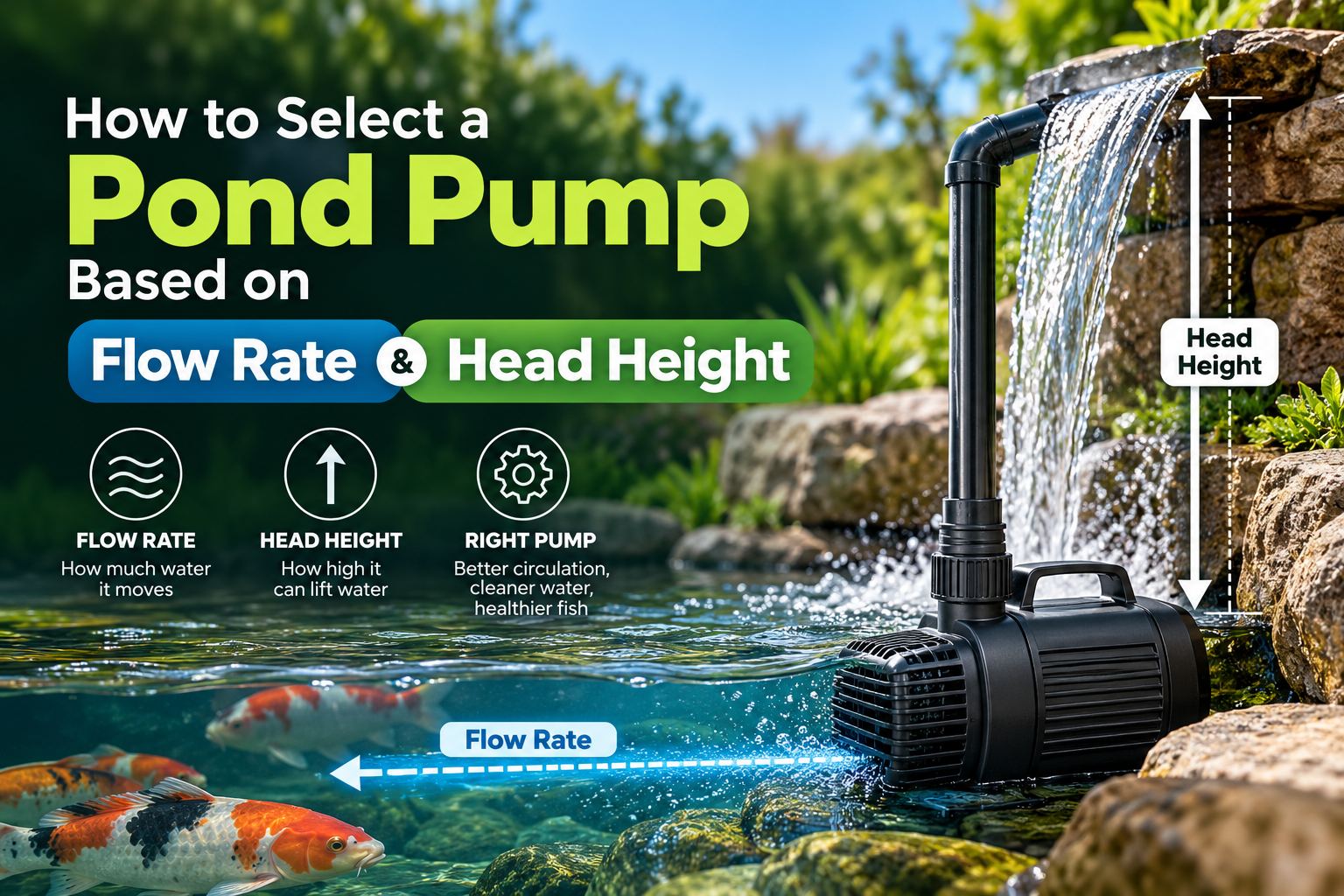
Choosing the right pond pump is essential for maintaining clean water, healthy fish, and efficient pond filtration. Whether you are building a koi pond, installing a waterfall, or upgrading an existing filtration system, selecting a pump based on its flow rate and head height helps ensure reliable performance.
Many pond owners choose a pump based only on its advertised litres per hour (LPH). However, a pump’s actual water flow can decrease significantly when it needs to lift water vertically or push it through long pipes, bends, filters, and other equipment.
Understanding pond pump flow rate and head height will help you choose the right pump for your pond’s requirements.
In this guide, we explain how pond pump flow rates work, what head height means, how to estimate your system’s requirements, and how to select a suitable pump for your pond.
What Is Pond Pump Flow Rate?
Pond pump flow rate refers to the volume of water a pump can move within a specific period. It is commonly measured in litres per hour (LPH) or litres per minute (LPM).
For example, a pump rated at 10,000 LPH is advertised as capable of moving up to 10,000 litres of water per hour under its specified test conditions. The actual flow rate in your pond installation may be lower.
Flow rate determines how effectively water moves through your pond’s filtration system, feeds a waterfall, or circulates throughout the pond.
Why Is Flow Rate Important?
Choosing the correct flow rate helps you:
- Circulate pond water efficiently.
- Supply the required flow to biological and mechanical filters.
- Support oxygen exchange when water returns through a waterfall or other suitable outlet.
- Reduce stagnant areas in the pond.
- Maintain the intended performance of your filtration system.
The required flow rate depends on pond volume, fish stocking levels, feeding habits, filter specifications, plumbing layout, and the purpose of the pump.
How to Calculate Pond Water Volume
Before selecting a pump, calculate the volume of water your pond holds.
For a rectangular pond, use this formula:
Water Volume (litres) = Length (m) × Width (m) × Average Water Depth (m) × 1,000
For example, consider a pond measuring:
- Length: 4 metres
- Width: 3 metres
- Average water depth: 1.2 metres
Water volume = 4 × 3 × 1.2 × 1,000
Total pond volume = 14,400 litres
If the pond has sloping sides or an irregular shape, use a suitable volume estimate based on its average dimensions.
Knowing the pond volume provides a starting point for determining the required pump flow rate.
Pond pump flow rate and head height
Head height refers to the height against which a pump must work to move water. It is commonly measured in metres.
For example, if a pump sends water from a pond to a waterfall outlet located 1.5 metres above the pond’s water surface, the static lift is approximately 1.5 metres.
However, the pump must also overcome resistance caused by pipe length, pipe diameter, bends, valves, filters, UV clarifiers, and other equipment.
This means the total head is often greater than the vertical height alone.
Types of Pump Head
1. Static Head
Static head is the vertical difference between the water source and the discharge point.
For a pond pump, measure the vertical lift from the pond’s operating water level to the point where the water is discharged.
2. Friction Head
Friction head is the pressure loss that occurs as water moves through pipes and fittings.
Long pipes, narrow pipe diameters, multiple bends, and restrictive fittings can increase friction losses.
3. Total Dynamic Head (TDH)
Total dynamic head represents the combined resistance the pump must overcome while delivering water.
For a typical pond pumping system:
Total Dynamic Head = Static Head + Friction Losses + Other System Losses
Other losses may include resistance from filters, UV clarifiers, valves, and fittings. Use manufacturer data or suitable hydraulic calculations to estimate these losses.
For example:
- Static head: 1.5 metres
- Estimated pipe friction loss: 0.7 metres
- Estimated equipment loss: 0.5 metres
Total dynamic head = 1.5 + 0.7 + 0.5
Estimated total dynamic head = 2.7 metres
These figures are illustrative. Actual losses depend on the system design and operating flow rate.
How Flow Rate and Head Height Work Together
Flow rate and head height are closely connected. As the head against which a pump operates increases, its delivered flow generally decreases.
A pump advertised at 10,000 LPH may not deliver that volume when installed in a system with significant vertical lift and plumbing resistance.
This is why checking only the maximum flow rate can lead to poor pump selection.
Understand the Pump Performance Curve
A pump performance curve shows how much water a pump can deliver at different head heights.
For example, a manufacturer’s curve might show the following illustrative performance:
| Operating Head | Example Delivered Flow |
|---|---|
| 0 metres | 10,000 LPH |
| 1 metre | 8,500 LPH |
| 2 metres | 6,500 LPH |
| 3 metres | 4,000 LPH |
| 4 metres | 1,500 LPH |
These values are hypothetical and do not represent a particular pump model.
When selecting a pump, find the point on its performance curve that corresponds to your estimated total dynamic head. Check whether the resulting flow rate meets the requirements of your pond and filtration equipment.
A pump’s maximum head is also important. At or near its maximum head, the delivered flow may approach zero. Therefore, maximum head should not be treated as the height at which a pump can still provide its advertised flow.
How to Select the Right Pond Pump Flow Rate
The right pump flow rate depends on the purpose of your pond system.
1. Calculate Your Pond Volume
Start by calculating the pond’s actual operating water volume.
For example:
- Small ornamental pond: 2,000 litres
- Medium garden pond: 5,000 litres
- Larger koi pond: 20,000 litres
These are example pond sizes, not fixed categories. Your pump selection should reflect the actual volume and pond conditions.
2. Determine the Required Circulation Rate
A common preliminary approach is to consider how frequently the pond’s water volume should pass through the filtration system.
For example, if you use a planning target of one pond volume per hour:
Target Flow Rate = Pond Volume ÷ Desired Turnover Time
For a pond containing 10,000 litres:
10,000 litres ÷ 1 hour = 10,000 LPH of delivered flow
This is only a starting point, not a universal requirement. Heavily stocked koi ponds, lightly stocked ornamental ponds, and ponds with different filtration designs can require different flow rates.
Always follow the filtration manufacturer’s recommended flow range. Excessive flow through a biological filter can reduce its effectiveness if the filter is not designed for that rate, while insufficient flow can compromise circulation and treatment.
3. Account for Actual Pump Performance
Once you establish the required delivered flow rate, calculate the total dynamic head of your system.
Then check the manufacturer’s pump curve to identify a model that can deliver the required flow at that head.
For example, if your pond needs 8,000 LPH of actual flow and the system’s total dynamic head is 2 metres, select a pump that delivers at least 8,000 LPH at 2 metres of head.
A pump with a maximum rating of 8,000 LPH may be too small if its advertised rating is measured at zero head.
How to Select a Pond Pump for a Waterfall
Waterfalls require additional consideration because their performance depends on the width of the spillway, the desired water sheet, the height of the waterfall, and the plumbing layout.
A narrow decorative waterfall may need much less water than a wide waterfall designed to produce a strong, continuous sheet.
Important Factors to Consider
Waterfall height: Measure the vertical lift from the pond’s operating water level to the waterfall outlet.
Waterfall width: Wider spillways generally require more flow to maintain a continuous sheet of water.
Pipe diameter: Appropriately sized pipes help reduce friction losses and maintain efficient pump performance.
Desired appearance: A gentle stream and a powerful cascading waterfall have different flow requirements.
Combined system requirements: If the same pump supplies both a filter and a waterfall, ensure that the available flow can meet both requirements without exceeding the filter’s permitted flow rate.
For more reliable results, use the waterfall manufacturer’s recommended flow rate per unit of spillway width, if available, and verify the final pump selection against its performance curve.
How to Select a Pump for a Pond Filtration System
Pond filtration systems may include mechanical filters, biological filters, UV clarifiers, bottom drains, and other components.
The pump must deliver enough water for the entire system to operate correctly.
Mechanical Filtration
Mechanical filters remove suspended solids and debris from pond water. Check the filter’s maximum permitted flow rate and the pressure or resistance it introduces into the system.
Biological Filtration
Biological filters provide surfaces for beneficial bacteria that help process fish waste. The filter must receive an appropriate flow of water to support effective treatment.
UV Clarifiers
UV clarifiers expose flowing water to ultraviolet light to help control suspended algae and other target microorganisms, depending on the unit’s design.
Check the manufacturer’s recommended flow rate and maximum operating pressure. The required flow may differ depending on the treatment objective.
Bottom Drains and Pipework
Ponds with bottom drains and gravity-fed filtration systems require careful hydraulic planning. Pipe diameter, water-level differences, filter layout, and pump placement all affect performance.
A pump selected without considering these factors may not deliver the expected flow through the complete system.
Common Pond Pump Selection Mistakes
Avoid these common mistakes when choosing a pond pump.
1. Choosing Only by LPH Rating
A pump’s maximum advertised flow does not necessarily represent its actual operating flow. Check the pump curve at the estimated total dynamic head.
2. Ignoring Pipe Diameter
Undersized pipes can create substantial friction losses, increasing the head the pump must overcome.
3. Ignoring Filter Flow Limits
A pump that pushes water through a filter faster than the recommended rate may compromise filtration performance or damage equipment.
4. Selecting a Pump with Insufficient Head Capacity
A pump may move plenty of water under low-head conditions but deliver inadequate flow when installed in a system with a high waterfall or restrictive plumbing.
5. Oversizing Without Checking the System
An unnecessarily powerful pump may increase electricity consumption and create excessive flow through the filtration system.
Choose a pump that meets the required operating conditions rather than simply selecting the largest available model.
6. Forgetting Maintenance Requirements
Debris, clogged filter media, blocked pipework, and dirty pump impellers can reduce water flow over time. Regular inspection and cleaning help maintain performance.
Energy Efficiency: Choose a Pump That Meets Your Needs
Pond pumps often run for long periods, so energy efficiency is an important selection factor.
Compare the electrical power consumption of suitable models and consider their actual operating performance.
For example, a pump rated at 100 watts running continuously for 24 hours uses:
0.1 kW × 24 hours = 2.4 kWh per day
Over 30 days, this equals approximately 72 kWh.
To estimate the running cost:
Monthly Electricity Cost = Monthly Energy Consumption × Electricity Tariff
If your electricity tariff is ₹8 per kWh, the illustrative monthly cost would be:
72 × ₹8 = ₹576 per month
Actual consumption depends on the pump’s rated and operating power, operating schedule, and electricity tariff.
An energy-efficient pump that provides the required flow at the necessary head can help reduce long-term operating costs.
Final Checklist Before Buying a Pond Pump
Before purchasing a pond pump, check the following:
- Pond water volume in litres.
- Required circulation and filtration flow rate.
- Vertical lift from the water surface to the discharge point.
- Estimated pipe friction and equipment losses.
- Pump performance curve at the expected total dynamic head.
- Filter and UV clarifier flow requirements.
- Pipe diameter and plumbing layout.
- Electricity consumption and operating costs.
- Installation requirements and maintenance access.
- Suitability for continuous operation and outdoor conditions.
Taking these factors into account helps you select a pump that provides reliable performance without unnecessary energy consumption.
Conclusion
Selecting the right pond pump requires more than comparing advertised LPH ratings. You need to understand your pond’s water volume, the required circulation rate, the vertical lift, and the resistance created by pipes and filtration equipment.
By calculating the estimated total dynamic head and checking the manufacturer’s performance curve, you can choose a pump that delivers the required flow under actual operating conditions.
Whether you are installing a koi pond, building a waterfall, or upgrading an existing filtration system, choosing the correct pump is an important step towards maintaining a healthy and well-circulated pond.
Looking for the right pond pump for your project? Explore pond pumps and filtration equipment at GreenfinIndia.com. If you are planning a new koi pond or upgrading an existing filtration system, consult the Greenfin The Pond Studio team for guidance on selecting equipment suitable for your pond’s requirements.