

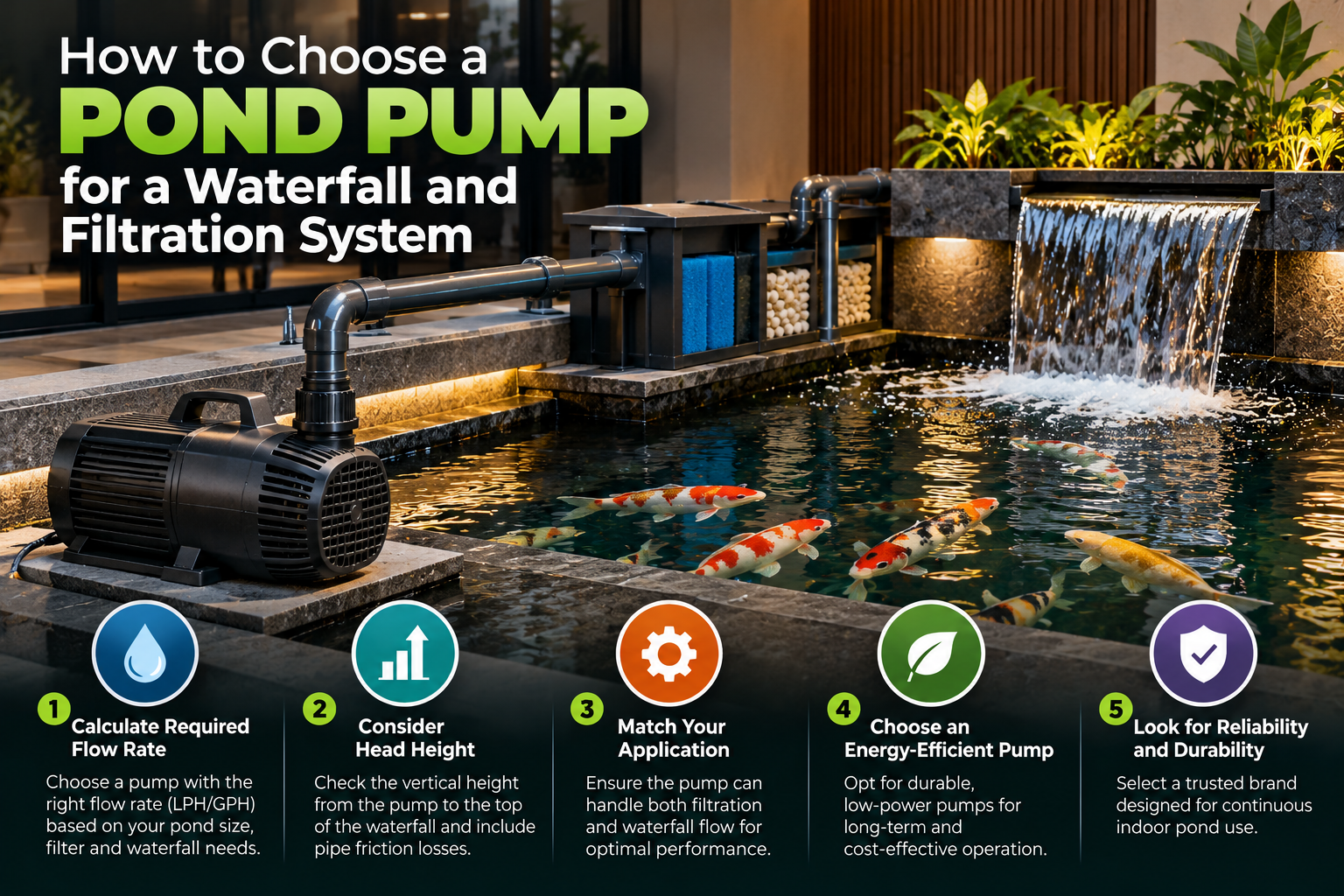
Choosing the right pond pump for a waterfall and filtration system is essential for maintaining clear water, supporting healthy fish, and creating an attractive water feature. Whether you are building a new koi pond, upgrading an existing pond, or installing a garden waterfall, the right pump helps ensure efficient water circulation and reliable filtration.
However, selecting a pond pump involves more than checking its maximum flow rate. You must consider pond volume, waterfall height, filter capacity, pipe diameter, and the resistance created by plumbing and filtration equipment.
A pump that is too small may not deliver enough water to the waterfall or filter. An unnecessarily powerful pump can increase electricity costs and push water through the filtration system faster than recommended.
In this guide, we explain how to choose the best pond pump for waterfall and filter applications, which specifications to compare, and how to select a suitable pump for your pond.
Why Do You Need the Right Pond Pump?
A pond pump moves water from the pond through the filtration system and returns it to the pond. In a waterfall installation, it also supplies the water needed to create the desired flow over the waterfall.
A properly selected pump helps you:
- Maintain continuous water circulation.
- Supply the required flow to mechanical and biological filters.
- Support water movement and surface agitation.
- Create a consistent waterfall.
- Improve the overall operation of your pond filtration system.
- Avoid unnecessary electricity consumption.
For koi ponds and other fish ponds, pump selection is particularly important because fish waste, uneaten food, and organic debris increase the demands on the filtration system.
The best pump depends on your pond’s volume, fish stocking levels, filter specifications, waterfall design, and plumbing layout.
1. Calculate Your Pond Water Volume
Before purchasing a pond pump, calculate the amount of water your pond holds. Pond volume helps establish an initial circulation target and provides useful information when selecting filtration equipment.
For a rectangular pond, use this formula:
Pond Water Volume (litres) = Length × Width × Average Water Depth × 1,000
For example, consider a pond with these dimensions:
- Length: 4 metres
- Width: 3 metres
- Average water depth: 1 metre
Calculation:
4 × 3 × 1 × 1,000 = 12,000 litres
The pond holds approximately 12,000 litres of water.
For ponds with sloping sides or irregular shapes, use the average water depth and an appropriate volume estimate.
Once you know your pond volume, you can determine a preliminary circulation requirement. The final pump selection must also account for the filter’s required flow rate and the waterfall’s water demand.
2. Choose the Correct Pond Pump Flow Rate
Flow rate is the amount of water a pump can move during a specified period. It is commonly measured in litres per hour (LPH).
For example, a pump advertised at 15,000 LPH may deliver less than 15,000 litres per hour once installed in a system with vertical lift, pipes, bends, and filtration equipment.
Therefore, choose a pump based on its delivered flow rate at the required operating head, not just its maximum advertised LPH.
How Much Flow Does Your Pond Need?
The required flow depends on the pond’s water volume, fish population, filter design, and waterfall dimensions.
As an initial planning example, a 12,000-litre pond might use a target circulation rate equivalent to one pond volume per hour, giving a target of 12,000 LPH.
However, this is not a universal rule. Some ponds need different circulation rates depending on their stocking density, filtration design, and operating requirements.
Always check the filter manufacturer’s recommended flow range before choosing the pump.
What If the Same Pump Supplies the Waterfall and Filter?
When one pump serves both the waterfall and filtration system, the system must be designed to provide the required flow to each component.
For example, if the filtration system requires a particular flow rate and the waterfall also needs a substantial supply, the pump and plumbing must accommodate both demands.
Depending on the layout, you may need a properly designed split-flow arrangement or separate pumps.
Do not simply add two advertised flow rates and assume the pump will deliver that total. Flow distribution depends on the hydraulic resistance of each branch and the pump’s performance curve.
3. Understand Waterfall Height and Pump Head
Head height is one of the most important factors when selecting a pond pump.
It represents the resistance against which the pump must operate. For waterfall installations, this includes the vertical lift from the pond’s operating water level to the waterfall outlet.
However, the total head also includes losses from pipe friction, bends, valves, filters, UV clarifiers, and other equipment.
How to Estimate Total Dynamic Head
Use this general relationship:
Total Dynamic Head = Static Head + Pipe Friction Losses + Equipment Losses
For example:
| Component | Estimated Head |
|---|---|
| Vertical lift | 1.5 metres |
| Pipe friction | 0.6 metres |
| Filter and fitting losses | 0.4 metres |
| Total estimated head | 2.5 metres |
These figures are illustrative. Actual losses depend on pipe diameter, flow rate, plumbing design, and equipment specifications.
Once you estimate the total dynamic head, check the pump manufacturer’s performance curve to determine the flow rate the pump can deliver at that operating point.
A pump rated at 10,000 LPH at zero head may deliver considerably less flow at 2.5 metres of head.
Buying tip: Select a pump that meets your required flow rate at the calculated head, with appropriate consideration for system variation and future maintenance.
4. Select a Pump That Matches Your Waterfall Design
Waterfalls can range from small decorative features to wide, powerful cascades. Each design requires a different amount of water.
Small Garden Waterfalls
Small waterfalls generally require less water than wide spillways. Consider the waterfall’s width, height, and the appearance you want to achieve.
A compact pond pump may be suitable if its performance curve provides sufficient flow at the required head.
Medium Waterfalls
Medium-sized waterfalls may require higher flow rates, especially when the waterfall is wide or the water must travel through long pipes.
Check the waterfall manufacturer’s recommended flow rate, if available, and account for the complete plumbing layout.
Large Waterfalls
Large waterfalls may require a high-flow pump or multiple pumps, depending on the waterfall width, height, and desired appearance.
For these installations, professional hydraulic planning can help prevent inadequate flow, excessive energy consumption, and uneven water distribution.
Factors That Affect Waterfall Performance
Before selecting your pump, consider:
- Waterfall width and design.
- Vertical lift from the pond.
- Desired water-sheet thickness.
- Pipe diameter and length.
- Number of bends and fittings.
- Whether the pump also supplies the filtration system.
The aim is to achieve the required waterfall appearance while maintaining the flow needed by the filtration system.
5. Choose Between Submersible and External Pond Pumps
Two common options for pond circulation are submersible pumps and external pumps.
Submersible Pond Pumps
Submersible pumps operate underwater and are often used in garden ponds, decorative waterfalls, and compact filtration systems.
Advantages:
- Generally straightforward to install.
- No separate dry pump chamber is usually required.
- Suitable for many small and medium pond installations.
- Can be convenient for decorative water features.
Things to consider:
- Access is needed for cleaning and maintenance.
- The pump must be suitable for continuous operation if it will run continuously.
- The installation must follow the manufacturer’s requirements for water depth, electrical protection, and placement.
Submersible pumps can be a practical choice when you want a relatively simple installation.
External Pond Pumps
External pumps are installed outside the pond and are commonly used in larger or more complex pond systems.
Advantages:
- Can be convenient to inspect and maintain.
- May suit installations requiring high flow rates.
- Can be integrated into appropriately designed filtration and plumbing systems.
Things to consider:
- Installation requires suitable pipework and pump placement.
- Suction-side plumbing must be designed carefully.
- Priming and installation requirements vary by model.
- The pump must be protected from unsuitable weather and operating conditions.
For larger koi ponds and professional installations, an external pump may be appropriate when the system design supports it.
The best choice depends on the required flow, head, installation conditions, and maintenance preferences.
6. Check Pump Power Consumption and Energy Efficiency
Pond pumps often operate for extended periods, so electricity consumption should be part of your purchasing decision.
Compare pumps that can deliver the required flow at the required head, then check their electrical power consumption.
For example, consider a pump rated at 150 watts operating continuously.
Daily energy consumption:
0.15 kW × 24 hours = 3.6 kWh per day
Monthly energy consumption over 30 days:
3.6 × 30 = 108 kWh per month
If the electricity tariff is ₹8 per kWh, the illustrative monthly running cost is:
108 × ₹8 = ₹864 per month
Actual consumption depends on the pump model, operating conditions, and usage schedule.
A more powerful pump is not automatically the better choice. Compare operating performance and power consumption to find a suitable balance between flow rate and energy efficiency.
7. Check Compatibility with Your Pond Filter
When buying a pond pump for a waterfall and filter, filter compatibility is just as important as pump performance.
Different filters are designed to operate within particular flow ranges.
Mechanical Filters
Mechanical filters remove suspended solids, leaves, and other debris from pond water.
Check the manufacturer’s maximum permitted flow rate and the filter’s operating requirements.
Biological Filters
Biological filters provide surfaces for beneficial bacteria that help process fish waste.
The pump must deliver an appropriate flow through the biological filter. Excessive flow through a filter not designed for it may reduce treatment effectiveness, while inadequate flow can compromise system performance.
UV Clarifiers
UV clarifiers use ultraviolet light to help control suspended algae and other target microorganisms, depending on the unit’s design.
Check the manufacturer’s recommended flow rate, operating pressure, and installation instructions.
Multi-Chamber Filtration Systems
Multi-chamber filters are frequently used in koi ponds and larger fish ponds.
Pump selection must account for the filter’s permitted flow rate and the way water enters and leaves the filtration system.
Important: Never choose a pump based solely on the pond volume or waterfall height. The complete filtration system must be considered before purchasing.
8. Features to Look for When Buying a Pond Pump
Before purchasing a pond pump, compare the following features.
| Feature | Why It Matters |
|---|---|
| Maximum flow rate | Indicates the pump’s advertised maximum water delivery under specified conditions. |
| Maximum head | Indicates the maximum head the pump can overcome, generally with little or no delivered flow at that limit. |
| Performance curve | Shows the flow available at different operating heads. |
| Power consumption | Helps estimate electricity costs. |
| Pipe connections | Must match the planned plumbing or suitable adapters. |
| Debris-handling capability | Important when pumping water containing suspended solids. |
| Continuous-duty suitability | Important if the pump will run for long periods. |
| Maintenance access | Helps simplify routine cleaning and inspection. |
| Warranty and support | Useful for long-term ownership and troubleshooting. |
Compare these specifications rather than selecting a pump based only on its price or maximum LPH rating.
9. Common Mistakes to Avoid When Buying a Pond Pump
Choosing a Pump with Insufficient Head
A pump may have a high advertised flow rate but fail to deliver enough water when installed beneath a tall waterfall.
Always check the performance curve at the expected total dynamic head.
Ignoring Pipe Diameter
Narrow pipes can increase friction losses and reduce the water delivered to the waterfall or filter.
Choose suitable pipe diameters based on the required flow rate and installation design.
Overlooking Filter Capacity
A pump that delivers too much water through a filter can cause operational problems if the flow exceeds the manufacturer’s recommendations.
Buying Only on Price
A low-cost pump may not meet your actual flow requirements or may consume more electricity than a suitable alternative.
Compare the complete operating specifications before making your decision.
Forgetting Maintenance
Debris buildup, blocked intakes, dirty impellers, and clogged filters can reduce pump performance.
Regular maintenance helps maintain circulation and protects equipment.
10. How to Choose the Right Pond Pump for Your Project
Before selecting a pump, collect the following information:
- Pond dimensions: Calculate the operating water volume.
- Fish stocking: Consider the number and size of fish and their feeding requirements.
- Filtration system: Identify the filter type and its recommended flow range.
- Waterfall height: Measure the vertical distance from the operating pond water level to the outlet.
- Pipework: Record pipe diameter, length, bends, and fittings.
- Waterfall requirements: Determine the flow needed to achieve the desired appearance.
- Pump performance: Check the manufacturer’s flow curve at the calculated total dynamic head.
- Operating costs: Compare power consumption, warranty, and maintenance requirements.
If the same pump supplies both a filter and a waterfall, make sure the complete system can deliver the required flow to both.
For large koi ponds, heavily stocked ponds, or complex waterfall installations, professional system planning can help ensure the pump and filtration equipment work together correctly.
Why Buy Pond Pumps from GreenfinIndia.com?
Choosing the right pond pump can be challenging when you need to balance waterfall performance, filtration requirements, and electricity consumption.
Greenfin The Pond Studio provides pond equipment and guidance to help pond owners select suitable solutions for their projects.
Whether you are building a new garden pond, maintaining an existing fish pond, or planning a koi pond filtration upgrade, selecting the right equipment is an important step towards reliable water circulation.
Explore the pond equipment available at GreenfinIndia.com to compare suitable pump options for your installation.
For projects involving larger ponds, waterfalls, or multi-stage filtration systems, contact the Greenfin The Pond Studio team for assistance in identifying the relevant pump specifications and system requirements.
Frequently Asked Questions
1. What size pond pump do I need for a waterfall and filter?
The required pump size depends on pond volume, waterfall dimensions, vertical lift, plumbing resistance, and filter specifications. Calculate the required flow rate and total dynamic head, then select a pump that can deliver the necessary flow under those conditions.
2. Can one pond pump run both a waterfall and a filter?
Yes. One pump can supply both a waterfall and a filtration system if it provides sufficient flow at the system’s total dynamic head and the flow can be distributed appropriately. Check the filter’s permitted flow rate before choosing this arrangement.
3. How do I calculate the required pond pump flow rate?
Calculate your pond volume in litres and establish a preliminary circulation target based on your pond and filtration requirements. Then check the filter manufacturer’s recommended flow range and verify that the pump can deliver the required flow at the calculated head.
4. Does waterfall height affect pond pump performance?
Yes. Greater vertical lift generally reduces the flow a pump can deliver. Pipe friction and resistance from filters and fittings can reduce the flow further.
5. Is a submersible or external pond pump better?
Submersible pumps can be convenient for many garden ponds and decorative waterfalls. External pumps can suit larger or more complex installations. The appropriate choice depends on flow requirements, head height, installation design, and maintenance access.
6. How can I reduce pond pump electricity costs?
Choose an efficient pump that meets your required flow at the actual operating head. Use appropriately sized pipes, clean the pump and filter regularly, and avoid selecting a pump that is unnecessarily powerful for your system.
Conclusion
Choosing the right pond pump for waterfall and filter applications requires careful consideration of pond volume, required flow rate, total dynamic head, filter capacity, and waterfall design.
A pump with the correct operating performance can help maintain effective water circulation, supply your filtration system, and create an attractive waterfall without unnecessary energy consumption.
Before purchasing, compare the manufacturer’s performance curves, check the filter’s recommended flow range, and account for all plumbing losses.
Ready to select a pond pump for your waterfall and filtration system? Explore the pond equipment available at GreenfinIndia.com or contact Greenfin The Pond Studio for guidance on your pond project.