

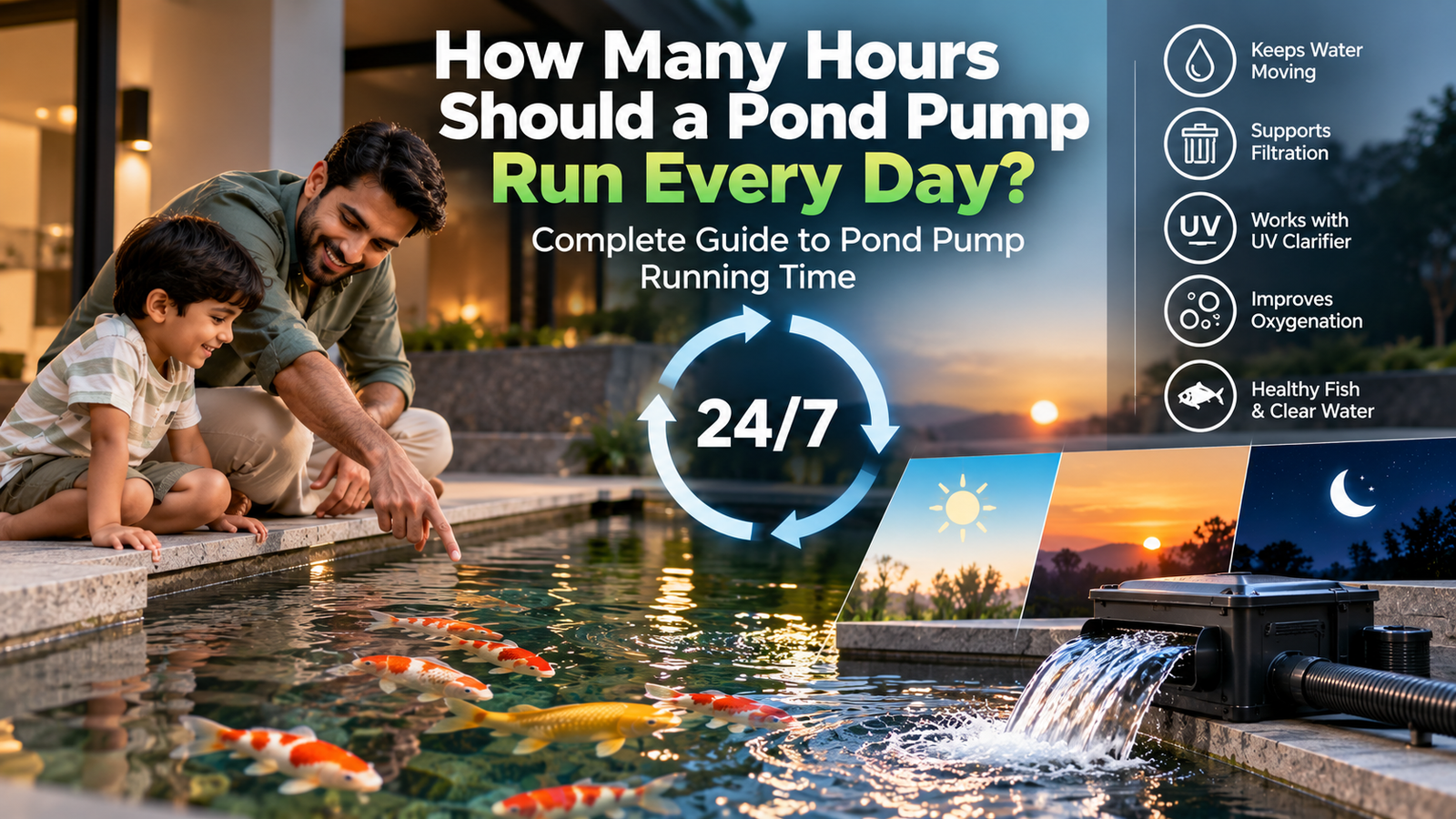
A pond pump is one of the most important pieces of equipment in a pond filtration system. It keeps water moving, circulates water through filters and UV clarifiers, supports waterfalls and fountains, and helps maintain better oxygenation and overall pond conditions.
But one common question among pond owners is:
How many hours should a pond pump run every day?
For most ponds with fish and filtration systems, the pump is generally best operated continuously, 24 hours a day, provided the pump and filtration system are designed for continuous operation. However, the ideal pond pump running time can vary depending on the pond size, fish load, filtration system, water temperature, pump type, and the purpose of the pump.
In this guide, we explain how long a pond pump should run, when continuous operation is important, and how to choose the right running schedule for your pond.
What Does a Pond Pump Do?
A pond pump does much more than simply move water.
Depending on the setup, a pond pump can:
- Circulate pond water
- Send water through mechanical and biological filters
- Supply water to a UV clarifier
- Operate waterfalls and fountains
- Improve water movement
- Support oxygen exchange
- Help distribute heat and dissolved oxygen throughout the pond
- Prevent stagnant areas
A properly sized pump is therefore an important part of maintaining a healthy pond ecosystem.
How Many Hours Should a Pond Pump Run?
For a pond containing fish, particularly koi, the recommended approach is generally to operate the filtration pump 24 hours a day.
Continuous operation keeps water moving through the filtration system and allows biological filtration to work consistently.
Why Run a Pond Pump 24/7?
A continuous pond pump running schedule provides several benefits.
1. Continuous Filtration
When the pump operates continuously, pond water constantly passes through the filtration system.
Mechanical filtration can capture suspended debris, while biological filtration provides surfaces for beneficial bacteria.
Stopping the pump for long periods can reduce circulation through the filter system.
2. Better Water Circulation
Water circulation helps prevent stagnant areas within the pond.
Continuous movement can help distribute oxygen, temperature, and dissolved substances throughout the water.
3. Continuous UV Operation
If your pond uses a UV clarifier, water needs to flow through the UV unit for it to work.
Turning off the pump means water is no longer passing through the UV clarifier during that period.
A continuously operating filtration pump therefore allows the UV system to operate consistently when it is designed for continuous use.
4. Supports Biological Filtration
Beneficial bacteria are an important part of biological pond filtration.
They help process waste produced by fish and other organic material.
Maintaining consistent water flow through biological filter media helps support stable filtration conditions.
5. Better Conditions for Koi
Koi produce a significant amount of waste compared with many ornamental pond inhabitants.
A koi pond therefore benefits from consistent filtration and circulation.
For koi ponds with an appropriately designed filtration system, continuous pump operation is commonly preferred.
Can You Turn Off a Pond Pump at Night?
Whether you should turn off your pond pump at night depends on the pond design and what the pump operates.
For a pond with a dedicated filtration system, turning the main filtration pump off every night is generally not ideal.
If the pump is responsible for:
- Biological filtration
- Mechanical filtration
- UV clarification
- Water circulation
- Waterfall filtration
then switching it off for several hours can interrupt these processes.
If you want to reduce nighttime noise or electricity consumption, it may be better to design separate circuits or pumps for features such as decorative waterfalls and fountains while keeping the essential filtration system running.
Does a Waterfall Pump Need to Run 24 Hours?
Not necessarily.
A decorative waterfall can sometimes be operated on a schedule if it is separate from the main filtration system.
For example, some pond owners may choose to run a decorative waterfall during the day and reduce or stop it at night.
However, if the waterfall is also part of the pond’s primary filtration and circulation system, switching it off may reduce the overall filtration and circulation of the pond.
The key question is:
Is the pump only operating a decorative feature, or is it responsible for filtration?
If it is the main filtration pump, continuous operation is generally more appropriate.
What About Fountain Pumps?
Fountain pumps can often be operated according to the owner’s preference.
A decorative fountain does not necessarily need to operate 24 hours a day if another pump is maintaining the pond’s essential filtration and circulation.
However, fountains can contribute to water movement and gas exchange, so the overall pond system should still provide adequate circulation and aeration when the fountain is switched off.
Pond Pump Running Time Based on Pond Type
Different pond systems can have different requirements.
| Pond Type | Typical Pump Approach |
|---|---|
| Koi pond | Usually continuous filtration |
| Fish pond | Continuous circulation is generally preferred |
| Natural ornamental pond | Depends on design and filtration |
| Water garden | Depends on plants and filtration |
| Waterfall-only feature | Can often be scheduled |
| Decorative fountain | Can often be scheduled |
| Pond with UV filtration | Continuous flow is generally beneficial |
These are general guidelines. Always consider the pump manufacturer’s specifications and the complete filtration design.
What Happens If You Turn Off the Pond Pump?
Turning off a pond pump for a short period does not necessarily cause an immediate problem.
However, regularly stopping the main filtration system for long periods can create several issues.
Reduced Water Circulation
Without the pump, water movement decreases.
This can result in stagnant areas, particularly in ponds with poor natural circulation.
Reduced Filtration
When the pump stops, water is no longer being processed through the filter.
This means mechanical and biological filtration are temporarily interrupted.
Reduced UV Treatment
If the UV clarifier depends on the same pump, water will not pass through the UV chamber while the pump is off.
Lower Oxygen Exchange
Water movement through waterfalls, returns, fountains, and other circulation points can contribute to oxygen exchange.
When these systems stop, overall circulation and gas exchange may decrease.
For heavily stocked ponds, maintaining good oxygen levels is particularly important.
Does Running a Pond Pump 24 Hours Increase Electricity Costs?
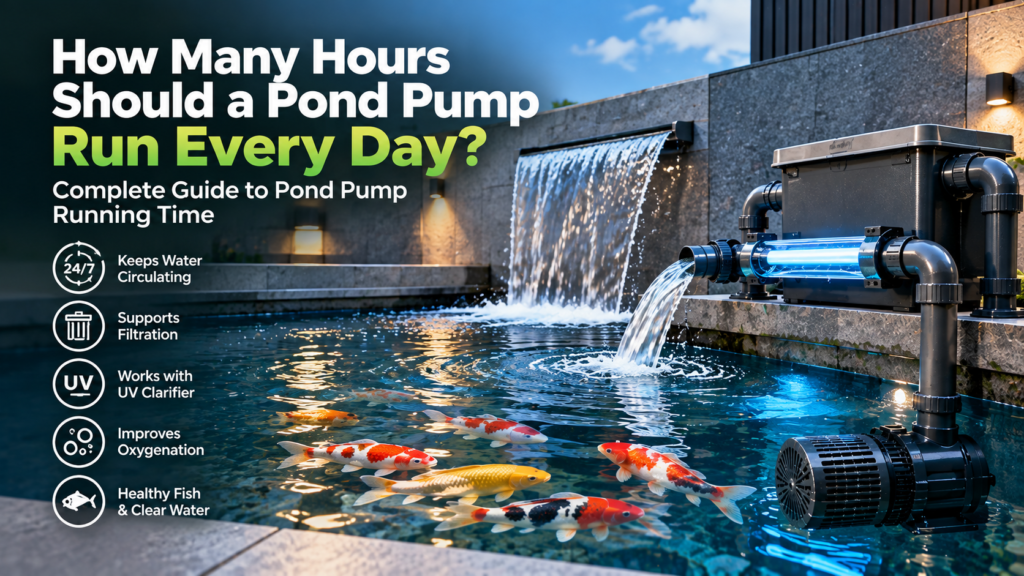
Yes, running a pump continuously uses more electricity than operating it for only a few hours.
However, the electricity cost depends on the pump’s power consumption.
For example, a 100-watt pump running continuously for 24 hours uses:
100 W × 24 hours = 2,400 Wh
or approximately:
2.4 kWh per day
For a 30-day period:
2.4 × 30 = 72 kWh per month
The actual electricity cost depends on your local electricity tariff.
A high-efficiency pump with an appropriate flow rate can therefore help reduce operating costs while maintaining the required circulation.
How to Reduce Pond Pump Electricity Consumption
If electricity usage is a concern, there are several ways to improve efficiency without unnecessarily reducing filtration.
Choose the Correct Pump Size
Avoid selecting a pump simply because it has a very high litres-per-hour rating.
The pump should be selected according to:
- Pond volume
- Required turnover
- Filter capacity
- Pipe diameter
- Pipe length
- Head height
- Waterfall or fountain requirements
- Manufacturer specifications
A pump that is too small may not provide sufficient circulation, while an unnecessarily oversized pump can waste energy.
Use Larger Pipework Where Appropriate
Pipe restrictions can increase resistance and reduce the actual flow delivered by a pump.
Properly sized plumbing can help the pump operate more efficiently.
Keep the Pump and Filter Clean
Blocked intake screens, clogged filter media, and dirty plumbing can reduce flow.
Regular maintenance helps keep the system operating properly.
Consider an Energy-Efficient Pump
Modern pond pumps are available in different power ratings and designs.
When choosing a pump, consider both the advertised flow rate and the electrical power consumption.
How Often Should Pond Water Pass Through the Filter?
There is no single pump flow rate that is suitable for every pond.
The desired turnover depends on pond volume, fish stocking, filtration design, and the type of pond.
For example, a heavily stocked koi pond generally requires a more carefully designed filtration and circulation system than a lightly stocked decorative pond.
Instead of selecting a pump only based on litres per hour, calculate the actual flow at the required head height.
Important:
Pump flow at zero head is not the same as actual flow after installation.
Pipework, bends, valves, filters, UV units, and vertical lift can all reduce the actual flow.
When selecting a pond pump, look at the manufacturer’s flow/head performance information.
Should the Pond Pump Run During Heavy Rain?
In many pond systems, keeping the filtration pump running during normal rainfall is useful because it maintains circulation and filtration.
However, extreme weather conditions can require additional precautions.
Heavy rain can introduce:
- Dirt
- Leaves
- Organic debris
- Pollutants
- Sudden changes in water chemistry
During severe storms, inspect the pond and filtration system and follow appropriate safety precautions.
Electrical equipment should always be protected from water exposure and installed according to applicable safety requirements.
Should a Pond Pump Run During Winter?
This depends on the climate, pond design, fish species, and local conditions.
In regions where ponds do not freeze, filtration and circulation can often continue throughout the year.
In colder climates where water can freeze significantly, pump operation may need to be adjusted according to the pond design and equipment.
For ponds in warmer parts of India, seasonal freezing is generally not the main concern. Instead, pond owners should pay attention to heat, evaporation, algae growth, oxygen levels, and water quality.
Pond Pump Running Time: A Simple Guide
If you’re unsure how long your pump should operate, use this general approach:
Main filtration pump:
Run continuously when the system is designed for 24-hour operation.
UV clarifier:
Keep water flowing through the UV unit according to the equipment manufacturer’s recommended operating conditions.
Waterfall pump:
Can be continuous if it is part of the filtration system; otherwise, it may be scheduled.
Decorative fountain:
Can often be operated during selected hours if separate from essential filtration.
Aeration system:
Follow the requirements of your fish load, pond design, and aeration equipment.
Signs Your Pond Pump May Not Be Running Enough
If your pump does not operate for sufficient periods, you may notice:
- Cloudy water
- Reduced water circulation
- Increased debris
- Poor filtration performance
- Increased algae growth
- Reduced waterfall or return flow
- Low oxygen conditions in heavily stocked ponds
These symptoms can have multiple causes, so check the complete pond system rather than assuming the pump is the only problem.
Frequently Asked Questions
Can I run my pond pump for only 8 hours a day?
It depends on what the pump is used for. A decorative pump may be scheduled, but a pump responsible for the main filtration system is generally better operated continuously when the equipment is designed for continuous operation.
Should a koi pond pump run 24 hours?
For most properly designed koi pond filtration systems, continuous pump operation is generally preferred to maintain circulation and filtration.
Should I turn my pond pump off at night?
If it is the main filtration pump, regularly turning it off at night is generally not recommended. A separate decorative waterfall or fountain pump can potentially be scheduled.
Does a pond pump need to run continuously?
Not every pond pump needs to run continuously. The correct schedule depends on the pump’s purpose and the pond’s filtration and circulation design.
Does running a pond pump use a lot of electricity?
Electricity consumption depends mainly on the pump’s wattage and operating hours. Choosing an appropriately sized, energy-efficient pump can help reduce operating costs.
How do I choose the right pond pump?
Consider pond volume, required flow, filter requirements, pipework, vertical lift, waterfall height, and the pump’s power consumption. Always check the manufacturer’s flow/head specifications.
Final Thoughts
The ideal pond pump running time depends on the role the pump plays in your pond system.
For ponds with fish and dedicated filtration, particularly koi ponds, 24-hour circulation is generally the preferred approach when the pump and filtration equipment are designed for continuous operation.
If the pump is only powering a decorative waterfall or fountain, you may have more flexibility with the operating schedule.
Rather than simply asking how many hours a pump should run, consider the complete system: pond volume, fish load, filtration, UV clarification, aeration, plumbing, pump capacity, and actual flow rate.
Choosing the right pump and designing the filtration system correctly can help maintain cleaner water, healthier fish, and more efficient pond operation.
At Greenfin India, you can explore pond pumps, filtration systems, UV clarifiers, aeration equipment, and other pond equipment for building and maintaining a reliable pond system.