

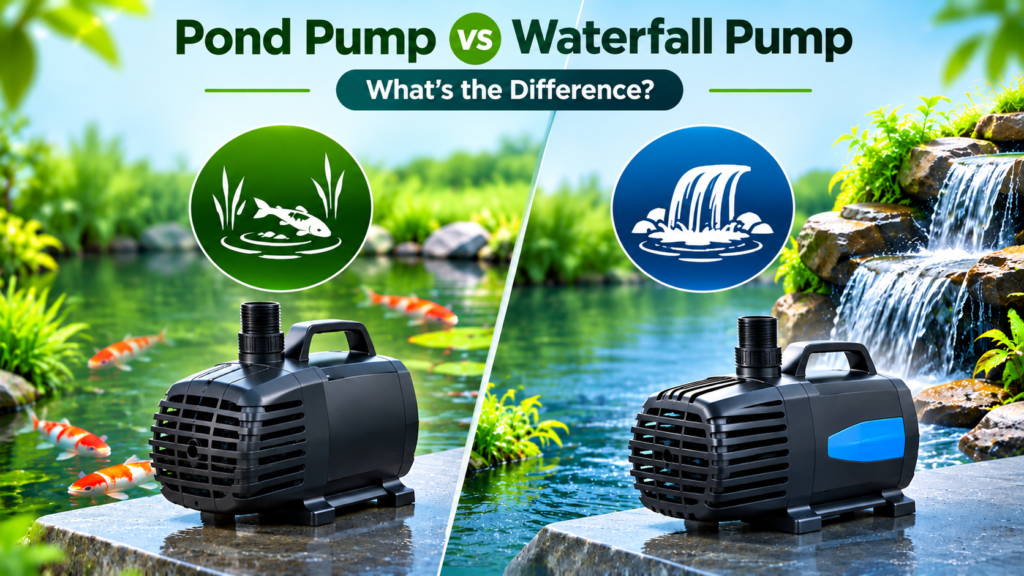
Choosing the right pump is one of the most important decisions when building or maintaining a garden pond, koi pond or outdoor water feature. A suitable pump helps maintain proper water circulation, supports filtration and creates attractive water movement.
However, many pond owners are confused about the difference between a regular pond pump and a waterfall pump. Although both types of pumps move water, their designs, flow characteristics and applications can differ depending on the model.
A pond pump is generally selected for water circulation, filtration and maintaining healthy pond conditions. A waterfall pump is selected to deliver sufficient water flow and pressure to create a continuous waterfall or stream.
In this guide, we will explain the difference between a pond pump and a waterfall pump, their applications, important specifications and how to choose the right pump for your pond.
1. What Is a Pond Pump?
A pond pump is equipment designed to circulate water throughout a pond. It helps move water towards filtration systems, UV clarifiers, fountains and other pond equipment.
Proper water circulation is important for maintaining pond water quality, especially in ponds containing koi fish and other aquatic animals.
Pond pumps are commonly used in:
- Koi ponds.
- Garden ponds.
- Fish ponds.
- Biological filtration systems.
- UV filtration systems.
- Water circulation setups.
- Aquaponics systems.
Many pond pumps are designed for continuous operation and energy-efficient water movement.
Main Benefits of a Pond Pump
Water Circulation: Helps prevent stagnant areas by continuously moving water.
Filtration Support: Transfers pond water through mechanical and biological filtration systems.
Fish Health: Supports oxygen exchange through water movement and surface agitation.
Energy Efficiency: Many pond pumps are designed to operate continuously while consuming relatively low electricity.
Versatile Applications: Can be used with pond filters, UV clarifiers, waterfalls and fountains when properly sized.
2. What Is a Waterfall Pump?
A waterfall pump is a pump selected to deliver the required volume of water to a waterfall, stream or decorative water feature.
Unlike a pump selected mainly for filtration circulation, a waterfall pump must provide enough flow at the required delivery height to create the desired visual effect.
Waterfall pumps are commonly used in:
- Garden waterfalls.
- Pond waterfalls.
- Cascading water features.
- Outdoor streams.
- Decorative water walls.
- Pond fountain systems.
A waterfall pump should be selected based on the waterfall width, desired water flow, pipe length and vertical height.
Main Benefits of a Waterfall Pump
Strong Water Flow: Provides the water movement required for attractive waterfall effects.
Suitable for Continuous Operation: Many models are designed for long operating periods.
Water Feature Performance: Helps create consistent water movement across waterfalls and streams.
Flexible Installation: Can be connected to suitable pipes, hoses and waterfall outlets.
Decorative Appearance: Supports natural-looking water features and cascading effects.
3. Pond Pump vs Waterfall Pump: Main Differences
Although both pumps move water, their primary applications and selection requirements are different.
| Feature | Pond Pump | Waterfall Pump |
|---|---|---|
| Main Purpose | Pond water circulation | Waterfall water delivery |
| Primary Application | Filtration and circulation | Waterfalls and streams |
| Flow Requirement | Based on pond volume and filtration | Based on waterfall width and desired flow |
| Head Height | Depends on filtration setup | Important for waterfall elevation |
| Operation | Often continuous | Often continuous |
| Energy Consumption | Depends on flow and motor efficiency | Depends on flow, head and motor efficiency |
| Installation | Pond, filter inlet or external plumbing | Usually connected to waterfall plumbing |
| Selection | Pond volume and filtration requirements | Waterfall width, height and flow requirements |
Important: These categories can overlap. Many pond pumps can operate waterfalls, and some waterfall pumps can support filtration. Always check the manufacturer’s pump curve and specifications rather than relying only on the product name.
4. Understanding Pump Flow Rate (L/H)
Flow rate is one of the most important specifications when selecting a pond or waterfall pump.
Flow rate indicates how much water a pump can move in one hour.
It is generally measured in litres per hour (L/H).
For example:
- 3,000 L/H: Moves up to 3,000 litres per hour under the specified test conditions.
- 5,000 L/H: Moves up to 5,000 litres per hour under the specified test conditions.
- 10,000 L/H: Moves up to 10,000 litres per hour under the specified test conditions.
- 15,000 L/H: Moves up to 15,000 litres per hour under the specified test conditions.
However, the actual flow rate decreases when the pump works against vertical height, pipe friction, bends and other restrictions.
For this reason, always check the pump’s performance curve before purchasing.
How Much Flow Does a Waterfall Need?
The required flow rate depends on the width and appearance of the waterfall.
A commonly used starting estimate for a sheet-style waterfall is approximately 100–150 litres per hour per centimetre of waterfall width.
For example:
| Waterfall Width | Approximate Flow Rate |
|---|---|
| 10 cm | 1,000–1,500 L/H |
| 20 cm | 2,000–3,000 L/H |
| 30 cm | 3,000–4,500 L/H |
| 40 cm | 4,000–6,000 L/H |
| 50 cm | 5,000–7,500 L/H |
| 60 cm | 6,000–9,000 L/H |
These are starting estimates, not fixed requirements. A thin trickle, natural rocky cascade and wide smooth waterfall can require very different flow rates.
5. Understanding Pump Head Height
Head height refers to the vertical height a pump can lift water under specified conditions.
It is usually measured in metres.
For example, if a waterfall outlet is positioned 2 metres above the pump’s water level, the pump must provide sufficient flow at approximately 2 metres of static head, plus additional allowance for pipe friction and fittings.
Consider these points:
- Higher waterfalls require pumps capable of delivering water at greater head heights.
- Longer pipes increase friction losses.
- Smaller pipe diameters can reduce water flow.
- Multiple bends and fittings create additional resistance.
Maximum head height does not mean the pump will deliver its maximum flow at that height. At the maximum rated head, the actual flow generally approaches zero.
Always check the flow-versus-head performance chart.
6. Can You Use a Pond Pump for a Waterfall?
Yes. Many pond pumps can be used for waterfalls if their flow rate and head-height capabilities are suitable.
For example, a pond pump rated at 10,000 L/H may be suitable for a small or medium waterfall, depending on the actual flow remaining at the required delivery height.
Before using a pond pump for a waterfall, consider:
- Waterfall width.
- Vertical delivery height.
- Required water flow.
- Pipe diameter.
- Total pipe length.
- Pump performance curve.
- Continuous operating capability.
If the pump cannot provide sufficient flow at the waterfall outlet, the waterfall may appear weak or uneven.
7. Can You Use a Waterfall Pump for Pond Filtration?
Yes, provided the pump is compatible with the filtration system.
However, some waterfall pumps are designed primarily for moving water and may not be suitable for handling solids or debris.
Before connecting a waterfall pump to a filtration system, check:
- Maximum particle or debris handling capacity.
- Whether the pump is suitable for continuous operation.
- Required inlet protection.
- Flow rate at the filtration system’s operating head.
- Compatibility with the filter manufacturer’s recommended flow rate.
For koi ponds, it is particularly important to ensure that the filtration system receives the correct flow rate for effective mechanical and biological filtration.
8. Which Pump Is Better for a Koi Pond?
For koi ponds, selecting a suitable pond pump is essential because koi produce significant waste compared with many smaller ornamental fish.
The pump should be selected according to pond volume, fish stocking level and filtration capacity.
Consider the following factors:
Pond Volume: Calculate the total water volume before selecting the pump.
Fish Stocking: Heavily stocked koi ponds generally require more effective circulation and filtration.
Filtration Capacity: The pump flow should match the filter manufacturer’s recommended operating range.
UV Clarifier: Ensure sufficient water flow through the UV unit without exceeding its recommended maximum flow.
Bottom Drain and Skimmer: Consider how water is collected and transferred through the filtration system.
For many koi pond installations, a properly sized pond pump connected to a suitable mechanical and biological filtration system is an effective solution.
9. How to Choose the Right Pond or Waterfall Pump
Choosing the right pump becomes easier when you understand your pond’s requirements.
Follow these steps before purchasing.
Step 1: Calculate Your Pond Water Volume
Measure the pond’s length, width and average water depth.
For a rectangular pond:
Water Volume (Litres) = Length × Width × Depth × 1,000
Use metres for all three dimensions.
Example:
- Length: 3 metres
- Width: 2 metres
- Depth: 1 metre
Water volume:
3 × 2 × 1 × 1,000 = 6,000 litres.
Step 2: Determine the Required Water Flow
For a filtration pump, follow the filtration manufacturer’s recommended flow rate.
For a waterfall, calculate the flow required according to the waterfall width and desired appearance.
Step 3: Measure the Head Height
Measure the vertical distance between the pump’s water level and the final water outlet.
Include additional allowance for pipe friction.
Step 4: Select the Correct Pipe Diameter
Use an appropriate pipe diameter to reduce friction losses and maintain efficient water delivery.
Avoid unnecessarily narrow pipes and excessive bends.
Step 5: Check Power Consumption
Compare the wattage of different pumps.
A pump with a higher flow rating is not necessarily more energy efficient. Compare the actual flow delivered at the required head against its electricity consumption.
Step 6: Consider Maintenance
Choose a pump that is easy to access, clean and maintain.
Regular maintenance helps prevent blockages and supports reliable operation.
10. Common Mistakes to Avoid When Choosing Pond Pumps
Many pond owners select pumps based only on the maximum L/H rating printed on the product.
This can lead to poor performance.
Avoid these mistakes:
- Choosing a pump without calculating pond volume.
- Ignoring head height.
- Selecting a pump based only on its maximum flow rate.
- Using undersized pipes.
- Ignoring filtration system flow requirements.
- Installing a pump without adequate debris protection.
- Choosing a pump without considering electricity consumption.
- Running a pump outside its specified operating conditions.
Selecting the correct pump from the beginning can improve pond performance and reduce unnecessary maintenance costs.
Frequently Asked Questions (FAQs)
1. What is the main difference between a pond pump and a waterfall pump?
A pond pump is generally selected for pond circulation and filtration, while a waterfall pump is selected to provide the required flow at the height of a waterfall. Some pumps can perform both functions.
2. Can I use a normal pond pump for a waterfall?
Yes. A pond pump can operate a waterfall if it provides sufficient flow at the required head height.
3. How many litres per hour does a waterfall pump need?
The required flow depends on waterfall width, height and desired appearance. A starting estimate for a sheet waterfall is 100–150 L/H per centimetre of width.
4. What is the ideal pump for a koi pond?
A suitable pond pump should provide the flow required by the koi pond filtration system while maintaining efficient water circulation.
5. Does a higher wattage pond pump mean better performance?
Not necessarily. Pump performance depends on its flow rate, head height, hydraulic efficiency and power consumption.
6. Can I run a pond pump 24 hours a day?
Many pond pumps are designed for continuous operation. However, always check the manufacturer’s operating instructions and installation requirements.
7. What happens if my waterfall pump is too small?
The waterfall may have weak water flow, uneven distribution or insufficient water movement.
8. Should I use separate pumps for filtration and waterfalls?
It depends on the pond design. A single correctly sized pump may support both applications, but separate pumps can offer better control, independent operation and easier maintenance.
Conclusion
Understanding the difference between a pond pump and a waterfall pump helps you select the right equipment for your pond.
A pond pump is generally ideal for water circulation and filtration, while a waterfall pump is selected according to the flow and head height required for decorative water features.
However, the right choice depends on the pump’s actual performance specifications rather than its name alone.
Before purchasing, calculate your pond volume, measure the waterfall height, determine the required flow rate and check the pump performance curve.
At Greenfin The Pond Studio, we offer pond pumps, filtration equipment and pond construction solutions to help create efficient and beautiful pond systems.
Explore our range of pond equipment at greenfinindia.com.