

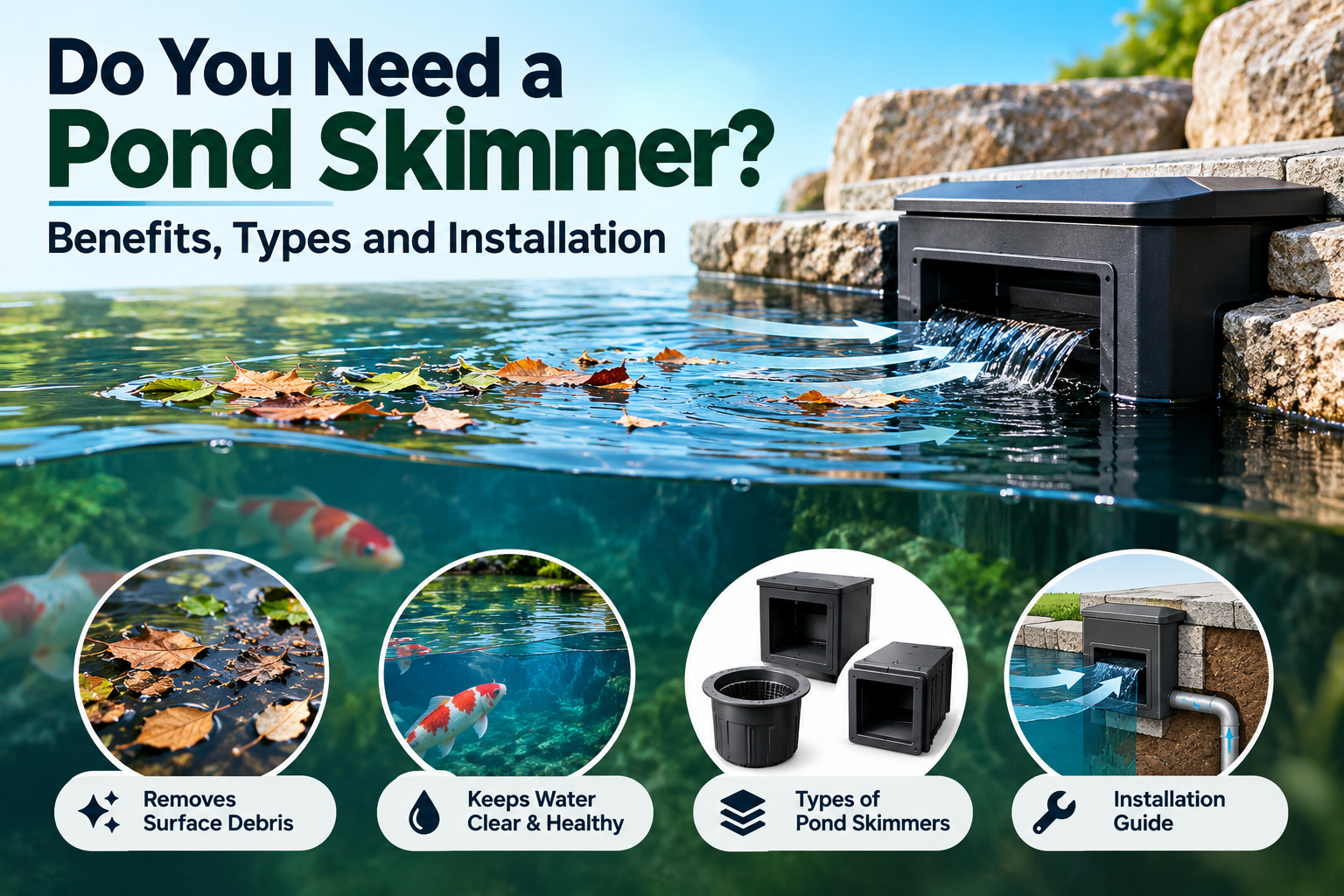
A clean and healthy pond requires more than a good pump and filtration system. Leaves, dust, insects, pollen, and other floating debris can quickly accumulate on the water surface, making a pond look dirty and affecting overall water quality. One effective solution is a pond skimmer.
Understanding the pond skimmer benefits can help pond owners decide whether this equipment is necessary for their pond. A pond skimmer collects floating debris before it sinks to the bottom, reducing maintenance work and helping the filtration system operate more efficiently.
Whether you have a small garden pond, a decorative water feature, or a large koi pond, choosing the right skimmer can improve water clarity and simplify routine cleaning.
In this guide, we explain what a pond skimmer is, its benefits, the different types available, where to install it, and how to select a model compatible with your pond filtration system.
What Is a Pond Skimmer?
A pond skimmer is a filtration component designed to remove floating debris from the water surface. It draws surface water through an opening, allowing leaves, insects, twigs, and other debris to collect in a removable basket or filter compartment.
The collected debris can then be removed manually before it sinks, decomposes, and adds organic waste to the pond.
Pond skimmers are commonly used in outdoor garden ponds, koi ponds, natural-style ponds, and ponds with waterfalls or surrounding vegetation.
Unlike a biological filter, which provides a place for beneficial bacteria to process harmful waste compounds, a skimmer primarily performs mechanical debris collection. It works best as part of a complete pond filtration system.
Pond Skimmer Benefits: Why Is It Useful?
Installing a pond skimmer offers several practical advantages for pond owners.
1. Removes Floating Debris Efficiently
One of the main pond skimmer benefits is its ability to collect floating waste before it spreads across the pond or sinks.
Common debris collected by a skimmer includes:
- Fallen leaves and small twigs
- Insects and pollen
- Floating plant fragments
- Dust and other lightweight organic material
This is particularly useful for outdoor ponds exposed to trees, gardens, wind, and seasonal changes.
2. Helps Maintain Clearer Pond Water
When leaves and organic debris remain in pond water, they eventually break down and contribute to the organic waste load.
A skimmer helps remove this material early, reducing the amount of debris entering the pond’s main filtration system.
However, a pond skimmer alone cannot eliminate green water caused by suspended algae or remove dissolved ammonia and nitrite. Proper biological filtration, suitable water circulation, and regular water testing remain essential.
3. Reduces Pond Maintenance Work
Without a skimmer, pond owners may need to remove floating leaves and debris manually using a pond net.
A properly sized skimmer collects much of this material automatically while the pump is operating. The owner only needs to inspect and empty the collection basket regularly.
This can be particularly helpful for large outdoor ponds where manual surface cleaning would otherwise require frequent effort.
4. Supports a Healthier Pond Environment
Organic debris can increase the amount of material that decomposes in pond water. Removing it before it sinks helps reduce the waste burden on the filtration system.
For koi ponds, this is especially useful because fish waste and uneaten food already contribute to the pond’s organic load.
A skimmer does not replace biological filtration, but it can complement the filtration system by removing debris before it decomposes.
5. Improves Water Circulation at the Surface
A skimmer draws water from the surface toward the filtration or pump system. When positioned correctly, it can help direct floating debris toward the collection point.
Its effectiveness depends on pump flow, wind direction, pond shape, and the location of other water returns.
In larger or irregularly shaped ponds, more than one surface collection point may be needed to prevent debris from accumulating in areas with poor circulation.
6. Helps Keep Decorative Ponds Looking Better
Floating leaves and insects can reduce the visual appeal of a decorative pond, especially when the pond includes a waterfall, fountain, or viewing area.
A skimmer helps keep the surface cleaner and allows the pond’s fish, stones, and water features to remain more visible.
For ponds designed as landscape features, this can make routine maintenance easier while improving the overall appearance.
Types of Pond Skimmers
Pond skimmers are available in different designs. The right option depends on pond size, construction, pump arrangement, and the amount of debris entering the water.
1. Floating Pond Skimmer
A floating skimmer sits on the water surface and adjusts to changes in water level. Many models use a floating intake and a pump or connection to a filtration system to collect surface debris.
Best suited for:
- Existing ponds where major construction is not practical
- Decorative ponds with changing water levels
- Pond owners looking for a simpler installation
Before purchasing, check the manufacturer’s recommended pond volume, flow rate, debris basket capacity, and installation requirements.
2. Built-In or Wall-Mounted Pond Skimmer
A built-in skimmer is installed through the pond wall, allowing surface water to enter through a skimmer opening. Debris collects in an accessible basket or chamber.
These systems are often incorporated during pond construction or major renovation.
Best suited for:
- Concrete koi ponds
- Large garden ponds
- Permanent pond filtration installations
- Ponds where a neat, integrated appearance is preferred
Built-in models require careful planning of the pond wall opening, water level, waterproofing, pipework, and pump connection.
3. Pump-Integrated Pond Skimmer
Some skimmers incorporate a pump within the unit or connect directly to a dedicated pump. Surface water passes through a collection basket before moving through the pump or onward to other filtration equipment, depending on the design.
Best suited for:
- Small and medium-sized decorative ponds
- Compact installations
- Ponds where an integrated surface-cleaning unit is convenient
Always follow the manufacturer’s installation instructions. The debris basket must be accessible, and the pump must receive adequate water flow to avoid running dry or becoming obstructed.
How to Choose the Right Pond Skimmer
Choosing the correct skimmer involves more than matching the product to the pond’s water volume. Consider the following factors before purchasing.
1. Pond Size and Surface Area
The pond’s surface area affects how much floating debris can accumulate and how much water must be drawn across the surface.
A small ornamental pond may require only a compact skimmer, while a large koi pond exposed to trees may need a higher-capacity system or multiple collection points.
Use the manufacturer’s rated capacity as a starting point rather than assuming that every skimmer is suitable for a particular pond volume.
2. Pump Flow Rate
The pump must provide enough flow for the skimmer to draw surface water effectively.
If the flow rate is too low, debris may remain scattered across the surface. If it exceeds the skimmer’s rated flow, the unit may not operate correctly.
When selecting a pump, account for pipe diameter, pipe length, bends, elevation changes, and the resistance created by connected filters.
For systems where one pump supplies both a skimmer and a biological filter, confirm that the design can distribute flow appropriately. In some installations, separate pumps or a properly designed shared suction arrangement may be more suitable.
3. Type and Quantity of Debris
A pond surrounded by trees may collect large quantities of leaves, twigs, and seed pods. A pond in an open garden may collect more dust, pollen, and small insects.
For heavy debris loads, look for a skimmer with a sufficiently large, easy-to-remove collection basket. A small basket may require frequent cleaning during autumn or windy weather.
4. Pond Construction and Water Level
The pond’s construction affects which skimmer can be installed.
A built-in model may be suitable for a new concrete pond, but retrofitting one into an existing pond can require cutting the wall, sealing the opening, and carrying out waterproofing work.
A floating or externally mounted alternative may be more practical when structural changes are undesirable.
5. Ease of Cleaning
A skimmer is only useful if its collection basket can be cleaned easily.
Check whether the basket can be removed without dismantling plumbing, whether the lid is accessible, and whether leaves can be removed safely while the pump is switched off when required by the manufacturer’s instructions.
Where Should You Install a Pond Skimmer?
Correct placement is essential for effective surface cleaning.
Install It Where Debris Naturally Collects
Wind and surface currents often move floating leaves toward one side of a pond. Observe where debris accumulates before deciding on the skimmer location.
Positioning the skimmer near this area can improve collection efficiency.
Consider the Pond’s Water Return
Water returning from a filter, waterfall, or circulation jet creates surface currents. These currents can help move debris toward the skimmer when the system is planned correctly.
Avoid creating a circulation pattern that pushes floating debris away from the intake.
Place It at the Correct Water Level
A built-in skimmer must be installed at the manufacturer’s specified operating water level. If the water level is too low, the intake may draw air or lose effectiveness. If it is too high, the opening may not collect surface debris as intended.
For ponds with fluctuating water levels, choose equipment designed to accommodate those changes.
Make the Basket Easy to Access
Install the skimmer where the basket can be reached without difficulty. Easy access encourages regular cleaning and reduces the risk of blocked flow.
For a large pond, accessibility is just as important as the skimmer’s position in the water.
How to Install a Pond Skimmer
Installation procedures vary by model, but the following steps provide a general overview.
Step 1: Plan the Skimmer Location
Identify the main debris collection area and consider the pond’s circulation pattern, pump position, filter location, and access for maintenance.
Step 2: Select a Compatible Skimmer
Confirm the skimmer’s flow requirements, pipe connections, pond size suitability, and compatibility with the selected pump and filtration equipment.
Step 3: Prepare the Installation Area
For a built-in skimmer, prepare the pond wall opening and supporting structure according to the manufacturer’s instructions. Ensure the design accounts for waterproofing and structural integrity.
For a floating model, prepare the required pump connection or power supply and secure the unit as directed.
Step 4: Connect the Plumbing
Connect the skimmer to the pump or filtration system using compatible pipes and fittings. Ensure that connections are secure and that the plumbing layout does not create excessive flow resistance.
Electrical equipment used near ponds must be installed with appropriate outdoor-rated protection and suitable residual-current protection by a qualified professional.
Step 5: Test the Water Flow
Fill the pond to the correct operating level and start the system according to the manufacturer’s instructions. Check for leaks, stable pump operation, and effective movement of floating debris toward the intake.
Step 6: Monitor and Adjust
Observe the pond over the following days. If debris continues to collect in certain areas, review the circulation pattern and skimmer position. Make adjustments only within the equipment’s operating limits.
For built-in installations, test the plumbing and waterproofing before completing any permanent finishing work.
Pond Skimmer vs Pond Filter: What Is the Difference?
A pond skimmer and a pond filter perform different functions. They should generally be considered complementary rather than interchangeable.
| Feature | Pond Skimmer | Pond Filter |
|---|---|---|
| Main purpose | Collect floating debris | Remove or process different types of waste |
| Typical waste | Leaves, insects, surface debris | Suspended solids and, in biological filters, dissolved waste compounds processed by bacteria |
| Installation | At the water surface or pond wall | In-line, gravity-fed, or pressurized, depending on design |
| Maintenance | Empty the debris basket | Clean mechanical stages and maintain biological media as required |
| Role in koi ponds | Reduces surface debris | Supports water quality and fish health |
For a koi pond, an effective system may include a skimmer, bottom drain, mechanical filtration, biological filtration, a suitable pump, and adequate aeration. The precise configuration depends on pond design, fish load, and maintenance requirements.
When Do You Need a Pond Skimmer?
A skimmer is especially useful when:
- Your outdoor pond collects leaves frequently.
- Floating debris accumulates faster than you can remove it manually.
- Your pond is surrounded by trees, plants, or landscaped areas.
- You want to reduce organic debris entering the main filtration system.
- You are building a new koi pond and can incorporate surface-water collection into the design.
- You want to maintain a cleaner-looking pond with less routine surface cleaning.
However, a skimmer may be less essential for a small indoor aquarium-style water feature or a covered pond that receives very little floating debris. In those cases, the cost and maintenance requirements should be weighed against the expected benefit.
A skimmer also will not solve every water-quality problem. Green water, high ammonia, poor oxygen levels, and excessive fish waste require their own diagnosis and appropriate corrective measures.
Common Pond Skimmer Maintenance Tips
To keep the skimmer working efficiently, follow a simple maintenance routine.
- Inspect the basket regularly: Remove leaves and other accumulated debris before they obstruct water flow.
- Increase checks during heavy leaf fall: Outdoor ponds may need daily inspections during periods of heavy debris accumulation.
- Check the pump and intake: Look for blockages and signs of restricted flow.
- Inspect pipe connections: Check accessible joints for leaks or damage.
- Maintain the complete filtration system: Clean mechanical filter stages as needed and preserve beneficial bacteria in biological media.
- Monitor water levels: Keep the pond within the skimmer’s required operating range.
- Follow manufacturer guidance: Use the specified cleaning and maintenance procedures for your particular model.
Regular inspection helps prevent blockages and supports consistent performance throughout the year.
Conclusion
A pond skimmer is a valuable addition to many outdoor ponds, particularly those exposed to leaves, insects, and other floating debris. The main pond skimmer benefits include easier surface cleaning, reduced organic debris accumulation, improved pond appearance, and support for the overall filtration system.
Choosing the right model requires consideration of pond size, surface area, pump flow rate, water level, debris load, and installation requirements. Correct placement and regular basket cleaning are equally important for achieving good results.
For koi ponds and larger water features, a skimmer works best as part of a properly designed filtration system that includes suitable mechanical and biological filtration.
If you are planning a new pond or upgrading an existing setup, explore the pond equipment and filtration solutions available at GreenfinIndia.com to find options suited to your pond’s requirements.
Frequently Asked Questions (FAQs)
1. What are the main pond skimmer benefits?
A pond skimmer collects floating leaves, insects, pollen, and other debris before they sink. It can reduce manual surface cleaning, lower the organic debris load, and help maintain a cleaner-looking pond.
2. Is a pond skimmer necessary for a koi pond?
Not every koi pond requires a skimmer, but it is often beneficial for outdoor ponds exposed to floating debris. It complements biological filtration and helps reduce the amount of organic material entering the pond.
3. Can a pond skimmer replace a pond filter?
No. A skimmer primarily collects floating debris. A biological filter supports beneficial bacteria that process ammonia and nitrite, while mechanical filtration removes suspended solids. Most koi ponds need appropriate filtration beyond a skimmer.
4. Where is the best place to install a pond skimmer?
Install it where surface currents naturally carry floating debris, taking wind direction, water returns, pump arrangement, and accessibility into account. Built-in skimmers must also be installed at the correct water level.
5. How often should I clean a pond skimmer?
Inspect the basket at least several times a week and more frequently when leaves or other debris accumulate rapidly. The required cleaning frequency depends on the season, pond surroundings, and basket capacity.
6. Can I install a pond skimmer in an existing concrete pond?
Yes, depending on the design. A built-in model may require structural modification and careful waterproofing. A floating or suitable external model may be easier to install without major construction.
7. Does a pond skimmer remove green water?
No. Green water is generally caused by suspended microscopic algae. Managing it may require appropriate filtration, nutrient control, suitable circulation, and, where appropriate, a correctly sized UV clarifier.
8. What size pond skimmer should I buy?
Choose a model based on pond surface area, water volume, debris load, rated flow, and pump compatibility. Follow the manufacturer’s specifications rather than selecting a skimmer based on pond volume alone.