

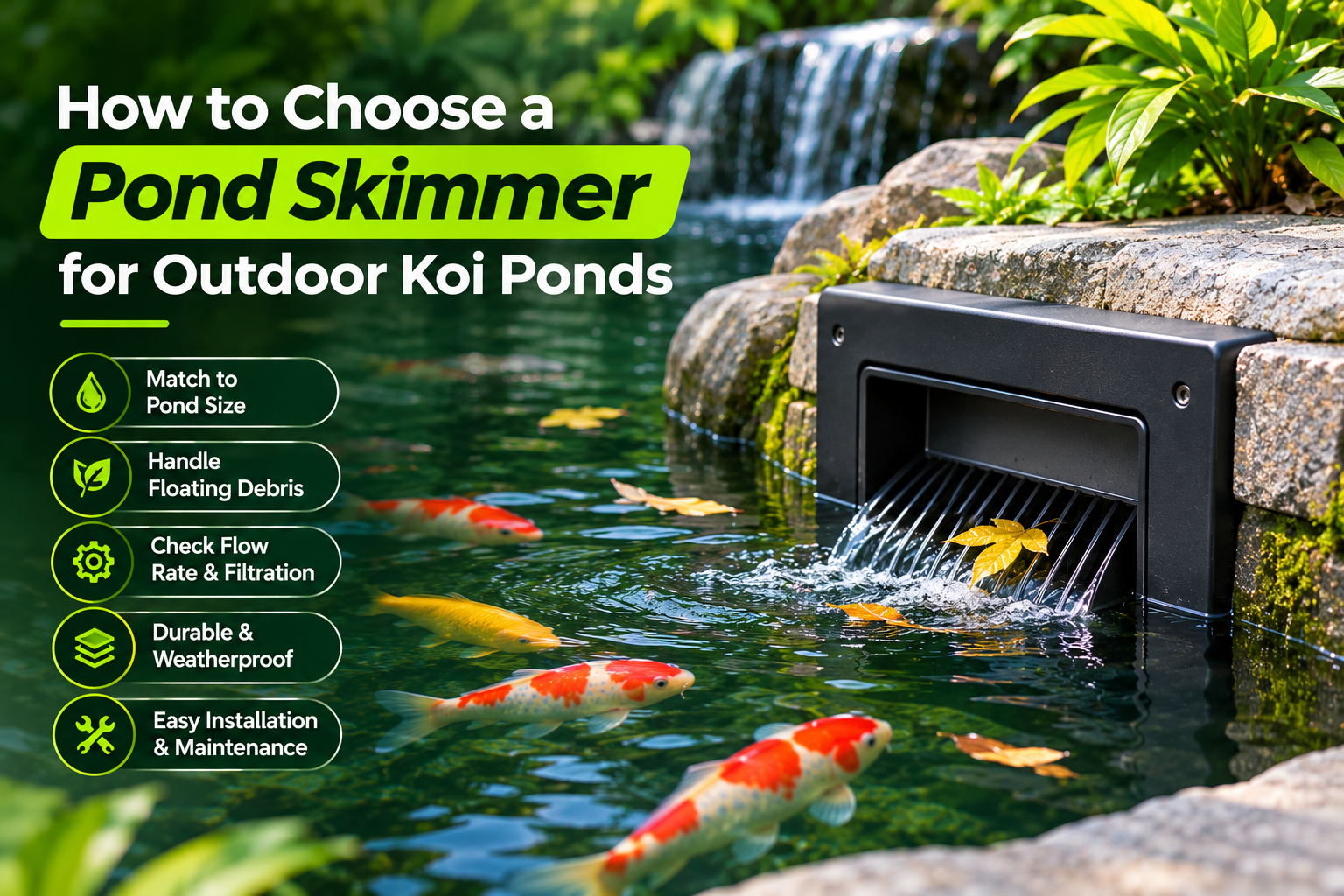
Maintaining clean water in an outdoor koi pond requires more than just a good filtration system. Leaves, dust, insects, floating debris and uneaten fish food can accumulate on the water surface, affecting the appearance and cleanliness of the pond. If these materials are not removed regularly, they may eventually sink, decompose and contribute to organic waste buildup.
A pond skimmer for koi ponds is an important piece of equipment that helps remove floating debris before it reaches the bottom of the pond. It collects unwanted materials from the water surface and directs them into a collection basket or filtration system.
However, choosing the right pond skimmer depends on several factors, including pond size, water surface area, pump capacity, installation type and the amount of surrounding vegetation.
In this guide, we will explain how pond skimmers work, their benefits, different types and the important factors to consider before purchasing one for your outdoor koi pond.
What Is a Pond Skimmer?
A pond skimmer is a filtration device designed to collect floating debris from the water surface.
It works by drawing surface water into a skimmer chamber through an opening called a weir. Floating leaves, insects, dust and other debris enter the chamber and are collected in a removable basket or filter mat.
The cleaned water is then directed towards the pond pump or filtration system, depending on the skimmer design.
Pond skimmers are particularly useful for outdoor koi ponds because they help maintain a cleaner water surface and reduce the amount of debris entering the main filtration system.
Why Do You Need a Pond Skimmer for an Outdoor Koi Pond?
Outdoor ponds are continuously exposed to environmental elements. Unlike indoor aquariums, they receive leaves, pollen, insects, dust and other materials from the surrounding environment.
Installing a pond skimmer offers several benefits.
1. Removes Floating Leaves and Debris
Falling leaves are one of the most common problems in outdoor ponds. A pond skimmer collects floating leaves before they sink to the bottom.
This helps reduce the accumulation of organic debris inside the pond.
2. Reduces the Load on Pond Filters
When leaves and other debris enter the main filtration system, they can increase the frequency of filter cleaning.
A pond skimmer captures much of this floating material before it reaches the main filter, helping reduce the mechanical filtration load.
3. Improves Water Surface Appearance
Floating debris can make even a beautifully designed koi pond look untidy.
A properly installed skimmer helps maintain a cleaner water surface, allowing you to enjoy a clearer view of your koi fish.
4. Helps Prevent Organic Waste Accumulation
Leaves and organic materials that sink into a pond gradually decompose. This can contribute to organic waste and nutrient buildup.
Removing floating debris early helps reduce this source of waste.
5. Supports Better Pond Circulation
A pond skimmer works as part of the overall water circulation system. When positioned correctly, it helps draw surface water towards the filtration system and supports effective debris collection.
Different Types of Pond Skimmers
Before selecting a pond skimmer, it is important to understand the different types available.
1. Floating Pond Skimmer
A floating pond skimmer operates on the water surface and adjusts to changing water levels.
It draws floating debris into a collection basket while maintaining contact with the water surface.
Best suited for:
- Garden ponds.
- Small and medium-sized ponds.
- Ponds with changing water levels.
- Ponds where simple installation is preferred.
2. Built-In or Wall-Mounted Pond Skimmer
A built-in pond skimmer is installed through the pond wall, usually during pond construction.
It collects floating debris through a surface opening and directs it into a collection basket or connected filtration system.
Best suited for:
- New koi pond construction.
- Concrete ponds.
- Large outdoor ponds.
- Permanent filtration installations.
3. External Pond Skimmer
An external pond skimmer is installed outside the pond and connected to the water circulation system.
Depending on its design, it can collect floating debris while providing convenient access for cleaning and maintenance.
Best suited for:
- Larger pond filtration systems.
- Ponds with external pump installations.
- Custom pond filtration arrangements.
4. Pump-Integrated Pond Skimmer
Some pond skimmers are designed to work together with a pump. They collect floating debris while water is drawn through the connected pump system.
Best suited for:
- Small and medium garden ponds.
- Compact filtration installations.
- Ponds requiring a simple circulation arrangement.
7 Important Factors to Consider When Choosing a Pond Skimmer
Selecting the correct pond skimmer is essential for effective surface cleaning. Consider these factors before making a purchase.
1. Pond Size and Water Surface Area
The first factor is the size of your pond.
A small garden pond and a large koi pond have different surface-cleaning requirements.
Consider both the total water volume and the surface area when selecting a pond skimmer.
A large pond may require a higher-capacity skimmer or multiple skimming points to collect debris effectively.
2. Pump Flow Rate
The pump plays an important role in pond skimmer performance.
The pump must provide sufficient water flow to draw floating debris towards the skimmer opening.
Check the manufacturer’s recommended flow rate before selecting a pump.
An undersized pump may not create sufficient surface movement, while an excessively powerful pump may cause problems with water level control or skimmer operation.
Always match the pump capacity to the skimmer’s specifications.
3. Skimmer Basket Capacity
The collection basket stores leaves, insects and other floating debris.
For outdoor koi ponds surrounded by trees or plants, choosing a skimmer with a larger debris basket can reduce cleaning frequency.
Consider:
- Basket size.
- Ease of removal.
- Cleaning convenience.
- Availability of replacement components.
A removable collection basket makes regular maintenance much easier.
4. Water Level Compatibility
Different skimmers are designed to operate at different water levels.
Floating skimmers adjust to changes in water level, whereas built-in skimmers generally require more precise installation.
Before purchasing, check the operating water-level range and installation requirements.
5. Pond Shape and Installation Location
The shape of your pond affects how floating debris moves across the water surface.
Wind direction, waterfalls, fountains and pump returns can influence surface circulation.
Ideally, position the skimmer where floating debris naturally collects.
For large or irregularly shaped ponds, more than one skimmer may be necessary.
6. Construction Material and Durability
Outdoor pond equipment must withstand continuous water exposure and environmental conditions.
Look for skimmers manufactured using durable, corrosion-resistant materials.
Important features include:
- Strong housing.
- Reliable sealing.
- Durable collection basket.
- UV-resistant materials where applicable.
- Easy-access cleaning components.
Choosing a reliable product can reduce maintenance issues over time.
7. Compatibility With Your Pond Filtration System
A pond skimmer should work effectively with the existing filtration setup.
Depending on the design, it may connect to:
- A dedicated pond pump.
- An external filtration system.
- A mechanical filtration chamber.
- A combined skimmer and pump system.
Check the inlet, outlet and plumbing specifications before purchasing.
Pond Skimmer vs Bottom Drain: What Is the Difference?
Pond skimmers and bottom drains perform different functions in a koi pond.
Both are important components of an effective pond filtration system.
| Feature | Pond Skimmer | Bottom Drain |
|---|---|---|
| Main function | Collects floating debris | Removes settled debris |
| Installation | At the water surface | At the pond bottom |
| Collects | Leaves, insects, dust and floating waste | Fish waste and settled solids |
| Water movement | Surface circulation | Bottom circulation |
| Main benefit | Keeps the water surface clean | Helps remove bottom waste |
| Application | Outdoor ponds | Koi ponds and larger ponds |
For a well-designed koi pond, using both a pond skimmer and a bottom drain provides more comprehensive debris collection.
How to Install a Pond Skimmer
Correct installation is important for effective surface cleaning.
Follow these general steps according to the manufacturer’s installation instructions.
Step 1: Choose the Installation Location
Identify the area where floating leaves and debris naturally collect.
Consider wind direction, pond shape and existing water circulation.
Step 2: Determine the Water Level
For built-in skimmers, establish the correct operating water level before installation.
The skimmer opening must be positioned to allow surface water to enter smoothly.
Step 3: Connect the Pump
Connect the skimmer to a suitable pond pump or filtration system as specified by the manufacturer.
Ensure that the pump flow rate is compatible with the skimmer.
Step 4: Check the Plumbing Connections
Inspect all inlet and outlet connections.
Ensure that pipes, fittings and seals are correctly installed to prevent leakage.
Step 5: Start the Filtration System
Switch on the pump and observe the water movement.
Floating debris should gradually move towards the skimmer opening and enter the collection basket.
Adjust the installation or water circulation if debris consistently collects in other areas.
How to Maintain a Pond Skimmer
Regular maintenance helps keep your pond skimmer operating efficiently.
Follow these maintenance practices:
- Empty the debris basket regularly.
- Remove accumulated leaves and insects.
- Clean the filter mat where provided.
- Inspect the skimmer opening for blockages.
- Check the pump and plumbing connections.
- Inspect seals and housing for damage.
- Ensure the skimmer maintains the correct operating water level.
- Clean the unit more frequently during periods of heavy leaf fall.
For ponds surrounded by trees, daily basket checks may be necessary during certain seasons.
Common Mistakes to Avoid When Buying a Pond Skimmer
Avoid these mistakes when selecting a pond skimmer for your koi pond.
- Choosing an undersized skimmer: A small unit may not handle the debris load of a large outdoor pond.
- Ignoring pump compatibility: Incorrect water flow can affect skimmer performance.
- Installing it in the wrong location: Poor positioning can prevent floating debris from reaching the skimmer.
- Ignoring water levels: Incorrect water levels can affect the operation of built-in skimmers.
- Selecting a small collection basket: A small basket may require frequent cleaning.
- Ignoring regular maintenance: Blocked baskets reduce water flow and debris collection.
- Using only a skimmer for pond filtration: A skimmer cannot replace biological filtration, mechanical filtration or a bottom drain.
Is a Pond Skimmer Necessary for Every Koi Pond?
A pond skimmer is not compulsory for every pond, but it is highly beneficial for most outdoor koi ponds.
If your pond is surrounded by trees, garden plants or open outdoor areas, a skimmer can significantly reduce floating debris.
For indoor ponds or ponds with very little surrounding debris, a skimmer may be less essential.
However, for larger outdoor koi ponds, incorporating a skimmer into the filtration design can make routine pond maintenance easier.
Why Choose Greenfin for Pond Filtration Equipment?
At Greenfin The Pond Studio, we offer pond equipment and filtration solutions for different pond sizes and applications.
Whether you are constructing a new koi pond or upgrading an existing filtration system, selecting the correct equipment is important for maintaining clean and healthy pond water.
Our product categories include:
- Pond pumps and water circulation systems.
- Pond filters and UV clarifiers.
- Pond skimmers and filtration accessories.
- Mechanical and biological filter media.
- Pond aeration equipment.
- Fountain pumps and accessories.
- Pond cleaning equipment.
We also provide pond construction, filtration installation and pond infrastructure upgrade services.
Explore pond equipment and filtration products at Greenfinindia.com.
Website: https://greenfinindia.com/
Frequently Asked Questions (FAQs)
1. What is the main purpose of a pond skimmer?
A pond skimmer removes floating debris such as leaves, insects, dust and uneaten fish food from the water surface before these materials sink to the bottom.
2. Do koi ponds need a pond skimmer?
A pond skimmer is highly beneficial for outdoor koi ponds, especially those exposed to falling leaves, dust and other environmental debris.
3. Where should a pond skimmer be installed?
A pond skimmer should be positioned where floating debris naturally collects. Consider wind direction, pond shape and water circulation when selecting the installation location.
4. What size pond skimmer do I need?
The correct size depends on pond surface area, debris load, pump flow rate and the manufacturer’s recommended operating capacity.
5. Can a pond skimmer replace a bottom drain?
No. A pond skimmer collects floating debris, whereas a bottom drain removes settled waste from the pond floor. They perform different functions.
6. How often should I clean a pond skimmer?
Check the collection basket regularly. In ponds with heavy leaf fall, daily cleaning may be necessary. Otherwise, clean it whenever debris begins to restrict water flow.
7. Can I install a pond skimmer in an existing koi pond?
Yes. Floating and certain external skimmers can be installed in existing ponds. Built-in wall skimmers generally require more extensive installation work.
8. Does a pond skimmer improve water quality?
A pond skimmer helps reduce floating organic debris before it decomposes. However, it does not replace biological filtration, which is essential for processing ammonia and nitrite.
Conclusion
Choosing the right pond skimmer for koi ponds is an important step towards maintaining a clean and attractive outdoor pond. Consider pond size, water surface area, pump flow rate, basket capacity, installation type and filtration compatibility before selecting a model.
A properly installed pond skimmer helps remove floating debris, reduces the load on mechanical filters and supports easier pond maintenance.
For the best results, combine a pond skimmer with a suitable bottom drain, mechanical filtration, biological filtration and an appropriately sized pond pump.
With the right equipment and regular maintenance, you can maintain a cleaner pond environment and enjoy watching your koi fish in a beautiful outdoor pond.
Explore pond equipment and filtration solutions at Greenfin The Pond Studio – Greenfinindia.com.
Additional SEO keywords
- Best pond skimmer for koi pond
- Outdoor pond skimmer
- Koi pond surface skimmer
- Floating pond skimmer
- Pond skimmer installation
- Automatic pond skimmer
- Pond filtration system
- Pond skimmer vs bottom drain
- Best koi pond cleaning equipment
- Pond debris removal system