

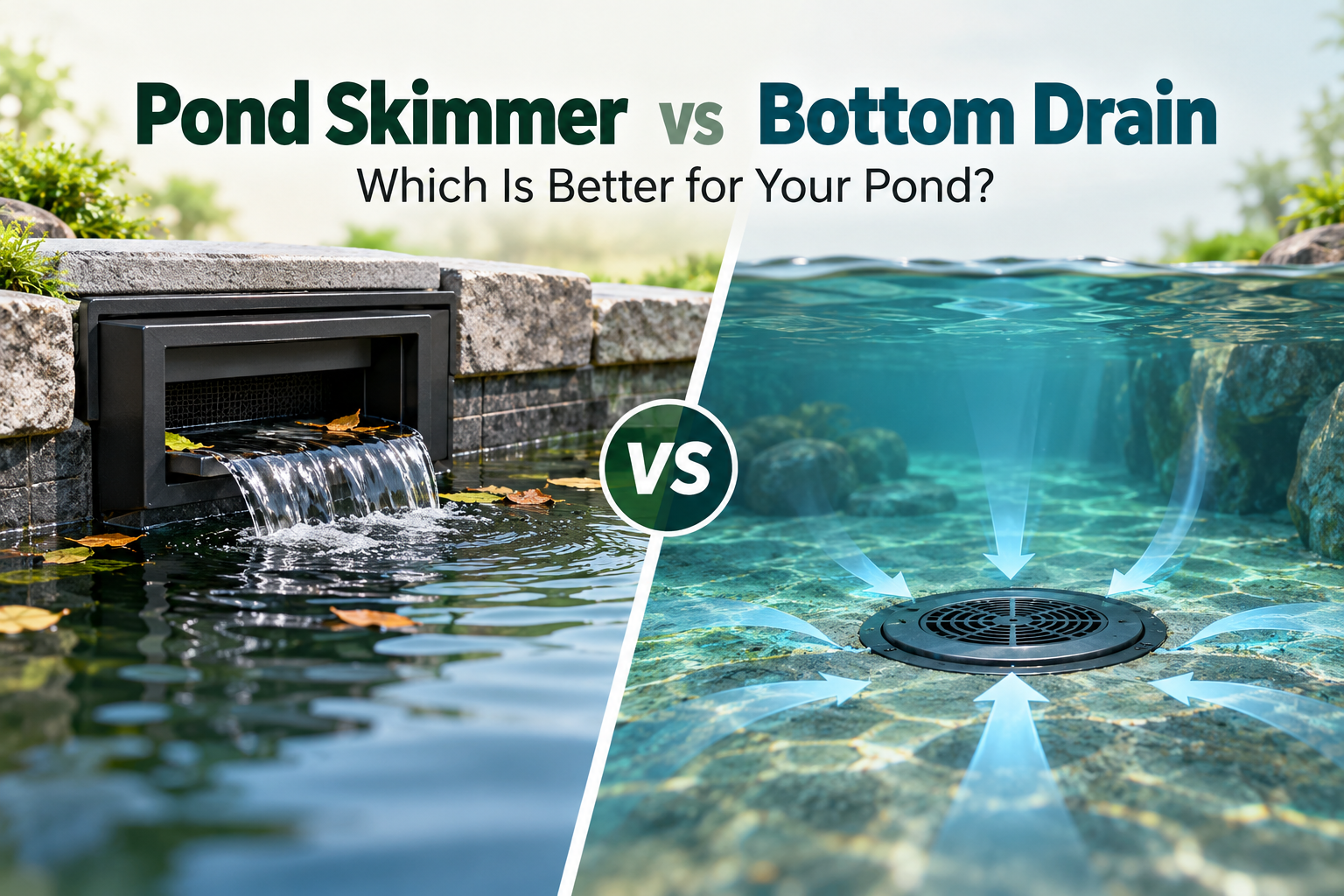
A clean and healthy pond requires more than just a good pond pump and filter. Proper water circulation and waste removal are equally important for maintaining clear water and creating a healthy environment for koi fish and other pond inhabitants. Two essential components commonly used in pond filtration systems are pond skimmers and bottom drains.
But when comparing a pond skimmer vs bottom drain, which one is better for your pond? Should you install a skimmer, a bottom drain, or both?
The answer depends on your pond’s design, size, fish population, and filtration requirements. In this guide, we will explain how pond skimmers and bottom drains work, their differences, their benefits, and how to choose the right setup for your pond.
What Is a Pond Skimmer?
A pond skimmer is a filtration component designed to remove floating debris from the surface of pond water. It collects leaves, dust, insects, uneaten floating food, and other debris before they sink to the bottom.
Pond skimmers are particularly useful for outdoor ponds surrounded by trees, gardens, and landscaping.
How Does a Pond Skimmer Work?
A pond skimmer draws water from the pond’s surface into a collection chamber. As water enters, floating debris is trapped in a removable basket or mechanical filter. The cleaned water then moves toward the pond pump or filtration system, depending on the skimmer design.
The process helps prevent floating debris from accumulating and decomposing in the pond.
Benefits of a Pond Skimmer
- Removes floating debris: Collects leaves, insects, and other surface waste.
- Improves water appearance: Helps maintain a cleaner pond surface.
- Reduces organic waste: Removes debris before it sinks and decomposes.
- Protects filtration equipment: A properly installed skimmer basket captures larger debris before it reaches downstream equipment.
- Simplifies maintenance: The collection basket can usually be removed and cleaned easily.
Limitations of a Pond Skimmer
A pond skimmer primarily cleans the water surface. It cannot effectively collect settled fish waste, heavy debris, or sludge from the pond floor.
It also needs sufficient surface-water movement to draw floating debris toward its intake. Dead zones, poor circulation, and incorrect placement can reduce its effectiveness.
What Is a Pond Bottom Drain?
A pond bottom drain is a plumbing fitting installed at the lowest point of a pond floor. It helps transport settled waste, fish excrement, uneaten sinking food, and other heavy particles toward the filtration system.
Bottom drains are especially useful in koi ponds, where fish produce considerable waste and maintaining water quality is important.
How Does a Pond Bottom Drain Work?
A bottom drain collects water and settled debris from the lower part of the pond. The waste-laden water travels through a pipe to a suitable mechanical filtration system, settlement chamber, drum filter, or other compatible filtration arrangement.
A gravity-fed system commonly uses a bottom drain connected to a filter positioned at a suitable water level. Other configurations use a pump-assisted arrangement.
For effective waste collection, the pond floor should be designed with appropriate slopes toward the drain. Drain size, pipe diameter, water flow, and filter capacity must be matched to the pond design.
Benefits of a Pond Bottom Drain
- Removes settled waste: Helps transport fish waste and sinking debris toward filtration.
- Supports koi pond maintenance: Particularly useful for ponds with a high fish load.
- Reduces waste accumulation: Helps prevent organic material from building up on the pond floor.
- Improves filtration efficiency: Supplies debris-laden water to mechanical filtration equipment.
- Supports larger pond designs: Can be incorporated into multi-chamber and advanced filtration systems.
Limitations of a Pond Bottom Drain
A bottom drain does not remove floating leaves and surface debris as effectively as a skimmer.
Installation also requires careful planning, especially in concrete ponds. Pipe routing, waterproofing, drain placement, and filter positioning must be considered before construction is completed.
Retrofitting a bottom drain into an existing pond can be difficult because it may require substantial structural work.
Pond Skimmer vs Bottom Drain: Key Differences
Although both components help maintain pond water quality, they serve different purposes.
| Feature | Pond Skimmer | Pond Bottom Drain |
|---|---|---|
| Main function | Collects floating debris | Collects settled waste |
| Installation location | Pond surface or upper wall | Lowest point of pond floor |
| Best for removing | Leaves, insects, floating debris | Fish waste, sinking food, settled particles |
| Koi pond suitability | Very useful | Very useful |
| Pond construction | Often easier to retrofit | Best planned during construction |
| Maintenance | Empty and clean the collection basket | Inspect drain flow and maintain connected filtration |
| Filtration role | Primarily surface-water collection | Primarily bottom-water and waste collection |
| Ideal application | Outdoor ponds with surface debris | Koi ponds and ponds requiring effective bottom-waste removal |
The main difference is simple: a pond skimmer cleans the surface, while a bottom drain helps remove waste from the pond floor.
Neither component completely replaces the other.
Which Is Better for a Koi Pond?
For most koi ponds, a combination of a pond skimmer and a bottom drain provides more complete waste management than either component alone.
Koi fish constantly produce waste. Uneaten food, fish excrement, and other organic material can accumulate on the pond floor, while leaves and dust collect on the surface.
A bottom drain helps transport settled waste toward the filtration system. A skimmer collects floating debris before it sinks.
Together, they help maintain better pond cleanliness and reduce the workload on the overall filtration system.
However, the best configuration depends on the pond’s dimensions, shape, stocking density, and filtration design. Smaller ponds with light fish loads may function adequately with simpler systems, provided that water circulation and filtration are appropriate.
Recommended Setup for a Koi Pond
A well-designed koi pond filtration system may include:
- Pond bottom drain: Collects settled waste from the pond floor.
- Pond skimmer: Removes floating leaves and surface debris.
- Mechanical filter: Captures suspended solids and other particles.
- Biological filter: Provides a surface for beneficial bacteria that process ammonia and nitrite.
- Pond pump: Maintains the required water flow through the filtration system.
- Aeration system: Supports dissolved oxygen levels for fish and beneficial bacteria.
The components should be selected and sized as a complete system rather than independently.
Do You Need Both a Pond Skimmer and a Bottom Drain?
You do not necessarily need both in every pond. However, using both is often beneficial for outdoor koi ponds and larger ponds with substantial fish loads.
Consider the following situations.
Choose a Pond Skimmer If:
- Your pond is surrounded by trees or plants that drop leaves.
- Floating debris regularly collects on the water surface.
- You want to improve surface cleanliness.
- Your existing pond has no convenient way to collect floating waste.
- You want to upgrade surface cleaning without major structural changes.
Choose a Bottom Drain If:
- You are constructing a new concrete koi pond.
- Fish waste and sinking debris accumulate on the pond floor.
- You are planning a gravity-fed filtration system.
- You want to connect the pond to a suitable mechanical filtration unit.
- Your pond has a substantial fish population and requires effective waste management.
Choose Both If:
- You are building a dedicated koi pond.
- Your pond is large or heavily stocked.
- You want to manage floating debris and settled waste separately.
- You are planning a complete pond filtration upgrade.
- Your filtration design supports both surface and bottom-water collection.
For many new koi pond projects, planning both components during construction is a practical long-term approach.
How to Choose the Right Pond Skimmer
Choosing a suitable skimmer requires more than selecting a product based on its appearance.
Consider these factors before purchasing.
1. Pond Surface Area
Larger ponds generally require greater surface-water movement to bring floating debris toward the skimmer. Consider the pond’s surface area, shape, and expected debris load.
2. Pump Flow Rate
The skimmer must work with the selected pump and plumbing arrangement. Excessive flow can create problems, while insufficient flow may prevent effective debris collection.
Follow the manufacturer’s recommended flow range and account for plumbing losses.
3. Skimmer Basket Capacity
A larger basket may be useful in outdoor ponds that collect many leaves. A suitable basket makes maintenance easier and reduces the frequency of emptying.
4. Installation Type
Depending on the pond design, you may choose a wall-mounted, floating, or other compatible skimmer type. Ensure that the product is suitable for your pond’s construction and water level.
5. Maintenance Access
Install the skimmer where the basket can be removed and cleaned conveniently.
How to Choose the Right Pond Bottom Drain
A bottom drain must be selected according to the pond’s dimensions, plumbing layout, and filtration requirements.
1. Pond Size and Shape
The number and placement of drains depend on the pond’s floor area, geometry, depth, and expected circulation pattern. Larger or irregularly shaped ponds may need multiple drains.
2. Drain and Pipe Diameter
The drain outlet and connecting pipe must accommodate the intended water flow without creating excessive restriction. Choose compatible fittings and follow the drain manufacturer’s recommendations.
3. Pond Floor Slope
A gently sloping pond floor can help guide settled debris toward the drain. The required slope depends on the pond’s dimensions, finish, and circulation design.
4. Filtration System Compatibility
Confirm whether the drain will feed a gravity-fed mechanical filter, settlement chamber, drum filter, or pump-assisted system.
5. Construction and Waterproofing
For concrete ponds, coordinate drain installation with structural work, pipe placement, and waterproofing. Proper installation reduces the risk of leaks and makes future repairs easier.
Common Mistakes to Avoid
Even high-quality pond equipment may perform poorly when installed incorrectly.
1. Expecting a skimmer to remove bottom waste
A skimmer is designed primarily for surface debris. It should not be relied upon to remove settled fish waste.
2. Expecting a bottom drain to collect every floating leaf
A bottom drain is not a replacement for surface-water collection. A skimmer is more appropriate for floating debris.
3. Choosing the wrong pump flow
The pump, drain, skimmer, pipework, and filter must work together. Incorrect flow selection can reduce collection efficiency.
4. Ignoring mechanical filtration
Both components transport waste toward collection points, but appropriate filtration is still needed to capture and remove solids from the water.
5. Poor placement and circulation
Dead zones can allow waste to accumulate even when a pond has a bottom drain. Pond shape, floor slope, return outlets, and water movement should be considered together.
6. Installing a bottom drain without planning for maintenance
Provide suitable access to valves, filter chambers, and cleaning points. Plan the plumbing before completing the pond structure.
7. Neglecting biological filtration
Removing physical debris does not eliminate dissolved ammonia and nitrite. A properly sized and established biological filter remains essential for fish health.
Can You Add a Bottom Drain to an Existing Pond?
Yes, but the installation method depends on the pond’s construction.
A bottom drain is easiest to incorporate when the pond is being built because the drain and pipes can be installed before the floor is finished and waterproofed.
For an existing concrete pond, retrofitting may require draining the pond, modifying the floor, installing pipework, and restoring the waterproofing. These changes can be expensive and may affect the pond’s structure.
If major structural modification is not practical, alternative solutions may include a suitable external waste-removal system, improved circulation, or a compatible pond vacuum.
A pond skimmer is generally easier to add to an existing pond, depending on its design.
Consult an experienced pond contractor before modifying a concrete pond.
Final Verdict: Pond Skimmer or Bottom Drain?
When comparing a pond skimmer vs bottom drain, there is no single winner because each component performs a different job.
A pond skimmer is the better choice for collecting floating leaves, insects, and surface debris. A bottom drain is the better choice for transporting settled waste from the pond floor toward the filtration system.
For a well-planned koi pond, using both a skimmer and a bottom drain is often the most effective approach because they address different sources of waste.
Before choosing equipment, consider your pond’s size, fish population, construction type, pump capacity, and filtration requirements. A properly designed system will be easier to maintain and better equipped to support clear water and healthy fish.
At Greenfin The Pond Studio, choosing suitable pond equipment starts with understanding the pond itself. Whether you are constructing a new koi pond or upgrading an existing filtration system, plan your surface-water collection, bottom-waste removal, mechanical filtration, and biological filtration together.
Explore pond pumps, filtration equipment, and pond solutions at GreenfinIndia.com to plan a pond system that meets your requirements.
Frequently Asked Questions (FAQs)
1. Is a pond skimmer better than a bottom drain?
Neither is universally better. A skimmer removes floating debris, while a bottom drain helps collect settled waste. The right choice depends on your pond’s cleaning requirements.
2. Does every koi pond need a bottom drain?
Not every koi pond requires one, but bottom drains are highly beneficial in many purpose-built koi ponds, particularly those with larger fish populations or advanced filtration systems.
3. Can a pond skimmer replace a bottom drain?
No. A skimmer primarily collects floating debris and does not effectively remove waste settled on the pond floor.
4. Can a bottom drain work without a pond pump?
A bottom drain can operate in a gravity-fed system without a pump directly attached to it, provided that the downstream water-level and filtration arrangement supports gravity flow. A pump is commonly used elsewhere in the system to circulate water back to the pond.
5. Where should a pond bottom drain be installed?
It is generally installed at the lowest point of the pond floor, with the floor and circulation designed to guide settled debris toward it.
6. How often should a pond skimmer basket be cleaned?
Check the basket regularly and remove debris whenever it begins to accumulate. During periods of heavy leaf fall, daily inspection may be necessary.
7. Which is better for a small garden pond?
A skimmer may be sufficient when the main problem is floating debris. A bottom drain or another suitable waste-removal method may be useful when settled waste accumulates. The choice depends on stocking levels and pond design.
8. Does a bottom drain keep pond water clear?
A bottom drain helps transport settled waste toward filtration, but clear water also depends on effective mechanical and biological filtration, proper circulation, suitable fish stocking, and regular maintenance.