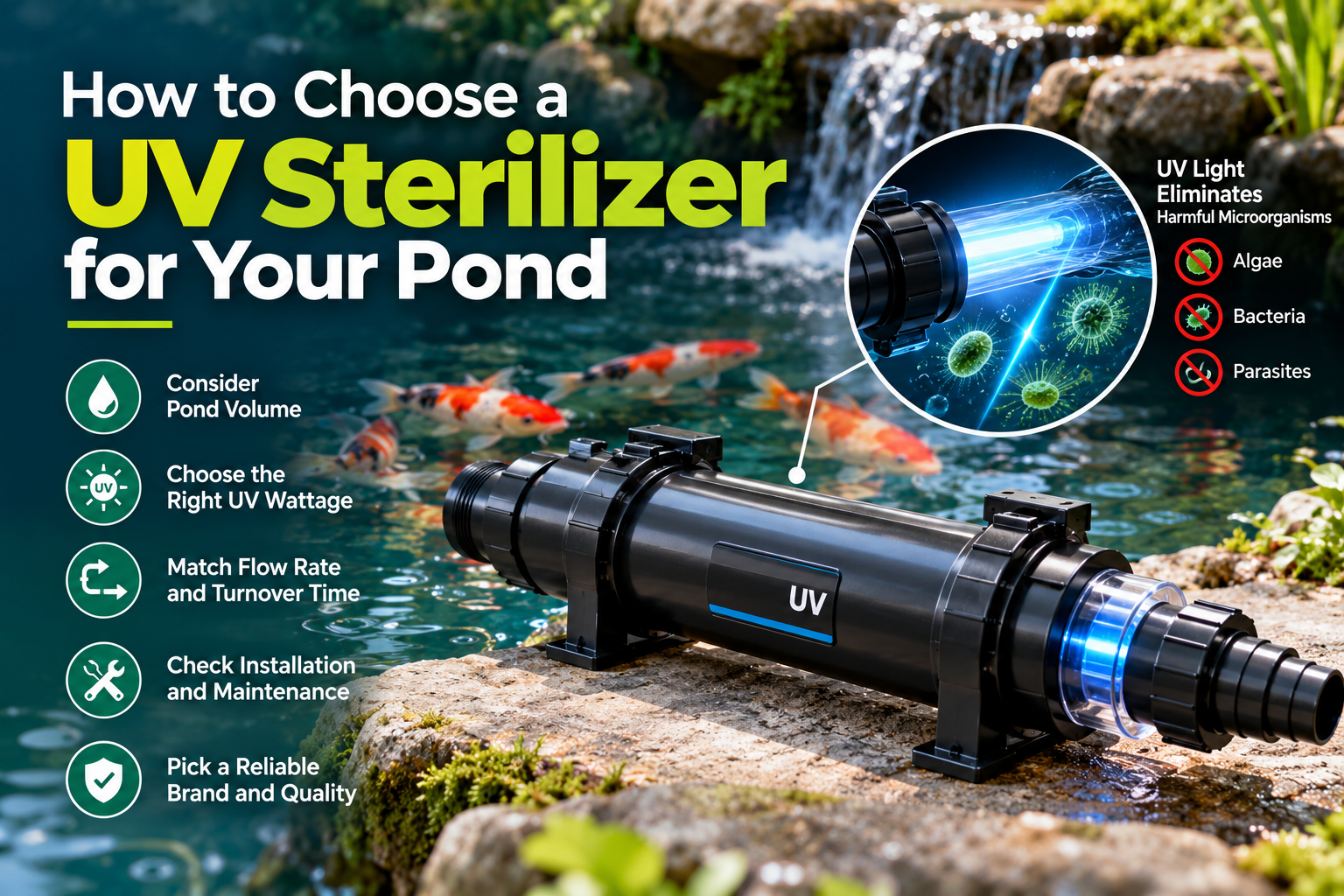
Maintaining clear and healthy pond water can be challenging, especially in outdoor ponds exposed to direct sunlight. Algae growth, suspended particles, and changing environmental conditions can affect water clarity and the overall appearance of your pond. A suitable pond UV sterilizer can help control suspended algae and improve water clarity when used with an appropriately designed pond filtration system.
Whether you have a small garden pond, a koi pond, or a large outdoor water feature, choosing the right UV sterilizer requires understanding your pond’s water volume, pump flow rate, UV unit capacity, and filtration requirements.
In this guide, we explain how pond UV sterilizers work, how to choose the right size, and what to consider before purchasing one.
What Is a Pond UV Sterilizer?
A pond UV sterilizer is a device that exposes flowing pond water to ultraviolet-C (UV-C) radiation. The radiation can damage the genetic material of microorganisms, preventing them from reproducing effectively when they receive an appropriate dose.
In garden ponds, UV equipment is commonly used to control suspended green-water algae. Depending on the unit’s design and operating conditions, UV treatment may also reduce certain microorganisms passing through the device.
However, a UV sterilizer does not remove all contaminants from pond water. It does not replace mechanical filtration, biological filtration, or regular pond maintenance.
For best results, use a suitable UV unit alongside a properly sized pond filter and pump.
How Does a Pond UV Sterilizer Work?
A typical pond UV sterilizer contains a UV-C lamp enclosed within a protective housing. Water flows through a chamber around the lamp, allowing the passing water to receive UV exposure.
The process generally involves these steps:
- Pond water is drawn into the circulation system by a pump.
- Water passes through appropriate filtration stages.
- The water enters the UV sterilizer chamber.
- UV-C radiation acts on susceptible microorganisms exposed to the light.
- Treated water returns to the pond.
UV treatment is most effective when the unit receives the correct flow rate and provides a suitable UV dose. Excessive flow can reduce exposure time, while dirty quartz sleeves, ageing lamps, and unsuitable installation conditions can reduce performance.
Important: UV sterilizers are particularly useful for controlling suspended algae that cause green water. They do not directly remove algae growing on pond walls, rocks, or other surfaces.
1. Calculate Your Pond’s Water Volume
The first step in choosing a pond UV sterilizer is calculating the total volume of water in your pond.
The required UV capacity depends partly on the amount of water being treated and the intended application.
How to Calculate Pond Water Volume
For a rectangular pond:
Water volume in litres = Length × Width × Average water depth × 1,000
Use metres for all three measurements.
Example:
Suppose your pond measures:
- Length: 4 metres
- Width: 3 metres
- Average water depth: 1 metre
Water volume = 4 × 3 × 1 × 1,000
Total water volume = 12,000 litres
This calculation provides an estimate of the pond’s capacity. If the pond has sloping sides, irregular dimensions, or varying depths, use an appropriate estimate of its actual water volume.
For circular ponds, the volume can be estimated using:
Water volume in litres = 3.1416 × Radius² × Average depth × 1,000
Here, radius and depth are measured in metres.
Knowing your pond’s water volume helps you compare UV sterilizers and filtration equipment more accurately.
2. Choose the Correct UV Sterilizer Capacity
UV sterilizers are available in different capacities and power ratings. The appropriate model depends on several factors, including pond volume, fish stocking, sunlight exposure, algae problems, and the manufacturer’s recommended flow rate.
A larger pond or a pond with heavy fish stocking may require a more capable treatment system than a lightly stocked ornamental pond.
Factors to Consider
Pond volume: Larger ponds generally require greater UV treatment capacity.
Fish stocking: Koi ponds often have a greater filtration demand because koi produce considerable waste.
Sunlight exposure: Ponds exposed to strong sunlight may experience more persistent suspended algae growth.
Water clarity: Cloudy water and suspended particles can interfere with UV treatment, making effective mechanical filtration important.
Desired result: A unit intended primarily for green-water control may have different sizing requirements from equipment designed and validated for a particular disinfection application.
Always follow the manufacturer’s recommendations for pond volume and flow rate rather than choosing a model based on wattage alone.
3. Understand UV Sterilizer Wattage
UV sterilizers are available in a range of wattages. Higher wattage can provide greater UV output, but wattage alone does not determine treatment effectiveness.
The performance of a UV unit also depends on:
- UV-C output from the lamp.
- Water flow rate through the chamber.
- Contact or exposure time.
- Chamber design.
- Lamp age and condition.
- Cleanliness of the quartz sleeve.
- Water quality and suspended particles.
For example, two UV units with the same electrical wattage may deliver different treatment performance because their designs and effective UV outputs differ.
When comparing products, check the recommended pond volume, maximum flow rate for the intended application, replacement lamp specifications, and manufacturer guidance.
4. Match the UV Sterilizer With Your Pond Pump
Choosing a suitable pump is essential because the pump determines how quickly water moves through the UV chamber.
If water flows too quickly, the exposure time may be insufficient for the intended treatment. If the flow is too low, the overall circulation system may not process enough water to provide the desired pond water clarity.
What Should You Check?
- Recommended operating flow rate.
- Maximum permitted flow through the UV unit.
- Pump performance at the actual installation head.
- Pipe diameter and plumbing restrictions.
- Flow requirements of the pond filter.
- The manufacturer’s installation instructions.
Remember that a pump’s advertised flow rate is usually measured under specified conditions. Actual flow may be lower because of pipe length, fittings, filter resistance, elevation, and other restrictions.
Choose a pump that provides an appropriate operating flow through the entire filtration system.
Should the UV Sterilizer Be Installed Before or After the Filter?
For many pond systems, placing the UV unit after mechanical filtration helps reduce the amount of suspended debris entering the UV chamber.
A common arrangement is:
Pond → Pump → Mechanical Filtration → UV Unit → Return to Pond
However, the correct order depends on the equipment design. Some integrated filter systems have a dedicated UV chamber, and the manufacturer’s recommended plumbing arrangement should always take priority.
Biological filtration should also be included in the overall system, particularly for ponds containing koi or other fish that produce significant waste.
5. Consider the Type of Pond You Have
Different pond types have different filtration requirements.
Garden Ponds
Garden ponds containing ornamental fish or aquatic plants may benefit from UV treatment when suspended algae repeatedly cause green water.
Choose a unit designed for the pond’s volume and circulation rate.
Koi Ponds
Koi ponds generally require a well-planned filtration system because of the fish’s waste production and feeding requirements.
A suitable UV sterilizer can help control suspended algae, but it cannot replace biological filtration or remove ammonia and nitrite.
Large Outdoor Ponds
Large ponds may need multiple treatment units or a dedicated filtration arrangement, depending on water volume, circulation, and the severity of algae problems.
Consider the practical maintenance requirements, plumbing layout, and replacement lamp availability before choosing equipment.
Ponds With Waterfalls or Fountains
Waterfalls and fountains improve circulation and may contribute to oxygenation. However, they do not automatically eliminate suspended algae.
A UV sterilizer can be integrated into a suitable pump and filtration arrangement to improve water clarity.
6. UV Clarifier vs UV Sterilizer: What’s the Difference?
The terms UV clarifier and UV sterilizer are often used interchangeably in pond equipment marketing, but they do not necessarily describe identical performance.
A UV clarifier is commonly designed to control suspended algae responsible for green pond water.
A UV sterilizer may be designed or marketed for a broader microbial-control application. However, the label alone does not establish its effectiveness against particular pathogens.
Actual performance depends on the UV dose delivered, water flow, organism susceptibility, equipment design, and operating conditions.
| Feature | UV Clarifier | UV Sterilizer |
|---|---|---|
| Common pond application | Controlling suspended green-water algae | Clarification or specified microbial-control applications, depending on design |
| Primary objective | Improve water clarity | Depends on the unit’s validated purpose |
| Flow requirements | Based on algae-control performance | May require a lower flow to achieve a specified UV dose |
| Mechanical filtration | Recommended | Recommended |
| Biological filtration | Still necessary for fish ponds | Still necessary for fish ponds |
| Product selection | Follow pond volume and flow recommendations | Follow application-specific UV dose and flow specifications |
Buying tip: Do not assume that a product labelled a UV sterilizer will eliminate every parasite, bacterial infection, or fish disease. Many pathogens require different control methods, and not all organisms passing through a pond UV unit will receive an effective dose.
7. Check the Quality of the UV Unit
The construction and serviceability of a UV sterilizer affect its long-term reliability.
Before purchasing, check the following features.
Quartz Sleeve Protection
The quartz sleeve separates the lamp from the flowing water while allowing UV radiation to pass through. It should be suitable for the unit and accessible for cleaning.
Replacement Lamp Availability
UV lamps gradually lose effective output with use. Check the recommended replacement interval and whether compatible replacement lamps are readily available.
Waterproofing and Electrical Safety
Choose equipment intended for the installation environment. Follow the manufacturer’s electrical safety instructions, use appropriate outdoor electrical protection, and keep connections protected from water.
Housing and Connection Quality
Inspect the housing, seals, pipe connections, and maintenance access. The equipment should suit the required flow and installation arrangement.
Maintenance Access
A UV unit that is difficult to open or clean may be harder to maintain properly. Consider how easily the quartz sleeve and lamp can be accessed.
8. How to Install a Pond UV Sterilizer
Correct installation is important for reliable performance.
Follow the manufacturer’s instructions for your specific unit. A typical installation involves these steps:
- Select the installation location: Choose a protected location that allows safe access for inspection and maintenance.
- Install the pond pump: Ensure the pump is suitable for the pond and filtration system.
- Connect the filtration equipment: Remove suspended debris through suitable mechanical filtration before water reaches the UV unit where the system design permits.
- Connect the UV sterilizer: Use compatible plumbing and follow the specified flow direction.
- Check for leaks: Inspect the pipework, housing, and connections before operation.
- Verify water flow: Confirm that the unit operates within its specified flow range.
- Check electrical safety: Ensure the unit is installed and operated according to its instructions.
Never operate or service a UV unit in a way that exposes your eyes or skin to direct UV-C radiation. Switch off and isolate the electrical supply before maintenance, and never bypass safety interlocks.
If you are unfamiliar with electrical installations around water, use a qualified professional.
9. How to Maintain a Pond UV Sterilizer
Regular maintenance helps keep the unit operating effectively.
Clean the Quartz Sleeve
Mineral deposits, biofilm, and dirt on the quartz sleeve can reduce UV transmission. Inspect and clean it according to the manufacturer’s instructions.
Replace the UV Lamp When Required
A lamp may continue to glow after its effective UV output has declined. Follow the manufacturer’s recommended replacement schedule rather than relying on visible light alone.
Inspect Seals and Connections
Check for leaks, damaged seals, and loose connections during maintenance.
Maintain the Pond Filter
A UV sterilizer does not remove all the particles or organic waste in pond water. Mechanical and biological filtration remain essential.
Monitor Water Clarity
Observe changes in water clarity after installation. If green water persists, investigate flow rate, lamp condition, unit sizing, and overall pond conditions rather than immediately assuming that a higher-wattage unit is necessary.
10. Common Mistakes to Avoid When Buying a UV Sterilizer
Avoid these common mistakes when selecting UV equipment.
Choosing by wattage alone: Wattage does not provide a complete measure of UV treatment performance.
Ignoring pump flow: Excessive flow can reduce the delivered UV dose.
Buying an undersized unit: A unit that is too small for the pond or intended application may not achieve the desired results.
Skipping mechanical filtration: Suspended debris can interfere with effective UV treatment and contribute to poor water clarity.
Ignoring biological filtration: UV treatment does not replace the biological processes needed to control ammonia and nitrite.
Neglecting lamp maintenance: An ageing lamp or dirty quartz sleeve can reduce performance.
Expecting UV treatment to solve every pond problem: Green water, string algae, poor water quality, and fish disease are different problems that may require different solutions.
Frequently Asked Questions About Pond UV Sterilizers
1. What Size UV Sterilizer Do I Need for My Pond?
The correct size depends on pond volume, sunlight exposure, fish stocking, the severity of green-water problems, and the manufacturer’s recommended flow rate. Calculate your pond volume and compare products using their stated application-specific specifications.
2. Does a Pond UV Sterilizer Remove Green Water?
A suitably selected and correctly operated UV clarifier can help control suspended algae responsible for green water. Mechanical filtration and proper pond maintenance are still necessary.
3. How Many Hours Should a Pond UV Sterilizer Run?
Many pond UV units are designed for continuous operation during the pond’s operating season. Follow the manufacturer’s instructions for your specific unit and pond setup.
4. Does a UV Sterilizer Kill Beneficial Filter Bacteria?
UV treatment primarily affects susceptible organisms that receive sufficient UV exposure inside the unit. It does not normally eliminate the beneficial bacteria established on biological filter media because those bacteria are not directly exposed to the UV light while attached to the media.
5. Can I Use a UV Sterilizer in a Koi Pond?
Yes. A suitably selected UV clarifier can help control suspended algae in a koi pond. However, koi also need adequate biological filtration, mechanical waste removal, oxygenation, and good water quality.
6. Why Is My Pond Still Green After Installing a UV Sterilizer?
Possible causes include insufficient UV capacity, excessive flow, an ageing lamp, a dirty quartz sleeve, inadequate circulation, or a high algae load. Check the equipment specifications and overall filtration system before making changes.
7. Does a UV Sterilizer Remove String Algae?
No. UV clarifiers primarily target susceptible organisms suspended in the water. String algae attached to rocks, pond walls, or other surfaces generally require separate management methods.
8. When Should I Replace a Pond UV Lamp?
Follow the replacement interval specified by the manufacturer. Effective UV output can decline before the lamp stops glowing, so visible light is not a reliable indicator of performance.
Conclusion
Choosing the right pond UV sterilizer involves more than selecting a unit with a high wattage. You need to consider pond volume, pump flow rate, sunlight exposure, fish stocking, filtration efficiency, and the equipment’s intended application.
A suitable UV unit can be an effective part of a pond filtration system, particularly for controlling suspended algae and improving water clarity. However, the best results come from combining UV treatment with mechanical filtration, biological filtration, adequate oxygenation, and regular maintenance.
Before purchasing, calculate your pond’s water volume, check the manufacturer’s recommended flow rate, and confirm that replacement lamps and maintenance components are available.
Looking for pond UV sterilizers, pond pumps, and filtration equipment? Explore GreenfinIndia.com to find suitable equipment for your pond and build a reliable water-management system.