


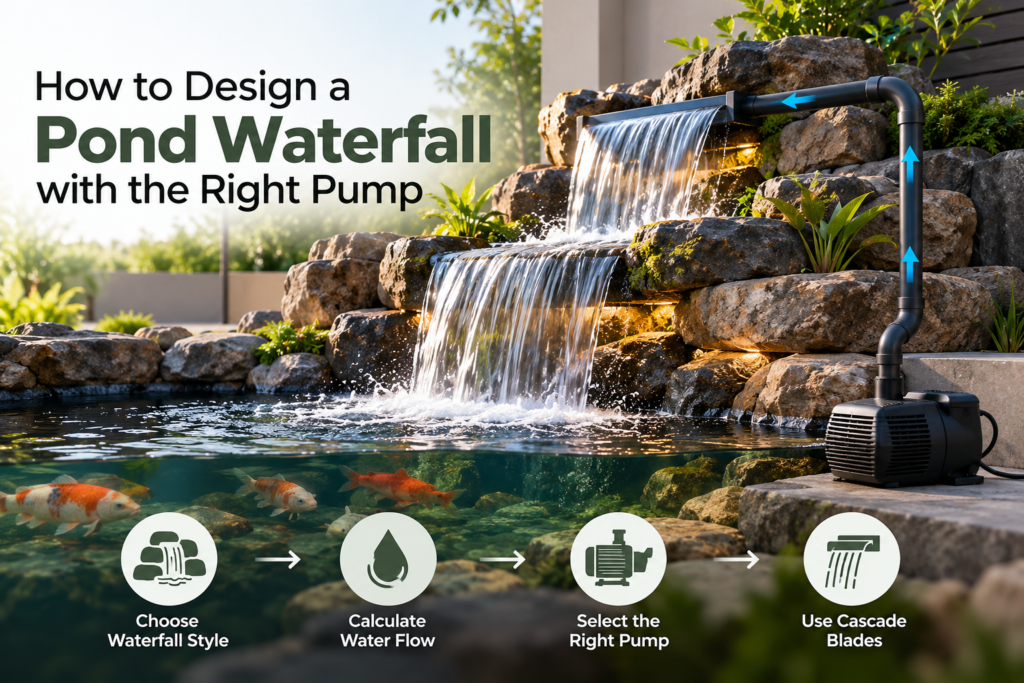
A well-designed pond waterfall adds movement, beauty, and soothing water sounds to any outdoor pond. Whether you are building a koi pond, a garden pond, or a modern water feature, choosing the right waterfall width, height, cascade blade, and pump is essential for achieving the desired water flow.
A properly planned pond waterfall design also helps maintain water circulation and supports a healthy pond environment when integrated with an appropriate filtration system.
In this guide, we explain how to design a pond waterfall, calculate the required water flow, choose the right pump, and avoid common installation mistakes.
1. Plan Your Pond Waterfall Design
Before selecting equipment, decide how you want your waterfall to look and function. The design determines the water flow required, the type of pump needed, and the plumbing arrangement.
Consider these important factors:
- Waterfall width: Determines how much water is needed to create a continuous water sheet.
- Waterfall height: Affects pump head requirements and the force of falling water.
- Waterfall style: A cascade blade creates a smooth sheet, while rocks create a more natural, irregular flow.
- Pond size: Determines how the waterfall should integrate with overall pond circulation.
- Pump location: Influences pipe length, friction losses, and maintenance access.
For koi ponds, plan the waterfall alongside the filtration system rather than treating it as a separate decorative feature. This helps create effective circulation without compromising the pond’s filtration requirements.
2. Choose the Right Waterfall Width
Waterfall width is one of the main factors affecting the required pump flow rate.
A narrow waterfall generally needs less water, while a wider waterfall requires more flow to maintain a consistent sheet across the entire spillway.
Common waterfall widths include:
- 12 inches: Suitable for compact garden ponds and small water features.
- 18–24 inches: Suitable for medium-sized ponds and decorative waterfalls.
- 36 inches or wider: Suitable for larger ponds and statement waterfall features.
These are general design examples, not strict size limits. The appropriate width depends on the cascade blade design, the desired water-sheet thickness, and the manufacturer’s recommended flow rate.
How to choose the width
For a small garden pond, a narrow cascade blade can create an elegant, controlled waterfall. For a larger koi pond, a wider blade may produce a more prominent visual effect and distribute water across a larger section.
Remember to consider the receiving area below the waterfall. The pond or collection basin should accommodate the falling water without excessive splashing or water loss.
3. Calculate the Required Waterfall Flow Rate
The required flow rate depends on the waterfall’s width, height, and desired appearance.
A useful starting point for a smooth sheet waterfall is approximately 100 US gallons per hour per inch of spillway width. Some cascade blades require more or less flow, so always check the manufacturer’s specifications.
For example, this guideline can be used for preliminary planning:
| Waterfall width | Approximate starting flow |
|---|---|
| 12 inches | 4,540 LPH |
| 18 inches | 6,810 LPH |
| 24 inches | 9,080 LPH |
| 36 inches | 13,630 LPH |
LPH means litres per hour. These figures are approximate starting points, not guaranteed operating requirements. Actual flow should be adjusted to suit the specific blade and desired water-sheet effect.
Example: 24-inch cascade blade
Suppose you plan to install a 24-inch-wide waterfall.
Using the preliminary guideline:
24 inches × 100 US gallons per hour = 2,400 GPH.
Converting gallons per hour into litres per hour gives approximately 9,080 LPH.
Therefore, you would initially look for a pump capable of delivering around 9,000 LPH at the actual operating head, not simply a pump advertised with a maximum flow of 9,000 LPH.
If you want a gentler sheet, the blade manufacturer may recommend a lower flow. For a fuller, more forceful waterfall, a higher flow may be necessary.
4. Understand Waterfall Height and Pump Head

Waterfall height is another essential consideration when choosing a pond pump.
Pump head describes the resistance the pump must overcome to move water. The vertical distance between the water level at the pump’s source and the waterfall outlet is called the static lift. Pipe friction, bends, valves, and fittings add further losses.
For example, if the water needs to travel from the pond to a cascade blade positioned 4 feet above the pond’s water level, the pump must overcome at least 4 feet of static lift, plus the losses caused by the plumbing.
A pump that delivers a high flow rate at zero head may deliver substantially less water when installed.
What to consider when measuring pump head
- Measure the vertical lift from the source water level to the waterfall outlet.
- Consider the length and diameter of the plumbing.
- Account for elbows, valves, and other fittings.
- Check the pump’s performance curve at the calculated total head.
- Confirm that the resulting flow meets the cascade blade’s requirements.
Selecting a pump using only its advertised maximum flow can result in a weak waterfall.
5. Choose the Right Cascade Blade
A cascade blade, also called a waterfall spillway, helps create a controlled sheet of water. It is particularly useful for modern ponds, raised walls, and architectural water features.
The right blade depends on the pond’s size, the installation surface, and the desired visual effect.
Types of waterfall spillways
Stainless steel cascade blades
These are suitable for modern pond walls and contemporary water features. They can create a clean, defined sheet of water when installed level and supplied with the correct flow.
Plastic waterfall spillways
These can be suitable for garden ponds and smaller installations. Their suitability depends on the model, construction quality, and installation conditions.
These use natural or artificial rocks to produce an irregular, natural-looking cascade. They require careful shaping and water-flow control to minimise splashing and leakage.
Cascade blade installation tips
- Install the blade level to help distribute water evenly.
- Follow the manufacturer’s recommendations for inlet plumbing and operating flow.
- Provide a stable mounting surface and secure connections.
- Waterproof the surrounding structure appropriately.
- Test the waterfall before completing the final cladding or finishing work.
An incorrectly levelled blade may produce uneven water flow, with more water spilling from one side than the other.
6. Select the Right Pond Waterfall Pump
The best pond waterfall pump is one that provides the required flow at the calculated total head while operating reliably under the intended conditions.
When comparing pumps, consider the following factors.
Flow rate
Choose a pump that can deliver the target flow at the actual operating head. If the pump will also supply filtration, confirm that the combined system can meet both requirements.
Pump head
Check the manufacturer’s pump curve to determine the flow available at your installation height and plumbing resistance.
Energy consumption
Compare the rated power consumption of suitable models. A pump that is efficient at your required operating point can help reduce running costs because waterfalls often operate for many hours each day.
Continuous operation
For a waterfall that runs throughout the day, select a model rated for the intended duty cycle and installation environment.
Installation and maintenance
Choose a pump that can be accessed for cleaning and servicing. Also check its inlet protection, recommended water conditions, and compatibility with the intended plumbing.
Flow adjustment
A controllable pump or suitable flow-control arrangement can help you fine-tune the waterfall. Avoid restricting flow in ways that conflict with the pump manufacturer’s instructions.
7. Integrate the Waterfall with Pond Filtration
For koi ponds, filtration planning is particularly important because fish produce waste that must be removed and processed.
A waterfall can contribute to water movement and surface agitation, but it should not automatically be considered a complete filtration system.
A suitable pond system may include:
- Mechanical filtration: Removes suspended debris and solid waste.
- Biological filtration: Supports beneficial bacteria that process ammonia and nitrite.
- Pond pump: Supplies water to the waterfall and, where designed appropriately, the filtration system.
- Aeration: Provides additional oxygen when required by the pond’s fish load and environmental conditions.
If one pump supplies both a filter and a waterfall, account for the flow required by each component and the resistance of the complete plumbing circuit. A shared system may require a larger pump or a different pipe layout.
For heavily stocked koi ponds, dedicated filtration and waterfall circuits may provide more control and make maintenance easier.
8. Calculate Pipe Size and Reduce Flow Loss
Even a correctly selected pump may underperform if the plumbing is too restrictive.
Narrow pipes, long pipe runs, sharp bends, clogged strainers, and restrictive fittings can reduce the flow reaching the waterfall.
To improve performance:
- Select pipe diameter according to the required flow and acceptable water velocity.
- Keep pipe runs as direct as practical.
- Minimise unnecessary elbows and restrictions.
- Install accessible valves where flow adjustment or maintenance is required.
- Check for blockages and air leaks during commissioning.
Use the pump manufacturer’s plumbing guidance or a suitable hydraulic calculation to determine the final pipe size. Do not select pipe diameter based only on the pump’s outlet connection.
9. Common Pond Waterfall Design Mistakes
Avoid these common mistakes when planning your installation.
Choosing a pump based only on maximum flow: The actual flow at operating head may be much lower.
Using an undersized pump: A wide blade may receive insufficient water, resulting in a thin or uneven sheet.
Ignoring waterfall height: Greater vertical lift increases the pump head requirement.
Installing the blade unevenly: This can cause uneven water distribution and splashing.
Using restrictive plumbing: Small pipes and excessive bends can reduce flow.
Ignoring water loss: Wind and splashing can carry water outside the pond, gradually lowering the water level.
Neglecting filtration: A decorative waterfall does not replace properly sized mechanical and biological filtration for koi ponds.
Failing to plan maintenance access: Pumps, valves, and connections should remain accessible after construction is completed.
10. Final Checklist Before Installing a Pond Waterfall
Before purchasing the pump and waterfall blade, confirm the following:
- Waterfall width and desired appearance are defined.
- Waterfall height has been measured.
- Required flow rate has been estimated using the blade manufacturer’s guidance.
- Pump flow has been checked at the expected total head.
- Pipe diameter and routing have been planned.
- The cascade blade is compatible with the intended installation.
- Filtration and aeration requirements have been considered.
- Waterproofing, drainage, and maintenance access are planned.
- The system can be tested before final finishing work.
Taking time to plan these details helps reduce installation problems and improves the appearance and reliability of the finished waterfall.
Conclusion
A successful pond waterfall design depends on matching the waterfall width, height, cascade blade, plumbing, and pump performance. Start by defining the appearance you want, calculate the approximate flow requirement, and select a pump based on its performance at the actual operating head.
For koi ponds, integrate the waterfall with appropriate filtration and aeration to maintain good water quality. With proper planning and installation, a waterfall can become an attractive and functional feature of your pond.
Planning a pond waterfall? Greenfin The Pond Studio offers pond pumps, cascade blades, filtration equipment, and pond construction solutions. Explore the available products at GreenfinIndia.com and choose equipment suited to your pond’s requirements.
Frequently Asked Questions
1. How much water flow is required for a pond waterfall?
The required flow depends on the waterfall width, height, and desired effect. A preliminary estimate for a smooth sheet waterfall is around 100 US gallons per hour per inch of spillway width, but the blade manufacturer’s specifications should determine the final requirement.
2. Which pump is best for a pond waterfall?
The best pump is one that delivers the required flow at the installation’s total operating head. Compare pump performance curves, power consumption, continuous-duty suitability, and maintenance requirements before choosing a model.
3. Does a higher waterfall require a bigger pump?
A higher waterfall generally requires a pump capable of overcoming greater static lift. The required pump also depends on the desired flow rate and plumbing losses.
4. What is the best width for a pond cascade blade?
The best width depends on the pond’s dimensions and the intended visual effect. Small garden ponds may suit narrow blades, while larger ponds can accommodate wider spillways when sufficient flow is available.
5. Can one pump run both a pond filter and a waterfall?
Yes, if the pump, plumbing, and filtration circuit are designed to deliver the required flow to both components. Account for flow distribution and the total hydraulic resistance of the system.
6. How can I prevent splashing and water loss from a waterfall?
Use a suitable flow rate, level the spillway, provide an adequate receiving area, and adjust the waterfall height and landing surface. Check the installation for leaks and monitor water levels during operation.
SEO Settings
SEO Title: Pond Waterfall Design: How to Choose the Right Pump
Meta Description: Learn pond waterfall design, including waterfall width, height, cascade blades, pump flow rate, and how to choose the right pond pump.
URL Handle: pond-waterfall-design-right-pump
Focus Keyword: pond waterfall design
Related Keywords:
- Best pond waterfall pump
- Pond pump flow rate calculation
- Cascade blade installation
- Pond waterfall design ideas
- Waterfall pump head calculation
- Pond waterfall construction
- Pond pump selection guide
Suggested Image Alt Text: Pond waterfall design with a cascade blade and pond pump installation.