

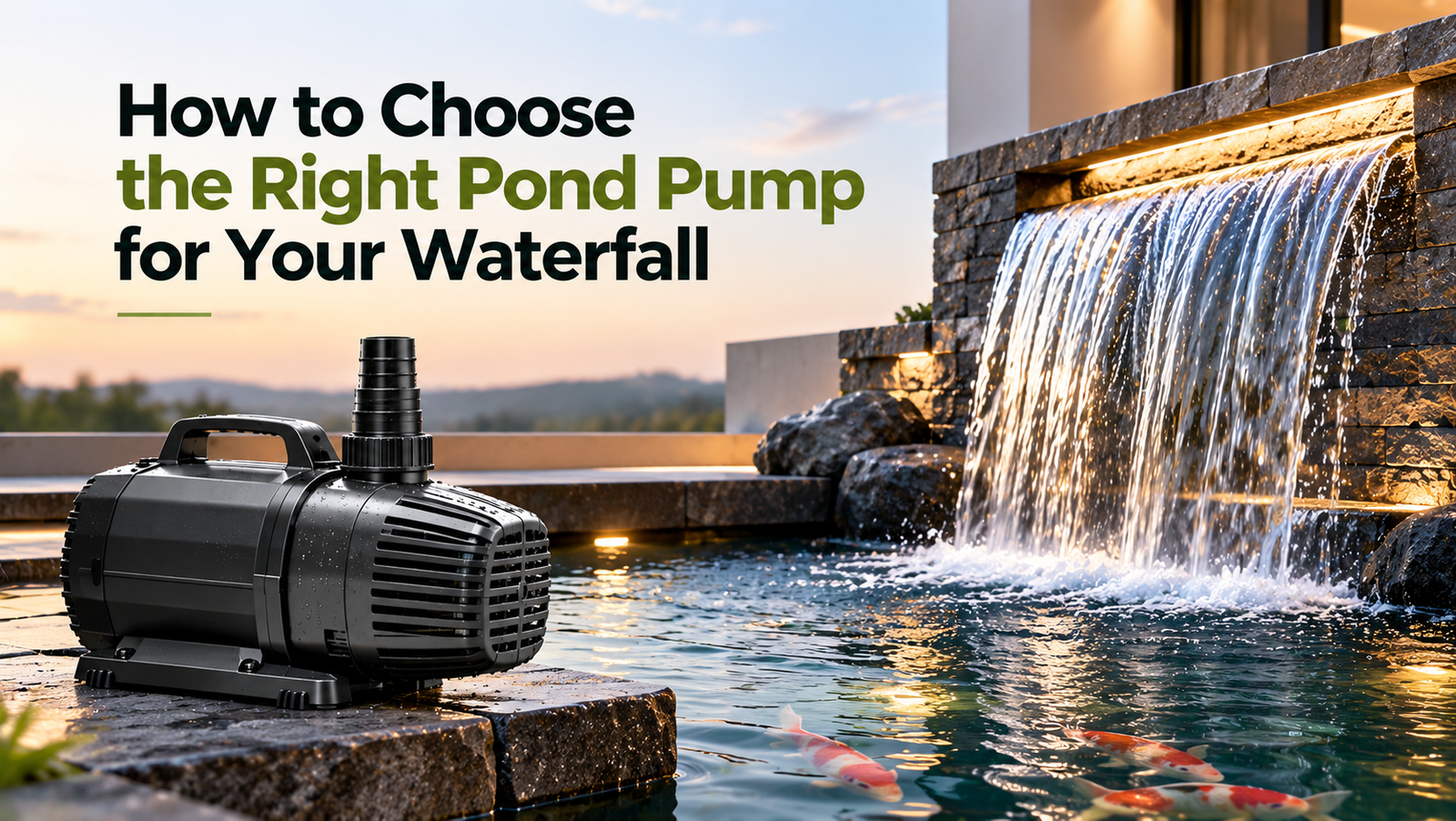
A beautiful waterfall can completely transform a garden pond, making it more attractive while also helping circulate and oxygenate the water. But the performance of a waterfall depends heavily on one important component: the pond pump.
Choosing the right pond pump is not simply about buying the pump with the highest litres-per-hour (LPH) rating. You need to consider the waterfall height, pipe size, pipe length, bends, filtration system, and the amount of water flow you want.
If the pump is too weak, the waterfall may look slow and uneven. If it is too powerful, it can cause excessive splashing, noise, and unnecessary energy consumption.
In this guide, we explain how to choose the right pond pump for your waterfall, including flow rate, head height, pipe sizing, and other important factors.
What Is a Pond Pump?
A pond pump is designed to move water from one part of a pond to another. In a waterfall setup, the pump usually draws water from the pond or filtration chamber and pushes it through a pipe to the top of the waterfall.
The water then flows back into the pond, creating continuous circulation.
A pond pump can also be used for:
- Waterfalls
- Fountains
- Pond filtration
- Stream features
- Water circulation
- Biological filtration systems
- Koi pond systems
For a waterfall installation, selecting a pump according to the actual requirements of your pond is essential.
Why Is Choosing the Right Pond Pump Important?
The pump determines how much water reaches the top of your waterfall and how quickly it returns to the pond.
A properly selected pump can provide:
- Consistent waterfall flow
- Better pond circulation
- Improved water movement
- Better oxygen exchange
- Efficient filtration
- Reduced energy waste
- Reliable long-term operation
An incorrectly sized pump can create several problems.
A pump that is too small may not deliver enough water to the waterfall. A pump that is too large may overwhelm the waterfall design and consume more electricity than necessary.
1. Determine Your Desired Waterfall Flow
The first step is deciding how you want your waterfall to look.
Do you want a gentle decorative flow or a strong, dramatic waterfall?
A narrow waterfall generally requires less water than a wide waterfall. For example, a small garden waterfall can work with a relatively modest flow rate, while a wide waterfall or large cascade requires considerably more water.
As a general planning approach, consider the width of the waterfall and the desired flow over its edge.
For a natural-looking waterfall, the flow should be distributed evenly across the entire width.
Waterfall Width Matters
A 30 cm wide waterfall and a 1 metre wide waterfall cannot normally use the same flow requirement.
The wider the waterfall, the greater the amount of water required to create an attractive sheet or cascade.
Therefore, before purchasing a pump, measure:
- Waterfall width
- Waterfall height
- Desired water flow
- Distance from pump to waterfall
These measurements will help you select a suitable pump.
2. Understand Pump Flow Rate
Pond pump capacity is commonly specified in litres per hour (LPH).
For example:
- 5,000 LPH
- 8,000 LPH
- 10,000 LPH
- 15,000 LPH
- 20,000 LPH
A pump rated at 10,000 LPH does not necessarily deliver 10,000 LPH at the top of your waterfall.
This is because pump performance decreases as the water has to be lifted higher and pushed through pipework.
This is why you should never select a waterfall pump based only on the advertised maximum LPH.
3. Check the Pump’s Head Height
One of the most important specifications when choosing a pond pump is maximum head height.
Head height refers to the vertical distance the pump can push water upward.
For example, imagine your pump is positioned at the bottom of the pond and the waterfall outlet is 1.5 metres above the pump.
The pump needs to be capable of delivering the required flow at approximately that height.
A pump may have a maximum flow of 15,000 LPH at zero head, but its actual flow could be significantly lower at 1.5 metres of head.
Therefore, always check the manufacturer’s flow-versus-head performance chart when available.
4. Consider Pipe Length
The distance between your pump and waterfall also affects performance.
Longer pipes create more resistance, meaning the pump has to work harder to move the same amount of water.
For example, a pump installation with:
- Short pipe
- Large-diameter pipe
- Few bends
will generally experience less resistance than one with:
- Long pipe
- Narrow pipe
- Multiple bends
When designing a waterfall system, keeping the pipe route as efficient as possible can help maintain better water flow.
5. Choose the Correct Pipe Size
Pipe diameter is another important factor.
Using a pipe that is too narrow can restrict water flow and increase resistance.
For larger pond pumps, a larger pipe is generally needed to allow the pump to move water efficiently.
The correct pipe size depends on:
- Pump capacity
- Pipe length
- Pump outlet size
- Number of bends
- Waterfall design
- Required flow rate
Avoid unnecessarily reducing the pipe diameter immediately after the pump outlet.
6. Account for Pipe Bends and Fittings
Every bend, elbow, valve, reducer, and fitting adds resistance to the system.
A waterfall system with several sharp bends may have noticeably lower flow than a system using a more direct pipe route.
When planning your pond:
Pump → Pipe → Waterfall
should ideally follow the shortest practical route.
Using smooth bends instead of unnecessary sharp elbows can also help reduce resistance.
7. Calculate Your Pond Volume
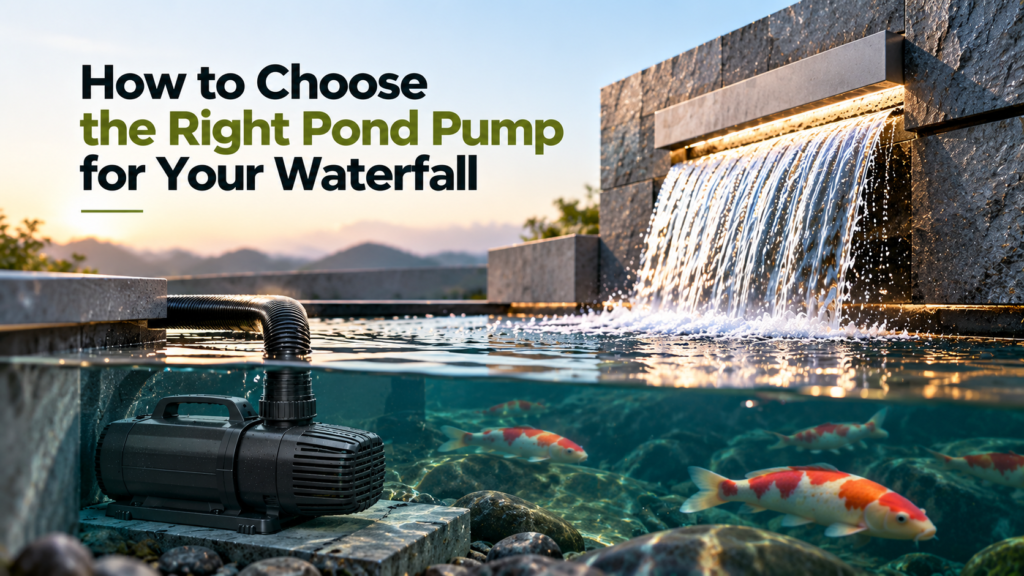
Knowing your pond’s approximate water volume is useful when selecting a circulation and filtration system.
To calculate a rectangular pond:
Length × Width × Average Depth = Pond Volume
For measurements in metres:
Length × Width × Depth × 1,000 = Litres
For example:
A pond measuring:
4 m × 2 m × 1 m
has an approximate volume of:
4 × 2 × 1 = 8 m³
or approximately:
8,000 litres
The actual operating volume may be lower depending on the pond shape, water level, shelves, rocks, and other features.
8. Match the Pump With Your Filtration System
If your waterfall pump also supplies your pond filter, the pump must satisfy both requirements.
A filtration system may require a specific flow rate to work correctly.
For example, your system could include:
Pond → Bottom Drain/Skimmer → Filter → Pump → Waterfall → Pond
In this type of setup, the pump should be selected according to the requirements of the entire system rather than the waterfall alone.
A professional pond design should consider filtration flow, waterfall flow, pipe resistance, and head height together.
9. Consider Energy Efficiency
A pond pump may operate for many hours every day, so electricity consumption is an important consideration.
A pump with unnecessarily high capacity may increase operating costs.
Instead of choosing the biggest pump available, select a pump that provides the required performance at your actual operating head.
When comparing pumps, consider:
- Flow rate
- Power consumption
- Maximum head
- Efficiency
- Operating hours
- Manufacturer specifications
For larger ponds, energy-efficient pumps can make a significant difference to long-term running costs.
10. Choose Between Submersible and External Pumps
Pond pumps are commonly available as submersible or external pumps.
Submersible Pond Pumps
These pumps are installed inside the pond or filtration chamber.
Advantages include:
- Simple installation
- Compact setup
- Suitable for many small and medium ponds
- Generally easy to install
They can be useful for decorative waterfalls, fountains, and smaller pond systems.
External Pond Pumps
External pumps are installed outside the pond or filtration chamber.
They can be suitable for:
- Large ponds
- High-flow waterfalls
- Koi ponds
- Large filtration systems
- Long pipe runs
The correct option depends on your pond design, available space, required flow, and filtration setup.
11. Think About Waterfall Design
Different waterfall designs require different pump capacities.
Gentle Waterfall
A gentle waterfall uses a relatively controlled flow and can be suitable for smaller garden ponds.
Natural Cascade
A multi-level cascade requires enough flow to maintain water movement between each level.
Wide Sheet Waterfall
A wide, continuous sheet of water generally requires a higher flow rate to maintain an even appearance across the entire width.
Large Koi Pond Waterfall
Large ponds may require a combination of high-flow pumps, filtration systems, bottom drains, skimmers, and properly sized pipework.
The waterfall should therefore be designed together with the pond’s complete circulation system.
12. Don’t Forget the Pump’s Continuous-Duty Rating
A pond pump is usually expected to run for extended periods.
Before purchasing, check that the pump is designed for continuous operation and suitable for pond applications.
Also consider:
- Electrical safety
- Proper cable protection
- Correct installation
- Pump maintenance
- Manufacturer instructions
For outdoor installations, electrical components should be installed safely and protected from water exposure.
13. Use a Pump With Adjustable Flow When Appropriate
Some waterfall systems benefit from adjustable flow.
An adjustable pump allows you to increase or decrease the water movement depending on your waterfall design.
This can be particularly useful when:
- The waterfall flow is stronger than required
- Seasonal water levels change
- You want different visual effects
- The pump also supplies filtration
- You want to reduce energy consumption when full flow isn’t necessary
14. Common Mistakes When Choosing a Pond Pump
Choosing Only by LPH
Maximum LPH doesn’t tell you the actual flow at your waterfall height.
Ignoring Head Height
A pump must be selected according to the vertical lift and system resistance.
Using Undersized Pipes
Small pipes can restrict the pump and reduce waterfall performance.
Installing Too Many Bends
Unnecessary elbows and fittings increase resistance.
Buying an Oversized Pump
An excessively powerful pump can increase electricity consumption and cause excessive splashing.
Ignoring Filtration Requirements
If the pump supplies your filter, its flow must also suit the filtration system.
15. Example: Selecting a Pump for a Waterfall
Imagine you have a garden pond with:
- Pond volume: approximately 10,000 litres
- Waterfall width: 60 cm
- Waterfall height: 1.5 metres
- Pipe run: 8 metres
- Several pipe bends
- Moderate waterfall flow desired
In this situation, simply purchasing a pump advertised as “10,000 LPH” may not be sufficient.
You need to determine the pump’s actual flow at approximately the required head height and account for pipe resistance.
The correct pump may therefore have a significantly higher maximum LPH rating than the actual flow you want at the waterfall.
This is why pump selection should be based on the operating point, not simply the maximum advertised flow.
How to Choose the Right Pond Pump: Quick Checklist
Before purchasing your pump, check these specifications:
- Pond volume
- Waterfall width
- Waterfall height
- Desired flow rate
- Pipe diameter
- Pipe length
- Number of bends
- Filter flow requirements
- Pump head height
- Power consumption
- Continuous-duty capability
- Submersible or external installation
Final Thoughts
Choosing the right pond pump for your waterfall requires more than looking at the maximum LPH rating.
The ideal pump should provide the required water flow at the actual waterfall height while working efficiently with your pipework and filtration system.
Consider the waterfall width, head height, pipe diameter, pipe length, fittings, pond volume, filtration requirements, and energy consumption before making your choice.
If you’re planning a new pond or upgrading an existing waterfall, selecting the pump and filtration system together can help create a more efficient and reliable pond setup.
Greenfin The Pond Studio provides pond pumps, filtration equipment, UV clarifiers, skimmers, and pond construction and filtration solutions for different pond requirements. Explore suitable pond equipment at greenfinindia.com.