

Koi fish are known for their beautiful colors, graceful swimming, and long lifespans. But keeping healthy koi is not only about choosing good-quality fish and food. Choosing the right pond size for koi fish is one of the most important decisions when planning a koi pond.
A pond that is too small can quickly become overcrowded, leading to poor water quality, insufficient oxygen, and increased maintenance. A properly planned pond gives koi enough space to grow while providing adequate water volume for stable water parameters.
Whether you are planning a small residential koi pond or a large outdoor pond, this guide explains how to choose the right pond dimensions based on pond depth, water volume, koi stocking, filtration, and future fish growth.
Why Pond Size Matters for Koi Fish
Koi can grow considerably larger than many beginner fishkeepers expect. Depending on genetics, nutrition, water quality, and environment, koi can eventually reach significant sizes.
As koi grow, they produce more waste. A pond that seems spacious when the fish are small can become overcrowded as they mature.
A properly sized pond provides:
- More swimming space
- Better water-quality stability
- Adequate oxygen availability
- More room for koi to grow
- Easier filtration management
- Better temperature stability
- Reduced stress and competition between fish
- Easier long-term maintenance
Therefore, pond planning should consider the adult size of the koi, not just their size when you purchase them.
What Is the Ideal Pond Size for Koi?
There is no single pond size that is perfect for every koi pond. The appropriate size depends on the number of fish, expected adult size, filtration capacity, available space, and pond design.
For a dedicated koi pond, it is generally better to prioritize water volume and depth rather than making the pond very shallow and wide.
For example, a pond measuring:
3 m × 2 m × 1.2 m
has a theoretical volume of:
3 × 2 × 1.2 = 7.2 m³
Since 1 cubic metre equals 1,000 litres, the theoretical volume is approximately:
7,200 litres
Actual operating volume will be lower if the pond has sloping sides, shelves, rocks, or other structures.
How Deep Should a Koi Pond Be?
Pond depth is an important part of koi pond construction.
A deeper pond provides greater water volume within a smaller footprint and can help reduce rapid temperature fluctuations. It also gives koi adequate vertical swimming space.
For many residential koi ponds, a depth around 1.2 to 1.5 metres can be a practical design range, although the appropriate depth depends on the site, climate, construction method, safety requirements, and pond purpose.
When planning the depth, consider:
- Adult koi size
- Local climate
- Pond location
- Water temperature
- Filtration design
- Bottom-drain positioning
- Ease of maintenance
- Structural requirements
Very shallow ponds can experience faster temperature changes and may provide less suitable swimming space for larger koi.
Is a Deeper Pond Always Better?
Not necessarily.
Increasing depth without properly planning filtration, circulation, construction, and maintenance does not automatically create a better koi pond.
The complete system should be designed together:
Pond volume + bottom drain + skimmer + filtration + pump + aeration + water return
A well-designed pond with appropriate circulation is more important than simply making the pond extremely deep.
How to Calculate Koi Pond Water Volume
Before choosing a pond filter or pump, calculate the approximate water volume.
For a simple rectangular pond:
Length × Width × Average Depth = Volume in cubic metres
Then:
Cubic metres × 1,000 = Approximate litres
Example
Suppose your pond is:
- Length: 4 metres
- Width: 3 metres
- Average depth: 1.2 metres
Calculation:
4 × 3 × 1.2 = 14.4 m³
Therefore:
14.4 × 1,000 = 14,400 litres
So the pond has approximately 14,400 litres of theoretical water volume.
For irregular-shaped ponds, calculate using average dimensions or divide the pond into smaller sections and calculate each section separately.
Knowing the approximate water volume is essential because it helps with:
- Filter selection
- Pump selection
- UV clarifier sizing
- Water-treatment calculations
- Water-change planning
- Aeration requirements
- Fish stocking decisions
How Many Koi Can You Keep in a Pond?
Fish stocking is one of the most important considerations when choosing pond size.
There is no universally applicable rule such as “one koi per X litres” that works for every pond. Stocking depends on several factors, including:
- Adult koi size
- Water volume
- Filtration capacity
- Mechanical filtration
- Biological filtration
- Aeration
- Water circulation
- Feeding levels
- Maintenance routine
- Water temperature
- Frequency of water changes
A pond containing a few large adult koi can have a very different filtration requirement from a pond containing many small juvenile koi.
Plan for Adult Fish, Not Small Fish
One of the most common mistakes is designing a pond based on the current size of the fish.
For example, a group of small koi may appear to have plenty of space when first introduced. However, their biomass and waste production can increase significantly as they mature.
When planning a new pond, ask:
“How many adult koi do I want to keep?”
rather than:
“How many small koi can I put into this pond today?”
This approach makes the pond more sustainable in the long term.
Consider Future Koi Growth
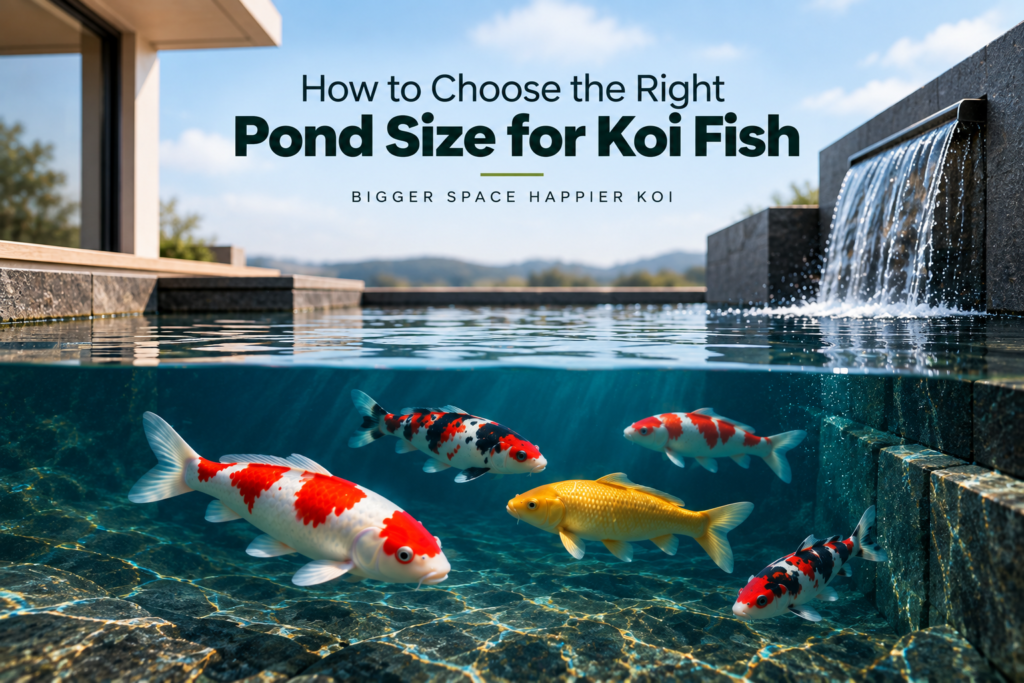
Koi are long-term pets, and a well-maintained koi can live for many years.
That means pond construction should account for future growth.
If you currently have 10 small koi, don’t design the pond only for their current size. Consider their potential adult size and the filtration required to support them.
Future-proofing your pond can include:
- Providing sufficient water volume
- Installing an appropriately sized filtration system
- Planning efficient bottom drainage
- Installing a suitable skimmer
- Providing adequate aeration
- Leaving room for additional filtration capacity
- Designing plumbing for effective circulation
Planning for future growth can prevent expensive pond modifications later.
Pond Shape Also Matters
Pond size is not determined by volume alone. Shape affects swimming space and water circulation.
For koi, a relatively open swimming area is often preferable to a pond filled with numerous narrow sections, sharp corners, or decorative structures.
A well-designed koi pond should allow water to circulate effectively toward the filtration system.
Common Pond Shapes
Rectangular ponds
Easy to calculate and construct. They can also provide efficient swimming space and straightforward plumbing.
Oval ponds
Can provide a smooth swimming environment and attractive appearance.
Freeform ponds
Can create a natural-looking landscape feature but require more careful planning for circulation, drainage, and filtration.
The best shape depends on the available space and the overall pond design.
Why Bottom Drains Are Important
When building a new koi pond, bottom-drain planning should be considered during the construction stage.
A bottom drain helps move settled waste and debris toward the filtration system instead of allowing organic waste to accumulate on the pond floor.
This can make filtration and maintenance more efficient.
The number and positioning of bottom drains should be based on the pond’s size, shape, depth, and filtration design.
It is better to plan the drainage system before construction begins rather than trying to add it after the pond is completed.
Don’t Forget the Skimmer
Leaves, dust, insects, and floating debris can enter an outdoor koi pond.
A pond skimmer helps remove floating debris before it sinks and becomes part of the waste load.
For outdoor koi ponds, a properly positioned skimmer can work together with bottom drains and filtration to improve overall water management.
The skimmer location should be planned according to prevailing wind direction, pond shape, and water circulation.
Filtration Must Match Pond Size and Fish Load
A large pond does not automatically have good water quality.
The filtration system must be designed according to:
Pond volume + fish biomass + feeding level + circulation + maintenance requirements
A koi pond filtration system commonly includes:
Mechanical Filtration
Mechanical filtration removes suspended particles and solid waste from the water.
Examples include:
- Filter brushes
- Filter mats
- Sieve filters
- Drum filters
- Other mechanical filtration systems
Biological Filtration
Biological filtration provides surface area for beneficial microorganisms that help process fish waste.
Common biological media include:
- Moving-bed media
- Japanese-style filter mats
- Ceramic media
- Bio balls
- Other biological filter media
The appropriate combination depends on the pond size and overall system design.
Pond Pump Selection
Once you know the pond volume, the next step is choosing an appropriate pump.
The pump should not be selected based only on its maximum litres-per-hour rating.
You also need to consider:
- Required circulation rate
- Head height
- Pipe length
- Pipe diameter
- Number of bends
- Filter resistance
- Waterfall requirements
- Fountain requirements
A pump rated at a particular flow rate may deliver considerably less actual flow once it is connected to plumbing and required to lift water.
Therefore, pump selection should be based on the actual operating conditions of the pond.
Aeration Is Important for Koi Ponds
Koi require adequate dissolved oxygen, particularly in heavily stocked ponds and during warm weather.
An aeration system can help increase gas exchange and improve oxygen availability.
Aeration may include:
- Air pump
- Air stones
- Air discs
- Air diffusers
- Bottom aeration systems
Aeration should be considered alongside circulation and filtration rather than as a completely separate component.
Small Koi Pond vs Large Koi Pond
Small Koi Pond
A smaller pond can be suitable when:
- The number of koi is limited
- Fish stocking is carefully controlled
- Filtration is properly designed
- Maintenance is performed regularly
- Future fish growth is considered
However, smaller water volumes can change more quickly when stocking or environmental conditions change.
Large Koi Pond
A larger pond provides greater water volume and swimming space.
It may also provide greater stability, but it requires more planning for:
- Construction
- Waterproofing
- Plumbing
- Filtration
- Pumping
- Aeration
- Electrical systems
- Maintenance
A large pond should therefore be designed as a complete system rather than simply excavating a larger hole.
Common Koi Pond Size Mistakes
1. Designing for Small Koi
Small koi grow. Always consider their expected adult size.
2. Overstocking
Adding too many fish can increase waste production and place additional demands on filtration.
3. Choosing the Filter After Construction
Filtration should be planned during the pond design stage.
4. Ignoring Plumbing
Poorly designed plumbing can reduce circulation and filtration performance.
5. Making the Pond Too Shallow
Very shallow ponds may provide less water volume and can experience faster temperature changes.
6. Not Planning for Maintenance
Every pond needs cleaning, water changes, filter maintenance, and equipment servicing.
Design access to filters and equipment so maintenance is practical.
7. Adding Fish Without Considering Future Capacity
Before purchasing additional koi, consider the pond’s total water volume, filtration capacity, aeration, and existing fish biomass.
A Simple Pond Planning Checklist
Before starting your koi pond construction, determine:
☐ Pond length
☐ Pond width
☐ Average depth
☐ Approximate water volume
☐ Number of koi
☐ Expected adult koi size
☐ Bottom-drain requirements
☐ Skimmer requirements
☐ Mechanical filtration
☐ Biological filtration
☐ Pump flow and head
☐ UV clarification requirements
☐ Aeration
☐ Plumbing layout
☐ Electrical requirements
☐ Waterproofing system
☐ Maintenance access
☐ Future expansion requirements
Final Thoughts
Choosing the right pond size for koi fish is about much more than calculating length × width × depth.
A successful koi pond is a complete ecosystem where pond volume, fish stocking, filtration, circulation, aeration, drainage, and maintenance work together.
The best approach is to plan your pond around the future adult size and number of koi, rather than designing it around the size of the fish when you first purchase them.
If you are planning a new koi pond, determine the required water volume first and then design the filtration, pump, drainage, and aeration system around that requirement.
For a professionally designed pond, the pond size and filtration system should be evaluated together based on the site, fish load, water volume, and intended design.
Frequently Asked Questions
How deep should a koi pond be?
For many residential koi ponds, around 1.2–1.5 metres can be a practical design range, but the ideal depth depends on the pond design, local conditions, construction method, and filtration system.
How do I calculate koi pond water volume?
Multiply the pond’s length × width × average depth in metres. Multiply the resulting cubic-metre value by 1,000 to estimate litres.
Can I keep many koi in a small pond?
High stocking levels can place greater demands on filtration, aeration, and maintenance. Stocking should be based on adult fish size, water volume, filtration capacity, and overall system performance.
Should I design my pond for small or adult koi?
Design for the expected adult size of the koi. This helps prevent overcrowding as the fish grow.
Does a bigger pond require a bigger filter?
Generally, increasing pond volume and fish load increases filtration requirements, but the appropriate filtration system depends on the complete setup rather than pond volume alone.
Do koi ponds need a bottom drain?
A properly designed bottom-drain system can help transport settled waste toward filtration and can make maintenance and water circulation more efficient.
Do koi ponds need aeration?
Adequate oxygen is important for koi. Aeration is especially valuable in stocked ponds and should be considered as part of the overall pond circulation and filtration design.
What should I plan before constructing a koi pond?
Plan the pond dimensions, water volume, fish load, depth, bottom drains, skimmer, filtration, pump, aeration, plumbing, waterproofing, electrical system, and future maintenance requirements before construction begins.