

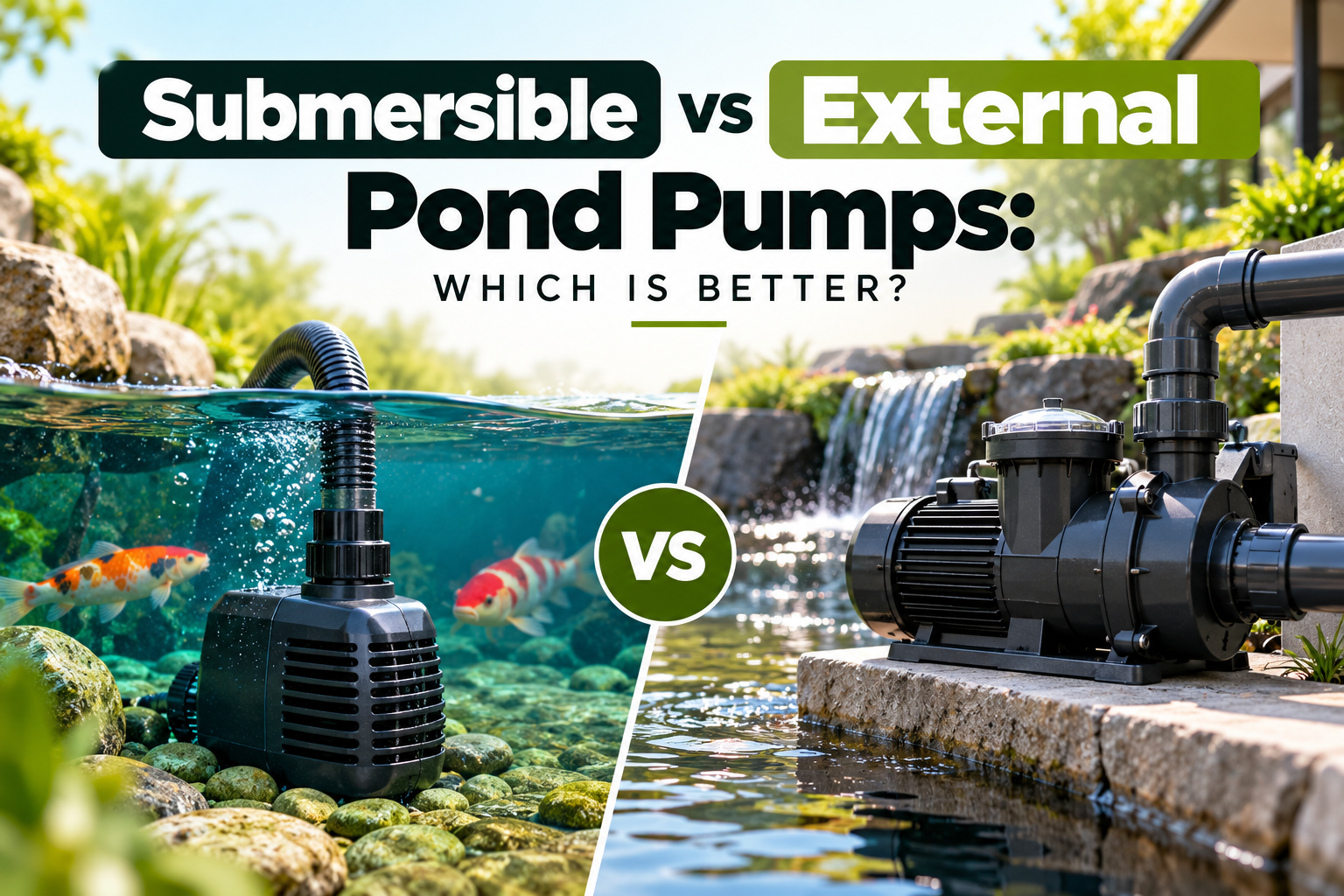
Choosing the right pond pump is essential for maintaining healthy fish, clear water, and efficient pond filtration. Whether you have a small garden pond, a large koi pond, or a decorative pond with a waterfall, the right pump helps circulate water and supports the performance of your filtration system.
Two popular options are submersible pond pumps and external pond pumps. Both are designed to move water, but they differ in installation, maintenance, energy consumption, and suitability for different pond applications.
Understanding the differences between these pumps will help you select the best option for your pond.
In this guide, we compare submersible vs external pond pump systems, explain their advantages and disadvantages, and help you determine which type is right for your pond.
What Is a Submersible Pond Pump?
A submersible pond pump is designed to operate underwater. It is placed inside the pond or a suitable submerged pump chamber, where it draws water and pumps it through a filter, waterfall, fountain, or other water feature.
Most submersible pond pumps have a sealed motor housing designed for underwater operation. Depending on the model, they may be suitable for garden ponds, koi ponds, fountains, and other water circulation applications.
Advantages of Submersible Pond Pumps
1. Easy Installation
Submersible pumps are generally straightforward to install. You place the pump underwater, connect the required pipes or hoses, and follow the manufacturer’s instructions.
They are often a convenient choice for homeowners who want a simple pond circulation system.
2. Space-Saving Design
Because the pump operates underwater, it does not usually require a separate external pump installation area. This can be useful in small gardens and compact pond installations.
3. Generally Quieter Operation
Water surrounding the pump can help reduce the sound of motor operation. However, noise levels depend on the pump design, vibration, and installation conditions.
4. Suitable for Many Small and Medium Ponds
Submersible pumps are available in different flow rates and capacities. Many models are suitable for small garden ponds, fountains, and selected fish pond filtration systems.
5. Convenient for Decorative Water Features
Many submersible pumps can supply water to fountains, waterfalls, and decorative features, provided the pump has sufficient flow at the required operating head.
Disadvantages of Submersible Pond Pumps
Despite their convenience, submersible pumps have some limitations.
- Accessing the pump for maintenance may require removing it from the water.
- Debris can accumulate around the intake if the pump is not adequately protected.
- Some models may be less convenient to service than externally installed pumps.
- Pump performance can decrease if the intake becomes blocked.
- Certain applications may require a larger or more specialised pump than a standard submersible model.
For koi ponds with significant waste production, appropriate pre-filtration and pump placement are important to prevent blockages and maintain reliable operation.
What Is an External Pond Pump?
An external pond pump is installed outside the pond water. Depending on its design, it may draw water from the pond through a suitable intake arrangement or receive water from a gravity-fed filtration system.
The pump then moves the water through filters, UV clarifiers, waterfalls, or other equipment.
External pumps are commonly used in larger ponds and installations where the pump needs to remain accessible for inspection and maintenance.
However, not every external pump is self-priming. Some models require flooded suction or a specific priming procedure, so the manufacturer’s installation requirements must be followed.
Advantages of External Pond Pumps
1. Easier Maintenance Access
Because the pump is outside the pond, it is generally easier to inspect connections, access the motor, and carry out routine servicing without removing the entire pump from the water.
2. Suitable for Larger Pond Systems
External pumps are available for a wide range of flow rates and operating conditions. Certain models are particularly suitable for larger koi ponds, filtration installations, and water circulation systems.
3. Convenient Integration with Filtration Equipment
External pumps can be integrated into appropriately designed filtration layouts, including systems with separate mechanical and biological filtration stages.
The correct arrangement depends on whether the system uses gravity-fed filtration, pump-fed filtration, or another configuration.
4. Flexible Installation
An external pump can be positioned in a dedicated pump chamber or equipment area, provided the location satisfies the manufacturer’s requirements for ventilation, weather protection, suction conditions, and maintenance access.
5. Potentially Efficient for Continuous Operation
Some external pumps are designed for efficient continuous operation. However, energy efficiency depends on the specific model, motor technology, hydraulic design, and actual operating point.
An external pump is not automatically more energy-efficient than a submersible pump.
Disadvantages of External Pond Pumps
External pumps also have limitations that should be considered before purchasing.
- Installation may require more plumbing and planning.
- Some models need priming before operation.
- Poor suction-line design can cause air leaks or insufficient water supply.
- Pumps may produce more noticeable operating noise.
- Outdoor installations may need protection from rain, flooding, and direct weather exposure.
- The installation may require additional space and more complicated plumbing.
External pumps must be installed according to the manufacturer’s instructions, with suitable electrical protection and safe access for servicing.
Submersible vs External Pond Pump: Key Differences
The following comparison highlights the main differences between the two pump types.
| Feature | Submersible Pond Pump | External Pond Pump |
|---|---|---|
| Installation | Installed underwater | Installed outside the pond |
| Space requirements | Usually requires less external space | Requires a suitable external installation area |
| Installation complexity | Generally simpler | May require more plumbing and planning |
| Maintenance access | May need to be removed from the water | Usually easier to access |
| Operating noise | Often quieter due to underwater placement | May be more noticeable |
| Large pond applications | Suitable when capacity and design match the pond | Often useful for larger engineered systems |
| Waterfall applications | Suitable if flow and head requirements are met | Suitable if flow and head requirements are met |
| Priming | Usually operates submerged according to its design | Depends on the pump model and suction arrangement |
| Energy consumption | Depends on the model and operating conditions | Depends on the model and operating conditions |
| Best installation location | Inside the pond or a suitable submerged chamber | Dedicated external pump area or equipment chamber |
Important: Neither pump type is automatically better in every category. The correct choice depends on the specific model, pond design, hydraulic requirements, and maintenance preferences.
Which Pond Pump Is Better for a Koi Pond?
Koi ponds require reliable water circulation and effective filtration because koi produce significant waste, particularly when they grow large or are fed heavily.
Both submersible and external pumps can be suitable for koi ponds, provided the pump is correctly sized and compatible with the filtration system.
When to Choose a Submersible Pump for a Koi Pond
A submersible pump may be suitable when:
- The pond is small or medium-sized.
- Installation simplicity is a priority.
- The pond layout does not require a dedicated external pump room.
- The selected model provides the required flow at the operating head.
- The pump can be accessed and maintained conveniently.
For a koi pond, check whether the pump is designed to handle the type and amount of debris it may encounter. A pump intended for clean water may require appropriate pre-filtration.
When to Choose an External Pump for a Koi Pond
An external pump may be preferable when:
- The pond has a dedicated filtration chamber.
- The installation requires convenient pump access.
- The filtration system is relatively large or complex.
- The selected model offers the required flow and head performance.
- The plumbing arrangement supports the pump’s suction requirements.
For larger koi ponds, external pumps can be part of a carefully planned system incorporating mechanical filtration, biological filtration, and suitable waste removal.
Our recommendation: Choose the pump that meets the pond’s hydraulic and filtration requirements rather than selecting it based only on whether it is submersible or external.
Which Pond Pump Is Better for Waterfalls?
Waterfalls require sufficient water flow to produce the desired visual effect.
Both submersible and external pumps can power waterfalls. The right option depends on the waterfall’s width, height, pipework, and desired flow.
Submersible Pumps for Waterfalls
Submersible pumps are convenient for many small and medium waterfalls.
They are generally easy to install and can be connected to a suitable hose or pipe leading to the waterfall.
Before choosing a pump, consider the vertical distance between the pump and the waterfall outlet. The pump must deliver adequate flow at that head.
External Pumps for Waterfalls
External pumps can be suitable for larger waterfalls and installations requiring higher flow rates.
They may be convenient where the pump is connected to a dedicated filtration system or installed in an accessible equipment chamber.
However, the actual suitability depends on the pump’s performance curve, pipe diameter, and total hydraulic resistance.
How to Choose the Correct Flow Rate
Check the manufacturer’s flow-rate information at the expected operating head.
For example, a pump advertised with a maximum flow of 10,000 litres per hour may deliver substantially less flow when lifting water through a tall waterfall and long pipework.
Do not select a pump using its maximum advertised flow alone.
How to Choose the Right Pond Pump Size
Selecting the correct pump size is important for both submersible and external pumps.
Step 1: Calculate the Pond Water Volume
For a rectangular pond, use the following formula:
Water Volume (litres) = Length (m) × Width (m) × Average Water Depth (m) × 1,000
For example, a pond measuring 4 metres long, 3 metres wide, and 1 metre deep contains approximately:
4 × 3 × 1 × 1,000 = 12,000 litres.
This gives you the estimated water volume needed to begin selecting suitable equipment.
Step 2: Determine the Required Water Flow
The required flow depends on fish stocking, filtration design, and the intended use of the pump.
A pump supplying a koi pond filter may need a different operating flow from a pump supplying a decorative waterfall.
Use the filtration manufacturer’s recommended flow range when selecting the pump.
Step 3: Calculate the Total Head
Total head includes the vertical lift and the effects of friction and other hydraulic losses in the plumbing system.
Consider:
- Vertical lift.
- Pipe length and diameter.
- Pipe bends and fittings.
- Filter resistance.
- Valves and other equipment.
Select a pump that can deliver the required flow at the calculated operating head.
Step 4: Check Power Consumption
If the pump will run continuously, its electricity consumption is an important consideration.
A simple estimate is:
Daily Energy Consumption (kWh) = Pump Power (W) × Operating Hours ÷ 1,000
For example, a 100-watt pump operating for 24 hours consumes:
100 × 24 ÷ 1,000 = 2.4 kWh per day.
Actual electricity costs depend on the pump’s real power consumption and your electricity tariff.
When comparing pumps, consider the flow they deliver at the required head in relation to their power consumption. This gives a more useful comparison than wattage alone.
Maintenance: Submersible vs External Pond Pumps
Regular maintenance helps keep a pond pump operating reliably.
Submersible Pump Maintenance
Follow these practices:
- Inspect the intake for leaves and debris.
- Clean the intake screen according to the manufacturer’s instructions.
- Check the impeller for obstructions.
- Inspect electrical cables and connections for damage.
- Ensure the pump remains submerged if its design requires underwater operation.
- Remove and service the pump when necessary, following the manufacturer’s instructions.
Never handle a submerged pump while it is connected to electrical power.
External Pump Maintenance
Follow these practices:
- Inspect suction and discharge connections for leaks.
- Check the suction line for blockages and air ingress.
- Clean the strainer or pre-filter where fitted.
- Check the impeller and seals according to the maintenance schedule.
- Ensure the pump receives the correct water supply.
- Protect the installation against flooding and weather exposure where required.
Never run an external pump dry unless the manufacturer explicitly states that the model can safely do so.
Common Mistakes to Avoid When Buying a Pond Pump
Choosing the wrong pump can affect filtration performance and increase maintenance costs.
Avoid these common mistakes:
1. Choosing a pump based only on wattage
Higher wattage does not necessarily mean better flow or greater efficiency.
2. Ignoring head height
The actual flow rate decreases as operating head and hydraulic resistance increase.
3. Selecting a pump without checking filter requirements
A filter may have a specified minimum and maximum operating flow. The pump must be compatible with these requirements.
4. Ignoring maintenance access
Consider how easily you can reach the pump for cleaning and servicing.
5. Using an unsuitable pump for the water conditions
Check whether the pump is designed for clean water, pond water containing debris, or another specific application.
6. Neglecting electrical safety
Use appropriate electrical protection, installation practices, and weather-resistant equipment suitable for the location.
7. Focusing only on the initial purchase price
Compare power consumption, servicing requirements, expected operating conditions, and suitability for your pond before making a decision.
Frequently Asked Questions
1. Is a submersible pond pump better than an external pump?
A submersible pump is often convenient for smaller ponds and simpler installations. An external pump may be more suitable for larger or more complex systems where maintenance access and dedicated plumbing are important. The best choice depends on the pond and the specific pump model.
2. Are external pond pumps more energy-efficient?
Not necessarily. Energy efficiency depends on the motor, pump design, and operating point. Compare the power consumption of each pump while delivering the required flow at the same operating head.
3. Can I use a submersible pump for a koi pond?
Yes. A suitably rated submersible pump can be used for a koi pond if it meets the required flow, head, and water-handling specifications and is compatible with the filtration system.
4. Can an external pond pump run continuously?
Many external pond pumps are designed for continuous operation, but this depends on the model. Follow the manufacturer’s instructions for operating conditions, cooling, priming, and maintenance.
5. Which pump is best for a pond waterfall?
Both types can work well. Choose a pump that delivers the required flow at the waterfall’s operating head, accounting for pipe friction and filter resistance.
6. How long do pond pumps last?
Pump lifespan varies according to build quality, operating conditions, water quality, maintenance, and usage. Regular inspection and correct installation help support reliable operation.
7. Can I connect a pond pump directly to a filter?
Yes, if the pump and filter are compatible and the plumbing arrangement follows the manufacturer’s recommendations. Check the permitted flow range and ensure the filter receives water in the intended direction.
Conclusion: Which Pond Pump Should You Choose?
Both submersible and external pond pumps have important roles in pond circulation and filtration.
Choose a submersible pond pump if you want a convenient installation, have limited external space, or need a suitable pump for a smaller pond or decorative water feature.
Choose an external pond pump if your pond has a dedicated equipment area, requires convenient pump access, or uses a larger and more complex filtration arrangement.
Before making your decision, calculate your pond volume, identify the required flow rate, account for total head, and check the pump’s compatibility with your filtration system.
The right pump can improve water circulation, support filtration performance, and help maintain a healthier environment for your pond fish.
Looking for the right pond pump for your installation? Explore pond pumps at GreenfinIndia.com or contact Greenfin The Pond Studio for guidance on choosing suitable equipment for your pond size, waterfall, and filtration requirements.