

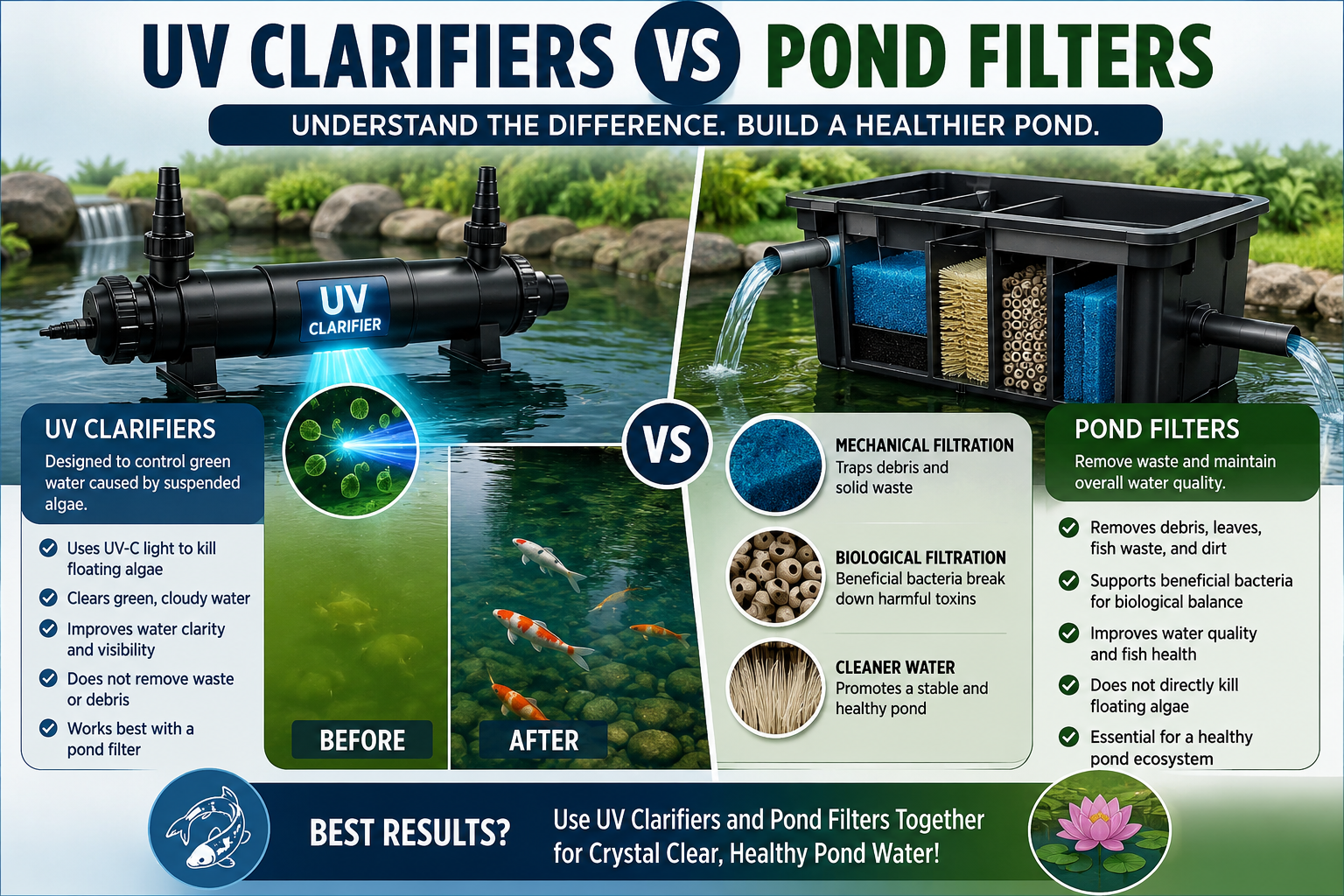
Maintaining crystal-clear pond water is one of the most important aspects of successful pond management. Whether you own a small garden pond, a decorative water feature, or a large koi pond, choosing the right equipment is essential for maintaining water quality and supporting aquatic life. Among the most commonly discussed pond filtration solutions are UV clarifiers and pond filters. Understanding the differences between UV Clarifiers vs Pond Filters can help pond owners make informed decisions and create a healthier aquatic environment.
Many people assume that a UV clarifier can replace a pond filter or that a pond filter alone can solve all water quality problems. However, when comparing UV Clarifiers vs Pond Filters, it becomes clear that each system performs a unique role. Pond filters are designed to remove debris, process fish waste, and support beneficial bacteria, while UV clarifiers specialize in controlling green water caused by suspended algae.
The debate surrounding UV Clarifiers vs Pond Filters often arises when pond owners experience cloudy water, algae blooms, or recurring maintenance issues. While both systems contribute to cleaner water, they address different challenges within the pond ecosystem. Understanding how UV Clarifiers vs Pond Filters work individually and together is the key to achieving clear water, healthy fish, and long-term pond stability.
In this guide, we’ll explore UV Clarifiers vs Pond Filters, compare their functions, advantages, and limitations, and help you determine the ideal filtration setup for your pond. Whether you’re maintaining a koi pond, fish pond, or ornamental water garden, understanding UV Clarifiers vs Pond Filters will help you make the best choice for optimal pond health and water clarity.
What Is a Pond Filter
A pond filter is the primary system responsible for removing waste and maintaining overall water quality. It continuously processes pond water, helping create a healthy environment for fish and aquatic plants.
Purpose of Pond Filtration
The main purpose of a pond filter is to remove debris, process fish waste, and support beneficial bacteria that keep water parameters stable.
Without proper filtration, ponds can quickly become cloudy, polluted, and unsafe for fish.
How Mechanical Filtration Works
Mechanical filtration removes physical debris from the water.
Common materials used include:
- Filter foam
- Brushes
- Filter mats
- Sponge media
Mechanical filtration captures:
- Fish waste
- Leaves
- Uneaten fish food
- Dirt and sediment
This prevents organic matter from decomposing inside the pond.
How Biological Filtration Works
Biological filtration is often considered the most important part of a pond filter.
Beneficial bacteria colonize biological media and convert harmful compounds into safer substances.
Benefits include:
- Reduced ammonia levels
- Lower nitrite concentrations
- Improved fish health
- Stable water quality
Key Benefits of Pond Filters
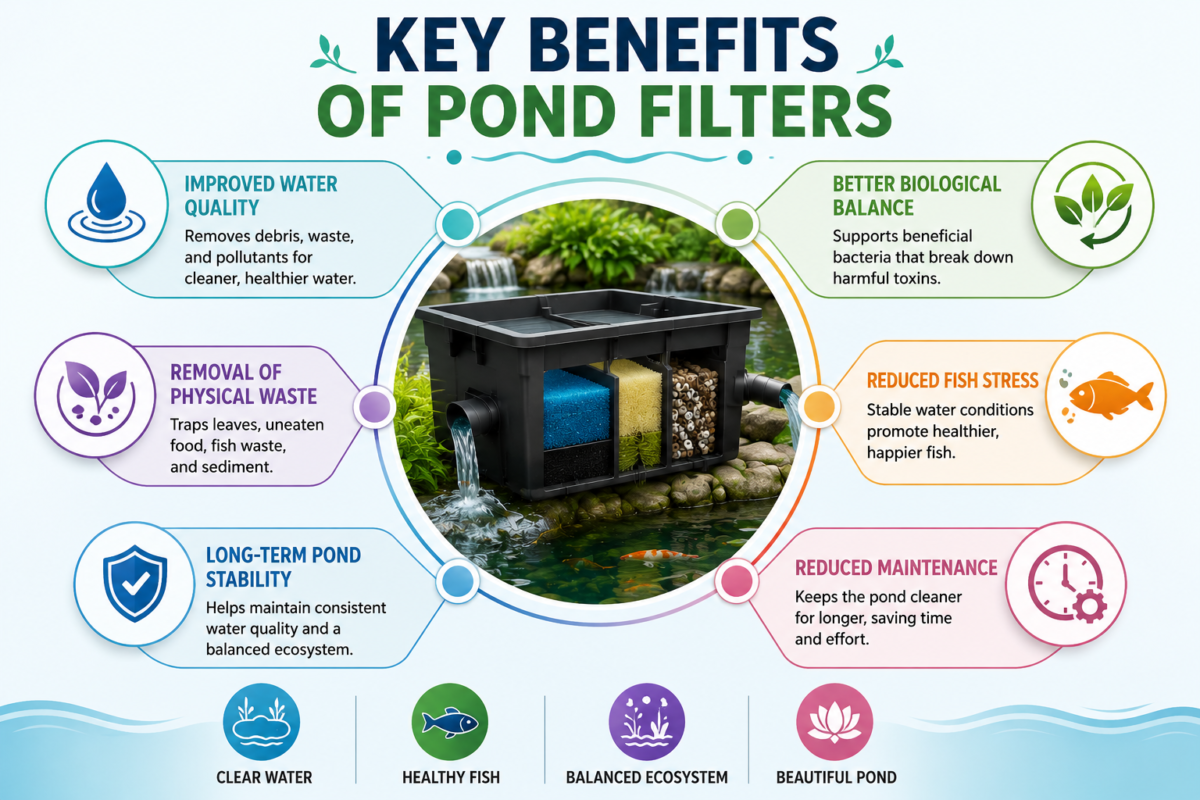
A quality pond filter provides:
- Improved water quality
- Reduced fish stress
- Better biological balance
- Removal of physical waste
- Long-term pond stability
What Is a UV Clarifier?
A UV clarifier is a specialized device designed to control green water caused by suspended algae.
Unlike a pond filter, it does not remove physical waste or process fish waste.
How UV Clarifiers Work
A UV clarifier contains a UV-C lamp enclosed within a protective chamber.
As pond water passes through the unit, ultraviolet light damages the cells of microscopic algae.
The algae lose their ability to reproduce and clump together, allowing the filtration system to remove them more easily.
How UV Clarifiers Control Green Water Algae
Green water is typically caused by free-floating algae suspended throughout the pond.
A UV clarifier targets these algae directly, helping restore water clarity.
It is particularly effective during:
- Warm weather
- High sunlight exposure
- Seasonal algae blooms
Benefits of Using a UV Clarifier
Advantages of UV clarifiers include:
- Crystal-clear water
- Effective green water control
- Reduced algae blooms
- Improved pond appearance
- Better visibility of fish
However, UV clarifiers do not remove leaves, fish waste, or dissolved pollutants.
UV Clarifiers vs Pond Filters: Understanding the Key Differences
Understanding the differences between UV Clarifiers vs Pond Filters helps pond owners make informed decisions.
Water Clarity Performance
UV Clarifier
- Excellent at clearing green water caused by floating algae.
Pond Filter
- Removes suspended debris and waste particles.
Winner: Both work together to improve water clarity.
Waste Removal Capabilities
UV Clarifier
- Does not remove physical waste.
Pond Filter
- Removes leaves, fish waste, and debris.
Winner: Pond Filter
Algae Control Efficiency
UV Clarifier
- Specifically designed for green water algae control.
Pond Filter
- Helps reduce nutrients that contribute to algae growth but does not directly eliminate suspended algae.
Winner: UV Clarifier
Biological Filtration Support
UV Clarifier
- Does not provide biological filtration.
Pond Filter
- Supports beneficial bacteria essential for water quality.
Winner: Pond Filter
Maintenance Requirements
UV Clarifier
- Requires periodic bulb replacement.
- Quartz sleeve cleaning may be necessary.
Pond Filter
- Requires routine cleaning of filter media.
Winner: Depends on system type and pond conditions.
UV Clarifier vs Pond Filter Comparison Table
| Feature | UV Clarifier | Pond Filter |
|---|---|---|
| Controls Green Water | Yes | Partially |
| Removes Fish Waste | No | Yes |
| Mechanical Filtration | No | Yes |
| Biological Filtration | No | Yes |
| Supports Beneficial Bacteria | No | Yes |
| Removes Debris | No | Yes |
| Improves Water Clarity | Yes | Yes |
| Essential for Pond Health | No | Yes |
| Controls Floating Algae | Yes | Limited |
Do You Need Both a UV Clarifier and a Pond Filter?
In most cases, the answer is yes.
A UV clarifier and pond filter perform different functions and work best when used together.
Small Decorative Ponds
Small decorative ponds may function adequately with a basic filtration system and optional UV clarification.
Fish Ponds
Fish ponds benefit greatly from combining biological filtration with UV clarification.
This combination:
- Improves water clarity
- Reduces algae blooms
- Supports fish health
Koi Ponds
Koi ponds almost always require both systems.
Koi produce large amounts of waste, making advanced filtration essential.
A UV clarifier helps maintain the crystal-clear water koi enthusiasts prefer.
Large Outdoor Ponds
Large landscape ponds often experience significant sunlight exposure and algae growth.
Combining filtration and UV technology provides the most reliable results.
Common Myths About UV Clarifiers
Many misconceptions surround UV clarifiers.
Myth 1 – UV Clarifiers Can Replace Pond Filters
This is false.
A UV clarifier does not remove waste, process ammonia, or support biological filtration.
A pond filter remains essential.
Myth 2 – UV Clarifiers Kill Beneficial Bacteria
Most beneficial bacteria live on filter media, rocks, and pond surfaces rather than floating freely in the water.
A properly installed UV clarifier has minimal impact on these bacterial colonies.
Myth 3 – UV Clarifiers Alone Keep Pond Water Clean
While UV clarifiers can eliminate green water, they do not remove organic waste or improve biological filtration.
Clear water does not always mean healthy water.
How to Choose the Right Pond Filtration Setup
The ideal setup depends on pond size, fish population, and maintenance goals.
Basic Pond Systems
For small decorative ponds:
- Pond pump
- Mechanical and biological filter
- Optional UV clarifier
Advanced Koi Pond Filtration Systems
For koi ponds:
- High-capacity pond pump
- Biological filtration system
- Mechanical filtration
- UV clarifier
- Aeration equipment
Professional Pond Filtration Solutions
Large ponds often benefit from:
- Drum filters
- Moving bed filtration
- High-output UV clarifiers
- Multiple circulation zones
These systems provide maximum water quality and reduced maintenance.
Benefits of Combining UV Clarifiers and Pond Filters
Using both systems together creates a more stable pond environment.
Superior Water Clarity
The filter removes debris while the UV clarifier controls algae.
Healthier Fish and Aquatic Life
Cleaner water reduces stress and supports healthy fish growth.
Reduced Pond Maintenance
Balanced water quality often leads to fewer cleaning requirements.
Enhanced Pond Appearance
Clear water allows you to fully enjoy fish, plants, and underwater features.
Frequently Asked Questions About UV Clarifiers and Pond Filter
Can a UV clarifier replace a pond filter?
No. A UV clarifier controls floating algae but does not remove waste or provide biological filtration.
Do all ponds need a UV clarifier?
Not necessarily. However, ponds with recurring green water problems often benefit greatly from UV clarification.
How long does a UV bulb last?
Most UV bulbs should be replaced every 8–12 months for maximum effectiveness.
Can a pond filter clear green water?
A pond filter can help reduce algae by improving water quality, but it typically cannot eliminate suspended green water as effectively as a UV clarifier.
Which is more important: a UV clarifier or a pond filter?
A pond filter is more important because it performs essential filtration functions. A UV clarifier is considered a valuable addition rather than a replacement
Conclusion: UV Clarifiers vs Pond Filters – The Best Solution for Clear and Healthy Pond Water
When evaluating UV Clarifiers vs Pond Filters, it is important to recognize that these two systems serve different but equally valuable functions within a pond ecosystem. Rather than competing with one another, UV clarifiers vs pond filters should be viewed as complementary technologies that work together to achieve optimal water quality, improved fish health, and long-term pond stability.
A pond filter acts as the foundation of any successful pond filtration system. It removes physical debris such as leaves, fish waste, uneaten food, and sediment through mechanical filtration. At the same time, biological filtration supports colonies of beneficial bacteria that break down harmful ammonia and nitrites, helping maintain a safe and healthy environment for fish and aquatic plants. Without adequate filtration, even the clearest pond water can quickly become unbalanced and unhealthy.
On the other hand, a UV clarifier addresses one of the most common pond problems—green water caused by suspended algae. When comparing UV Clarifiers vs Pond Filters, it becomes clear that a UV clarifier is specifically designed to target microscopic algae that traditional filtration systems may struggle to remove. By exposing pond water to UV-C light, the clarifier prevents algae from reproducing, resulting in clearer and more attractive water.
The discussion around UV Clarifiers vs Pond Filters often leads pond owners to ask which system is more important. The answer depends on the specific challenge being addressed. A pond filter is essential for maintaining overall pond health and water quality, while a UV clarifier is highly effective for controlling green water and improving visibility. For this reason, most pond professionals recommend using both systems together rather than choosing one over the other.
Combining UV Clarifiers vs Pond Filters offers numerous advantages. The pond filter removes waste and supports biological balance, while the UV clarifier controls algae blooms that can make pond water appear cloudy or green. This combination creates crystal-clear water, reduces maintenance requirements, and provides a healthier habitat for fish, including koi and other ornamental species.
For koi ponds, fish ponds, and larger landscape ponds, the benefits of combining UV Clarifiers vs Pond Filters become even more significant. Higher fish populations produce more waste, and increased sunlight exposure often leads to algae growth. A properly sized filtration system paired with an effective UV clarifier can help maintain stable water conditions throughout the year.
Ultimately, the debate over UV Clarifiers vs Pond Filters should not focus on choosing one system over the other. Instead, pond owners should understand how each contributes to a complete pond management strategy. A high-quality pond filter ensures biological and mechanical filtration, while a UV clarifier delivers exceptional water clarity by controlling floating algae.
By investing in both a reliable pond filter and a correctly sized UV clarifier, pond owners can enjoy cleaner water, healthier fish, fewer algae problems, and a more beautiful pond. When it comes to UV Clarifiers vs Pond Filters, the most effective solution is not one or the other—it is the combination of both working together to create a thriving and visually stunning aquatic ecosystem.